Pocock's lampshade-web spider (Hypochilus pococki)
The Pocock's lampshade-web spider is a spider in the family Hypochilidae that is not dangerous to people. GBIF holds 492 licensed U.S. records of it; it reaches our listing threshold in 5 states, most of all North Carolina (302), Tennessee (137) and Georgia (34). Its observation records peak in July.
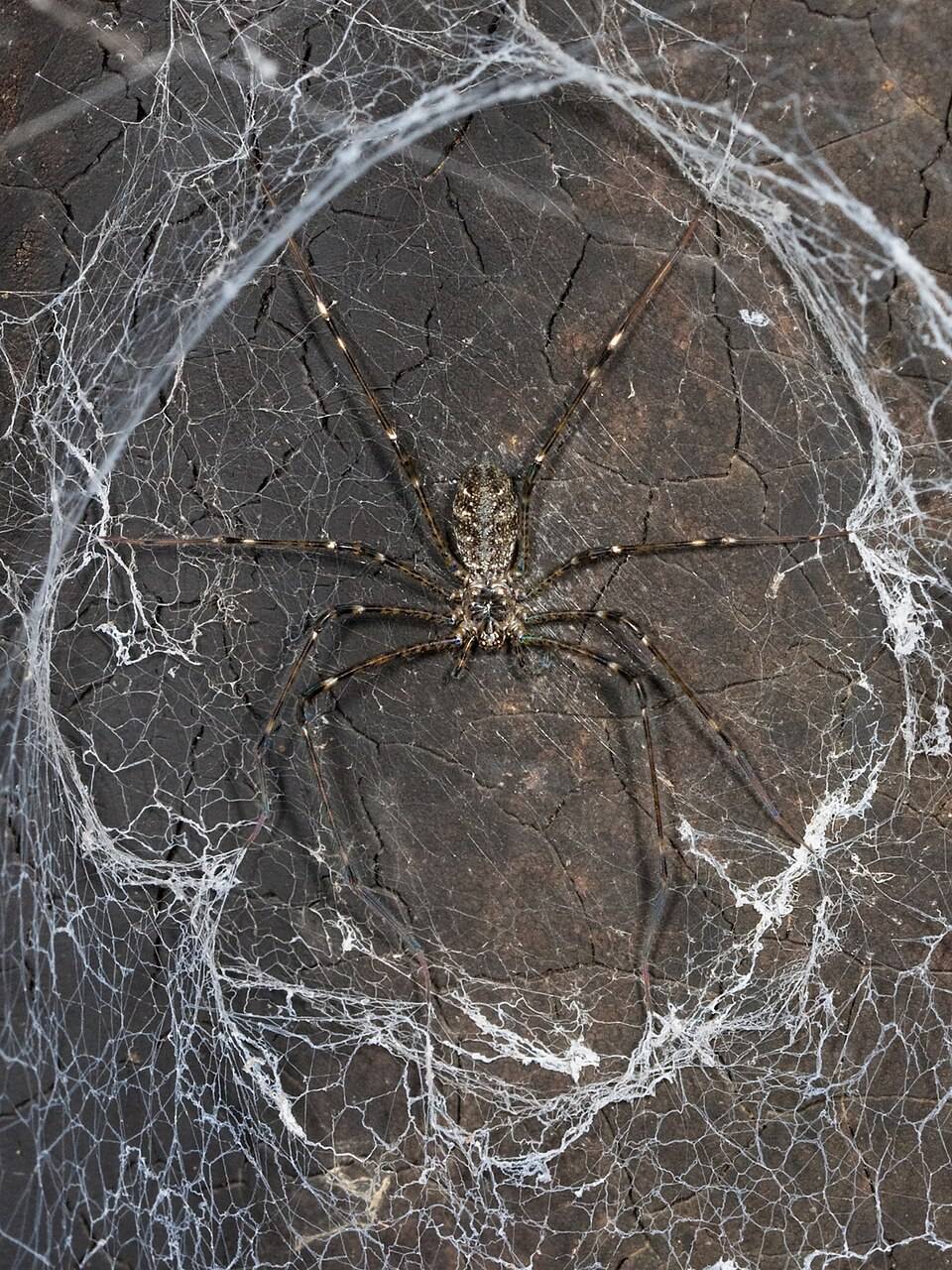

Hypochilus pococki, or Pocock's lampshade-web spider, is a species of lampshade weaver in the family Hypochilidae. It is found in the United States.
From Wikipedia: Hypochilus pococki, text under CC BY-SA 4.0.
Is the Pocock's lampshade-web spider poisonous or venomous?
Not in any medically significant way. Like almost all spiders the Pocock's lampshade-web spider (family Hypochilidae) has venom for its prey, but it is not a widow or recluse, the two U.S. groups whose bites need medical attention.
Which states have the Pocock's lampshade-web spider?
The Pocock's lampshade-web spider's U.S. record is concentrated: North Carolina alone holds 61% of licensed records. It is listed in 5 states in all; the next are Tennessee (137), Georgia (34) and Virginia (15).
| # | State | Records | Share of state spiders | Rank in state |
|---|---|---|---|---|
| 1 | North Carolina | 302 | 3.6% | 2nd of 184 |
| 2 | Tennessee | 137 | 3.7% | 2nd of 138 |
| 3 | Georgia | 34 | 0.5% | 44th of 186 |
| 4 | Virginia | 15 | 0.1% | 98th of 176 |
| 5 | South Carolina | 3 | 0.1% | 82nd of 121 |
When is the Pocock's lampshade-web spider seen?
Across the U.S., observation records of the Pocock's lampshade-web spider run mostly May through November, peaking in July with 30% of them. Winter (December to February) holds 3% of them.
Where the Pocock's lampshade-web spider is recorded in each state
North Carolina
North Carolina holds 302 licensed records, the 2nd most recorded of 184 spiders listed there. Its observation records in North Carolina run mostly May through September, peaking in July; most licensed records come from Macon County, Swain County and Haywood County. Next come Graham County (22) and Avery County (22).
Tennessee
Tennessee holds 137 licensed records, the 2nd most recorded of 138 spiders listed there. Most of its licensed records in Tennessee come from Carter County, Cocke County and Sevier County. Next come Unicoi County (14) and Monroe County (12).
Georgia
Georgia holds 34 licensed records, the 44th most recorded of 186 spiders listed there. Most of its licensed records in Georgia come from Rabun County, Murray County and White County. Next come Towns County (6) and Lumpkin County (5).
Top counties in the U.S.
| # | County | State | Records | Share of U.S. |
|---|---|---|---|---|
| 1 | Macon County | North Carolina | 46 | 9.3% |
| 2 | Swain County | North Carolina | 40 | 8.1% |
| 3 | Haywood County | North Carolina | 37 | 7.5% |
| 4 | Graham County | North Carolina | 22 | 4.5% |
| 5 | Avery County | North Carolina | 22 | 4.5% |
| 6 | Jackson County | North Carolina | 20 | 4.1% |
| 7 | Carter County | Tennessee | 20 | 4.1% |
| 8 | Transylvania County | North Carolina | 17 | 3.5% |
| 9 | Caldwell County | North Carolina | 16 | 3.3% |
| 10 | Cherokee County | North Carolina | 16 | 3.3% |
| 11 | Cocke County | Tennessee | 16 | 3.3% |
| 12 | Sevier County | Tennessee | 16 | 3.3% |
| 13 | Unicoi County | Tennessee | 14 | 2.8% |
| 14 | Buncombe County | North Carolina | 12 | 2.4% |
| 15 | Madison County | North Carolina | 12 | 2.4% |
How recent are the Pocock's lampshade-web spider records?
The Pocock's lampshade-web spider record leans on older material: only 13% of dated U.S. records come from 2017–2026, and the median record is from 2002. The oldest dated record is from 1982; the busiest year was 2001, with 130 records.
| Decade | Records | Share |
|---|---|---|
| 1980s | 3 | 0.6% |
| 1990s | 21 | 4.3% |
| 2000s | 399 | 81.6% |
| 2010s | 8 | 1.6% |
| 2020s | 58 | 11.9% |
Species recorded in the same counties
Of the 34 counties where the Pocock's lampshade-web spider is most recorded, 14 are also top counties for the dark fishing spider, more than for any other spider. None of its closest neighbors is venomous.
| Species | Shared counties |
|---|---|
| Dark fishing spider | 14 |
| Banded fishing spider | 13 |
| Furrow orbweaver | 12 |
| Spined micrathena | 12 |
| White micrathena | 12 |
| Bronze jumper | 10 |
| White-banded fishing spider | 9 |
| Whitebanded crab spider | 9 |
GBIF records read 2026-09-29. Listed: any license. Counted: CC0/CC BY only. How we count.