Burmese python (Python bivittatus)
The Burmese python is a non-venomous snake in the family Pythonidae, but a large constrictor that can inflict serious bites and constriction injuries. GBIF holds 8,143 licensed U.S. records of it; it reaches our listing threshold in 1 state, most of all Florida (8,141). It is not native to the U.S.; it is introduced in Florida. Its observation records peak in July.
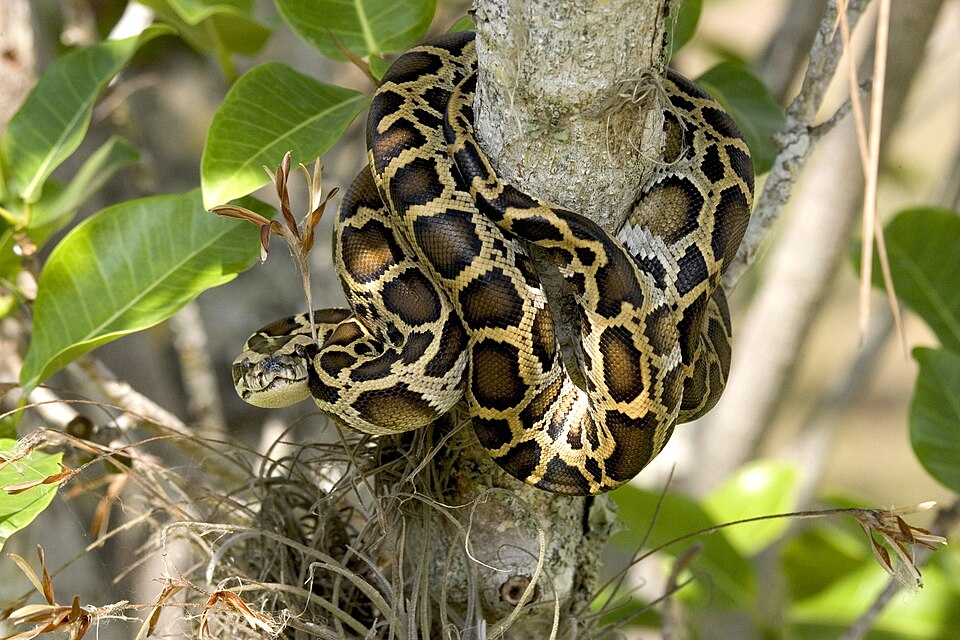
,_NPSPhoto,_R._Cammauf_(9101584016).jpg)
The Burmese python (Python bivittatus) is one of the largest species of snakes. It is native to a large area of Southeast Asia and is listed as Vulnerable on the IUCN Red List. Until 2009, it was considered a subspecies of the Indian python, but is now recognized as a distinct species.
From Wikipedia: Burmese python, text under CC BY-SA 4.0.
Is the Burmese python poisonous or venomous?
Not venomous, but not harmless either. The Burmese python is a large constrictor (family Pythonidae): it has no venom, yet its bite can leave deep, torn wounds, and a large one can coil around and squeeze a person or a pet. Keep your distance and never handle one; after any bite, wash the wound and get medical care, and call 911 if a snake is wrapped around someone.
Which states have the Burmese python?
All listed records come from a single state, Florida, with 8,141 records.
| # | State | Records | Share of state snakes | Rank in state |
|---|---|---|---|---|
| 1 | Florida | 8,141 | 39.1% | 1st of 49 |
When is the Burmese python seen?
Across the U.S., observation records of the Burmese python run mostly May through January, peaking in July with 14% of them. Winter (December to February) holds 28% of them.
How recent are the Burmese python records?
Most of what is known about the Burmese python is recent: 77% of dated U.S. records were made in 2017–2026, and half date from 2019 or later. The oldest dated record is from 1979; the busiest year was 2020, with 1,366 records.
| Decade | Records | Share |
|---|---|---|
| 1970s | 1 | 0.0% |
| 1990s | 6 | 0.1% |
| 2000s | 761 | 9.3% |
| 2010s | 3,576 | 43.5% |
| 2020s | 3,880 | 47.2% |
Species recorded in the same counties
Of the 15 counties where the Burmese python is most recorded, 9 are also top counties for each of the first three snakes in the table below; no other snake shares more. None of its closest neighbors is venomous.
| Species | Shared counties |
|---|---|
| DeKay's brown snake | 9 |
| Ring-necked snake | 9 |
| Southern watersnake | 9 |
| Eastern kingsnake | 8 |
| Eastern racer | 8 |
| Eastern ribbonsnake | 8 |
| Florida brown snake | 8 |
| Florida green water snake | 8 |
GBIF records read 2026-09-29. Listed: any license. Counted: CC0/CC BY only. How we count.