Eastern coral snake (Micrurus fulvius)
The eastern coral snake is a venomous elapid snake in the family Elapidae. GBIF holds 366 licensed U.S. records of it; it reaches our listing threshold in 5 states, most of all Florida (238), North Carolina (47) and South Carolina (26). Its observation records peak in May.
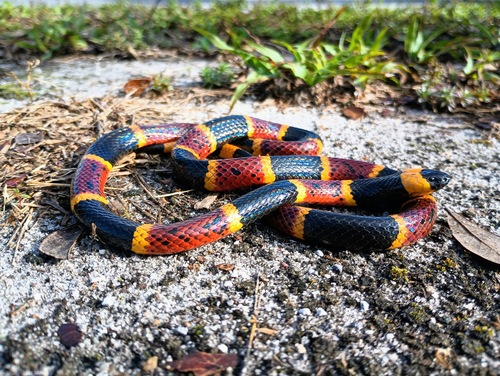
Micrurus fulvius, commonly known as the eastern coral snake, common coral snake, American cobra, and more, is a species of highly venomous coral snake in the family Elapidae. The species is endemic to the southeastern United States. The family also contains the cobras and sea snakes.
From Wikipedia: Micrurus fulvius, text under CC BY-SA 4.0.
Is the eastern coral snake poisonous or venomous?
Yes. The eastern coral snake is an elapid (family Elapidae), the family of coral snakes. Its venom acts on nerves, and symptoms can be delayed for hours, so any bite needs a hospital even if it seems minor.
Snakes often mistaken for it
Species commonly confused with coral snakes and recorded in the same states: eastern milksnake (recorded in all 5 of its states), scarlet kingsnake (recorded in all 5 of its states) and scarlet snake (recorded in all 5 of its states).
Which states have the eastern coral snake?
The eastern coral snake's U.S. record is concentrated: Florida alone holds 65% of licensed records. It is listed in 5 states in all; the next are North Carolina (47), South Carolina (26) and Alabama (21).
GBIF records filed under this name in Texas are counted as the Texas coral snake, the species that lives there. Records filed under this name in Arizona and Massachusetts are not counted: there the name stands for another species, or the record lies outside this species’ range.
| # | State | Records | Share of state snakes | Rank in state |
|---|---|---|---|---|
| 1 | Florida | 238 | 1.1% | 17th of 49 |
| 2 | North Carolina | 47 | 0.2% | 34th of 39 |
| 3 | South Carolina | 26 | 0.7% | 31st of 40 |
| 4 | Alabama | 21 | 0.4% | 39th of 44 |
| 5 | Georgia | 20 | 0.3% | 29th of 44 |
When is the eastern coral snake seen?
Across the U.S., observation records of the eastern coral snake run through most of the year, peaking in May with 18% of them. Winter (December to February) holds 23% of them.
Where the eastern coral snake is recorded in each state
Florida
Florida holds 238 licensed records, the 17th most recorded of 49 snakes listed there. Its observation records in Florida run through most of the year, peaking in May; most licensed records come from Alachua County, Marion County and Citrus County. Next come Lake County (12) and Highlands County (9).
North Carolina
North Carolina holds 47 licensed records, the 34th most recorded of 39 snakes listed there. Most of its licensed records in North Carolina come from New Hanover County, Pender County and Bladen County. Next come Brunswick County (3) and Sampson County (3).
Top counties in the U.S.
| # | County | State | Records | Share of U.S. |
|---|---|---|---|---|
| 1 | Alachua County | Florida | 42 | 11.5% |
| 2 | Marion County | Florida | 28 | 7.7% |
| 3 | New Hanover County | North Carolina | 19 | 5.2% |
| 4 | Citrus County | Florida | 13 | 3.6% |
| 5 | Lake County | Florida | 12 | 3.3% |
| 6 | Highlands County | Florida | 9 | 2.5% |
| 7 | Miami-Dade County | Florida | 9 | 2.5% |
| 8 | Putnam County | Florida | 9 | 2.5% |
| 9 | Seminole County | Florida | 9 | 2.5% |
| 10 | Pender County | North Carolina | 8 | 2.2% |
| 11 | Palm Beach County | Florida | 7 | 1.9% |
| 12 | Pinellas County | Florida | 7 | 1.9% |
| 13 | Monroe County | Florida | 6 | 1.6% |
| 14 | Orange County | Florida | 6 | 1.6% |
| 15 | Polk County | Florida | 6 | 1.6% |
How recent are the eastern coral snake records?
The eastern coral snake record leans on older material: only 23% of dated U.S. records come from 2017–2026, and the median record is from 1975. The oldest dated record is from 1854; the busiest year was 2023, with 16 records.
| Decade | Records | Share |
|---|---|---|
| 1850s | 2 | 0.6% |
| 1860s | 2 | 0.6% |
| 1870s | 1 | 0.3% |
| 1880s | 2 | 0.6% |
| 1890s | 5 | 1.5% |
| 1900s | 4 | 1.2% |
| 1910s | 10 | 3.0% |
| 1920s | 7 | 2.1% |
| 1930s | 23 | 7.0% |
| 1940s | 35 | 10.7% |
| 1950s | 25 | 7.6% |
| 1960s | 26 | 7.9% |
| 1970s | 34 | 10.4% |
| 1980s | 23 | 7.0% |
| 1990s | 15 | 4.6% |
| 2000s | 19 | 5.8% |
| 2010s | 31 | 9.5% |
| 2020s | 64 | 19.5% |
Species recorded in the same counties
Of the 26 counties where the eastern coral snake is most recorded, 19 are also top counties for both the coachwhip and the scarlet snake; no other snake shares more. None of its closest neighbors is venomous.
| Species | Shared counties |
|---|---|
| Coachwhip | 19 |
| Scarlet snake | 19 |
| Eastern rat snake | 18 |
| Corn snake | 16 |
| Mud snake | 16 |
| Eastern hog-nosed snake | 15 |
| Eastern racer | 15 |
| Eastern kingsnake | 14 |
Related species in the U.S.
Other species of the genus Micrurus with profiles here: Texas coral snake.
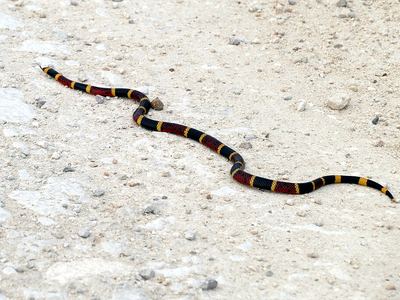
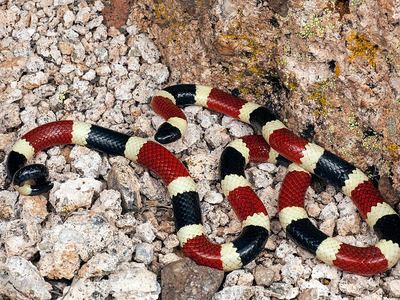
GBIF records read 2026-09-29. Listed: any license. Counted: CC0/CC BY only. How we count.