California turret spider (Atypoides riversi)
The California turret spider is a spider in the family Antrodiaetidae that is not dangerous to people. GBIF holds 389 licensed U.S. records of it; it reaches our listing threshold in 1 state, most of all California (389). Its observation records peak in February.
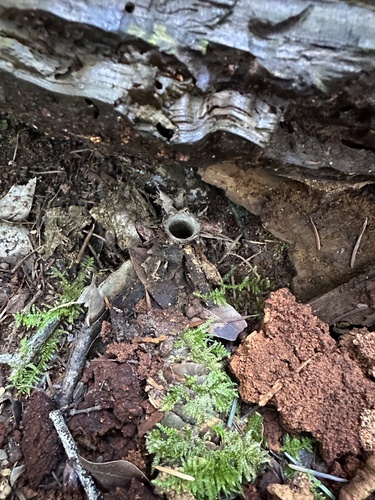
Atypoides riversi, known as turret spider, is a species of mygalomorph spider in the family Antrodiaetidae. It is a medium-sized spider native to Northern California that constructs a burrow with a turret made of soil, vegetation and silk. This spider's length is 13 to 18 millimetres (0.51 to 0.71 in) long, though females are larger than males.
From Wikipedia: Atypoides riversi, text under CC BY-SA 4.0.
Is the California turret spider poisonous or venomous?
Not in any medically significant way. Like almost all spiders the California turret spider (family Antrodiaetidae) has venom for its prey, but it is not a widow or recluse, the two U.S. groups whose bites need medical attention.
Which states have the California turret spider?
All listed records come from a single state, California, with 389 records.
| # | State | Records | Share of state spiders | Rank in state |
|---|---|---|---|---|
| 1 | California | 389 | 0.8% | 21st of 309 |
When is the California turret spider seen?
Across the U.S., observation records of the California turret spider run through most of the year, peaking in February with 18% of them. Winter (December to February) holds 40% of them.
How recent are the California turret spider records?
Most of what is known about the California turret spider is recent: 87% of dated U.S. records were made in 2017–2026, and half date from 2021 or later. The oldest dated record is from 1938; the busiest year was 2025, with 60 records.
| Decade | Records | Share |
|---|---|---|
| 1930s | 1 | 0.3% |
| 1960s | 4 | 1.0% |
| 1980s | 1 | 0.3% |
| 1990s | 1 | 0.3% |
| 2000s | 2 | 0.5% |
| 2010s | 123 | 31.3% |
| 2020s | 261 | 66.4% |
Species recorded in the same counties
Of the 15 counties where the California turret spider is most recorded, 11 are also top counties for the California funnel-web spider, more than for any other spider. None of its closest neighbors is venomous.
| Species | Shared counties |
|---|---|
| California funnel-web spider | 11 |
| Garden spider | 10 |
| Gray house spider | 10 |
| Johnson jumper | 10 |
| Proszynski's jumping spider | 10 |
| Zebra spider | 10 |
| Castianeira thalia | 9 |
| False black widow | 9 |
GBIF records read 2026-09-29. Listed: any license. Counted: CC0/CC BY only. How we count.