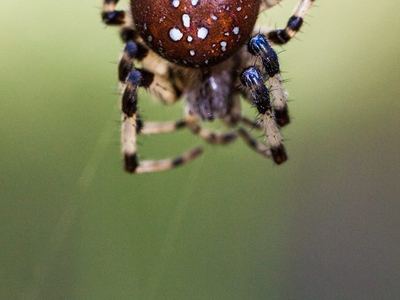
Garden spider (Araneus diadematus)
The garden spider is a spider in the family Araneidae that is not dangerous to people. GBIF holds 2,248 licensed U.S. records of it; it reaches our listing threshold in 21 states, most of all Washington (785), California (457) and Oregon (372). Its observation records peak in September.
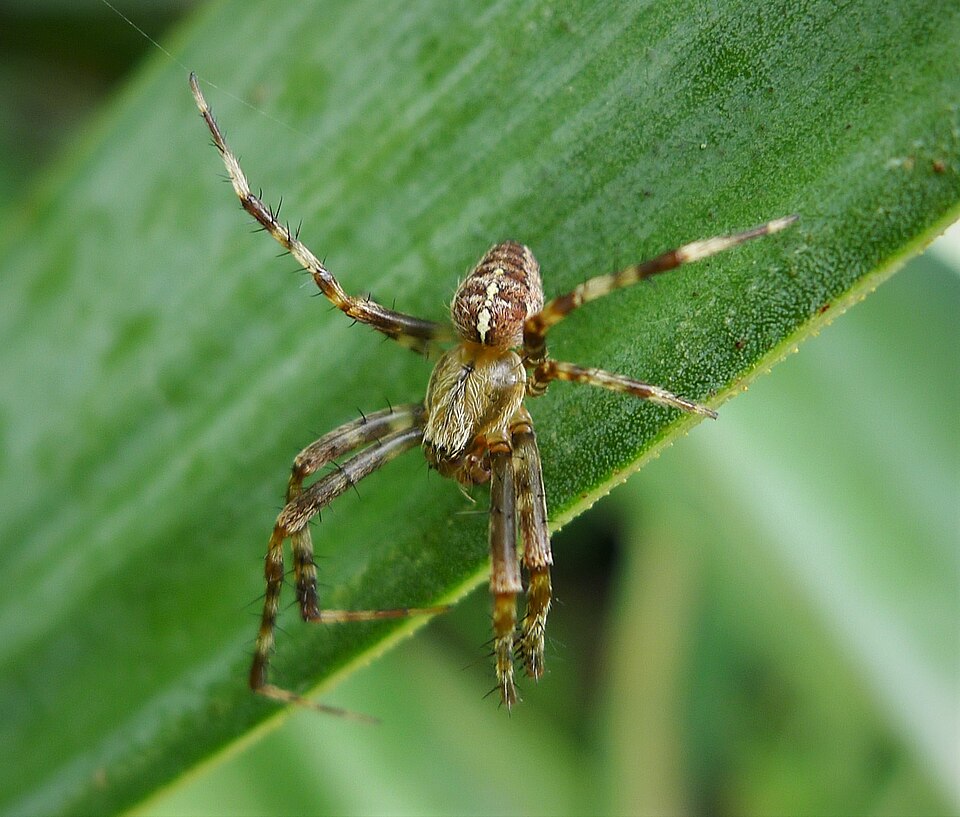
.jpg)
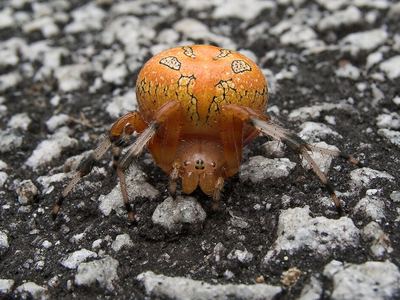
The spider species Araneus diadematus is commonly called the European garden spider, cross orbweaver, diadem spider, orangie, cross spider, and crowned orb weaver. It is sometimes called the pumpkin spider, although this name is also used for a different species, Araneus marmoreus. It is an orb-weaver spider found in Europe, where it is native, and North America, where it was introduced.
From Wikipedia: Araneus diadematus, text under CC BY-SA 4.0.
Is the garden spider poisonous or venomous?
Not in any medically significant way. Like almost all spiders the garden spider (family Araneidae) has venom for its prey, but it is not a widow or recluse, the two U.S. groups whose bites need medical attention.
Which states have the garden spider?
Records are spread over 21 states; the top three, Washington, California and Oregon, hold 72% of them. It is the most recorded spider of all in Washington and Oregon.
| # | State | Records | Share of state spiders | Rank in state |
|---|---|---|---|---|
| 1 | Washington | 785 | 19.6% | 1st of 157 |
| 2 | California | 457 | 0.9% | 19th of 309 |
| 3 | Oregon | 372 | 13.3% | 1st of 88 |
| 4 | Massachusetts | 119 | 2.6% | 6th of 189 |
| 5 | New York | 118 | 1.9% | 13th of 149 |
| 6 | Maine | 68 | 7.2% | 2nd of 297 |
| 7 | Michigan | 66 | 2.8% | 8th of 122 |
| 8 | Ohio | 60 | 0.9% | 27th of 332 |
| 9 | Wisconsin | 54 | 1.7% | 10th of 149 |
| 10 | Illinois | 28 | 0.1% | 94th of 243 |
| 11 | Pennsylvania | 24 | 0.3% | 50th of 164 |
| 12 | Connecticut | 22 | 2.2% | 12th of 86 |
| 13 | Vermont | 20 | 1.3% | 19th of 74 |
| 14 | Minnesota | 12 | 0.4% | 52nd of 145 |
| 15 | New Jersey | 11 | 0.5% | 50th of 127 |
| 16 | Rhode Island | 8 | 4.7% | 4th of 53 |
| 17 | Alaska | 6 | 0.0% | 278th of 280 |
| 18 | New Hampshire | 6 | 0.4% | 46th of 72 |
| 19 | Idaho | 3 | 0.6% | 26th of 56 |
| 20 | Utah | 3 | 0.1% | 58th of 97 |
| 21 | Indiana | 1 | 0.0% | 131st of 133 |
When is the garden spider seen?
Across the U.S., observation records of the garden spider run mostly July through November, peaking in September with 33% of them. Winter (December to February) holds 2% of them.
Season by state
Among states whose main season falls within one calendar year, it starts earliest in June (California) and latest in July (Maine, Massachusetts, Michigan, New York, Ohio, Oregon and 2 more). The most common peak month is September, shared by California, Massachusetts, Michigan, New York, Oregon and Washington.
| State | Main season | Peak month | Observation records |
|---|---|---|---|
| Washington | July through November | September | 785 |
| California | June through November | September | 457 |
| Oregon | July through November | September | 371 |
| New York | July through October | September | 118 |
| Massachusetts | July through November | September | 113 |
| Maine | July through October | August | 67 |
| Michigan | July through November | September | 66 |
| Ohio | July through October | August | 60 |
| Wisconsin | July through October | August | 54 |
Where the garden spider is recorded in each state
Washington
Washington holds 785 licensed records, the most recorded of 157 spiders listed there. Its observation records in Washington run mostly July through November, peaking in September; most licensed records come from King County, Snohomish County and Whatcom County. Next come Clallam County (49) and Thurston County (48).
California
California holds 457 licensed records, the 19th most recorded of 309 spiders listed there. Its observation records in California run mostly June through November, peaking in September; most licensed records come from Alameda County, San Francisco County and Santa Cruz County. Next come Sonoma County (37) and Contra Costa County (33).
Oregon
Oregon holds 372 licensed records, the most recorded of 88 spiders listed there. Its observation records in Oregon run mostly July through November, peaking in September; most licensed records come from Multnomah County, Lane County and Benton County. Next come Clackamas County (30) and Washington County (24).
Massachusetts
Massachusetts holds 119 licensed records, the 6th most recorded of 189 spiders listed there. Its observation records in Massachusetts run mostly July through November, peaking in September; most licensed records come from Middlesex County, Plymouth County and Suffolk County. Next come Essex County (14) and Barnstable County (13).
New York
New York holds 118 licensed records, the 13th most recorded of 149 spiders listed there. Its observation records in New York run mostly July through October, peaking in September; most licensed records come from Tompkins County, Erie County and Monroe County. Next come Westchester County (13) and Wyoming County (6).
Maine
Maine holds 68 licensed records, the 2nd most recorded of 297 spiders listed there. Its observation records in Maine run mostly July through October, peaking in August; most licensed records come from Hancock County, Washington County and Cumberland County. Next come Lincoln County (5) and Androscoggin County (4).
Michigan
Michigan holds 66 licensed records, the 8th most recorded of 122 spiders listed there. Its observation records in Michigan run mostly July through November, peaking in September; most licensed records come from Ingham County, Oakland County and Charlevoix County. Next come Emmet County (5) and Washtenaw County (5).
Ohio
Ohio holds 60 licensed records, the joint 27th most recorded of 332 spiders listed there. Its observation records in Ohio run mostly July through October, peaking in August; most licensed records come from Cuyahoga County, Summit County and Erie County. Next come Lake County (8) and Stark County (2).
Wisconsin
Wisconsin holds 54 licensed records, the joint 10th most recorded of 149 spiders listed there. Its observation records in Wisconsin run mostly July through October, peaking in August; most licensed records come from Milwaukee County, Dane County and Ozaukee County. Next come Door County (4) and Brown County (4).
Top counties in the U.S.
| # | County | State | Records | Share of U.S. |
|---|---|---|---|---|
| 1 | King County | Washington | 349 | 15.5% |
| 2 | Multnomah County | Oregon | 134 | 6.0% |
| 3 | Alameda County | California | 126 | 5.6% |
| 4 | San Francisco County | California | 108 | 4.8% |
| 5 | Snohomish County | Washington | 90 | 4.0% |
| 6 | Lane County | Oregon | 61 | 2.7% |
| 7 | Whatcom County | Washington | 51 | 2.3% |
| 8 | Clallam County | Washington | 49 | 2.2% |
| 9 | Thurston County | Washington | 48 | 2.1% |
| 10 | Pierce County | Washington | 43 | 1.9% |
| 11 | Jefferson County | Washington | 42 | 1.9% |
| 12 | Santa Cruz County | California | 39 | 1.7% |
| 13 | Sonoma County | California | 37 | 1.6% |
| 14 | Middlesex County | Massachusetts | 36 | 1.6% |
| 15 | Benton County | Oregon | 36 | 1.6% |
How recent are the garden spider records?
Most of what is known about the garden spider is recent: 95% of dated U.S. records were made in 2017–2026, and half date from 2023 or later. The oldest dated record is from 1979; the busiest year was 2025, with 460 records.
| Decade | Records | Share |
|---|---|---|
| 1970s | 1 | 0.0% |
| 1990s | 1 | 0.0% |
| 2000s | 9 | 0.4% |
| 2010s | 455 | 19.0% |
| 2020s | 1,929 | 80.5% |
Species recorded in the same counties
Of the 124 counties where the garden spider is most recorded, 74 are also top counties for the zebra spider, more than for any other spider. None of its closest neighbors is venomous.
| Species | Shared counties |
|---|---|
| Zebra spider | 74 |
| Bold jumper | 67 |
| Sixspotted orbweaver | 65 |
| Goldenrod crab spider | 58 |
| Bronze jumper | 57 |
| Black-and-yellow argiope | 54 |
| Longbodied cellar spider | 47 |
| Nursery web spider | 44 |
Related species in the U.S.
Other species of the genus Araneus with profiles here: Marbled orbweaver, Butterfly orbweaver, Giant lichen orbweaver and Shamrock orbweaver.
GBIF records read 2026-09-29. Listed: any license. Counted: CC0/CC BY only. How we count.