Cribellate spider (Metaltella simoni)
The cribellate spider (genus Metaltella) is a spider in the family Desidae that is not dangerous to people. Most of its 10 listed states are in the South Atlantic (4) and West South Central (3) census divisions. None is in the Northeast or the Midwest. Its observation records peak in January.
Also called: hacklemesh weaver, south American toothed hacklemesh weaver (English names in GBIF)
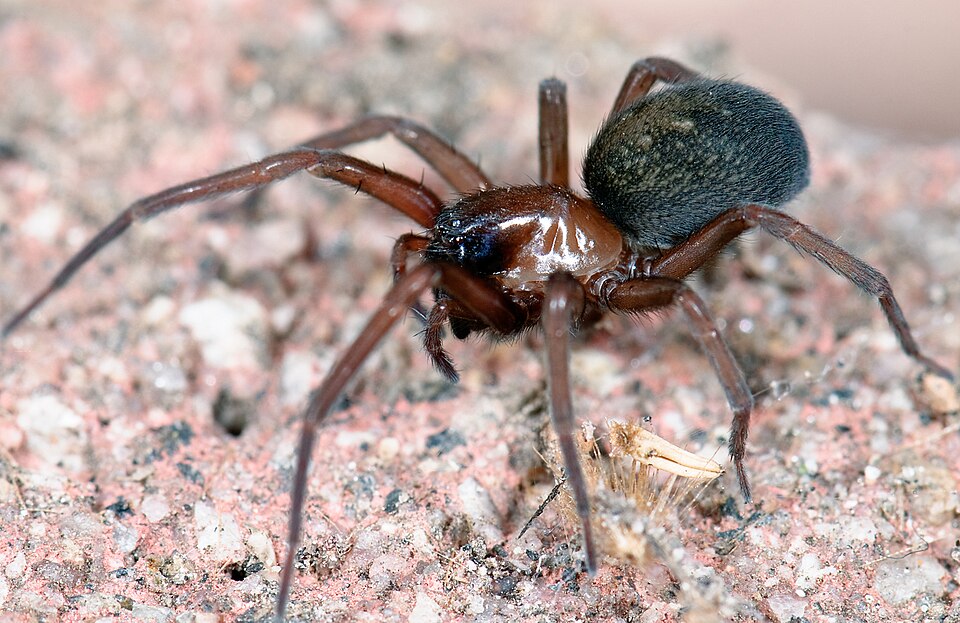
Metaltella simoni is a species of spider, native to South America (Brazil, Uruguay and Argentina), and introduced into the United States and Canada.
From Wikipedia: Metaltella simoni, text under CC BY-SA 4.0.
Is the cribellate spider poisonous or venomous?
Not in any medically significant way. Like almost all spiders the cribellate spider (family Desidae) has venom for its prey, but it is not a widow or recluse, the two U.S. groups whose bites need medical attention.
Which states have the cribellate spider?
California alone holds 52% of its licensed U.S. records.
| # | State | Records | Share of state spiders | Rank in state |
|---|---|---|---|---|
| 1 | California | 389 | 0.8% | 23rd of 312 |
| 2 | Texas | 242 | 0.8% | 20th of 387 |
| 3 | Alabama | 32 | 0.8% | 31st of 146 |
| 4 | Florida | 29 | 0.2% | 65th of 241 |
| 5 | Georgia | 15 | 0.2% | 76th of 190 |
| 6 | Louisiana | 14 | 0.3% | 48th of 108 |
| 7 | North Carolina | 10 | 0.1% | 89th of 189 |
| 8 | South Carolina | 8 | 0.3% | 63rd of 124 |
| 9 | Mississippi | 6 | 0.4% | 46th of 117 |
| 10 | Arkansas | 1 | 0.1% | 95th of 114 |
When is the cribellate spider seen?
Its observation records run through most of the year. December to February still holds 33% of them.
Season by state
Observation records run through most of the year in Alabama, California and Texas. Each of these states peaks in a different month: January in Texas, May in Alabama and June in California.
| State | Main season | Peak month | Observation records |
|---|---|---|---|
| Texas | most of the year | January | 193 |
| California | most of the year | June | 125 |
| Alabama | most of the year | May | 32 |
Where the cribellate spider is recorded in each state
| State | Licensed records | Place among the state's spiders | Most recorded counties |
|---|---|---|---|
| California | 389 | 23rd of 312 | Los Angeles County (239), San Diego County (38), Riverside County (22), San Bernardino County (22) and Solano County (17) |
| Texas | 242 | 20th of 387 | Fort Bend County (48), Williamson County (40), Travis County (31), Dallas County (24) and Bexar County (20) |
| Alabama | 32 | joint 31st of 146 | Mobile County (11), Jefferson County (10), Pickens County (8), Baldwin County (2) and Autauga County (1) |
Top counties in the U.S.
| # | County | State | Records | Share of U.S. |
|---|---|---|---|---|
| 1 | Los Angeles County | California | 239 | 32.0% |
| 2 | Fort Bend County | Texas | 48 | 6.4% |
| 3 | Williamson County | Texas | 40 | 5.4% |
| 4 | San Diego County | California | 38 | 5.1% |
| 5 | Travis County | Texas | 31 | 4.1% |
| 6 | Dallas County | Texas | 24 | 3.2% |
| 7 | Riverside County | California | 22 | 2.9% |
| 8 | San Bernardino County | California | 22 | 2.9% |
| 9 | Bexar County | Texas | 20 | 2.7% |
| 10 | Tarrant County | Texas | 18 | 2.4% |
| 11 | Solano County | California | 17 | 2.3% |
| 12 | Ventura County | California | 14 | 1.9% |
| 13 | Harris County | Texas | 14 | 1.9% |
| 14 | Orange County | California | 12 | 1.6% |
| 15 | Mobile County | Alabama | 11 | 1.5% |
How recent are the cribellate spider records?
| Decade | Records | Share |
|---|---|---|
| 1970s | 1 | 0.1% |
| 1980s | 4 | 0.5% |
| 1990s | 1 | 0.1% |
| 2000s | 39 | 5.1% |
| 2010s | 311 | 40.8% |
| 2020s | 407 | 53.3% |
Species recorded in the same counties
| Species | Shared counties |
|---|---|
| Spotted orbweaver | 23 |
| Black-and-yellow argiope | 21 |
| Cyclosa turbinata | 21 |
| Bold jumper | 20 |
| Green lynx spider | 20 |
| Dysdera crocata | 19 |
| Striped lynx spider | 18 |
| Triangulate bud spider | 18 |
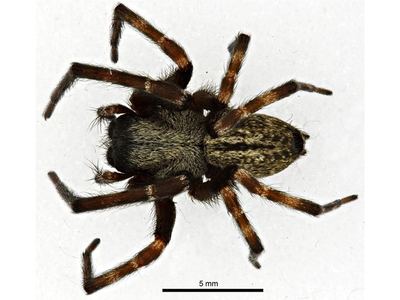
Related species in the U.S.

GBIF records read 2026-11-05 (open these records on GBIF). Listed: any license. Counted: CC0/CC BY only. How we count.