Flathead snake (Tantilla gracilis)
The flathead snake is a snake in the family Colubridae with a mild venom for its prey, not dangerous to people. GBIF holds 3,134 licensed U.S. records of it; it reaches our listing threshold in 5 states, most of all Oklahoma (1,297), Texas (946) and Kansas (809). Its observation records peak in April.
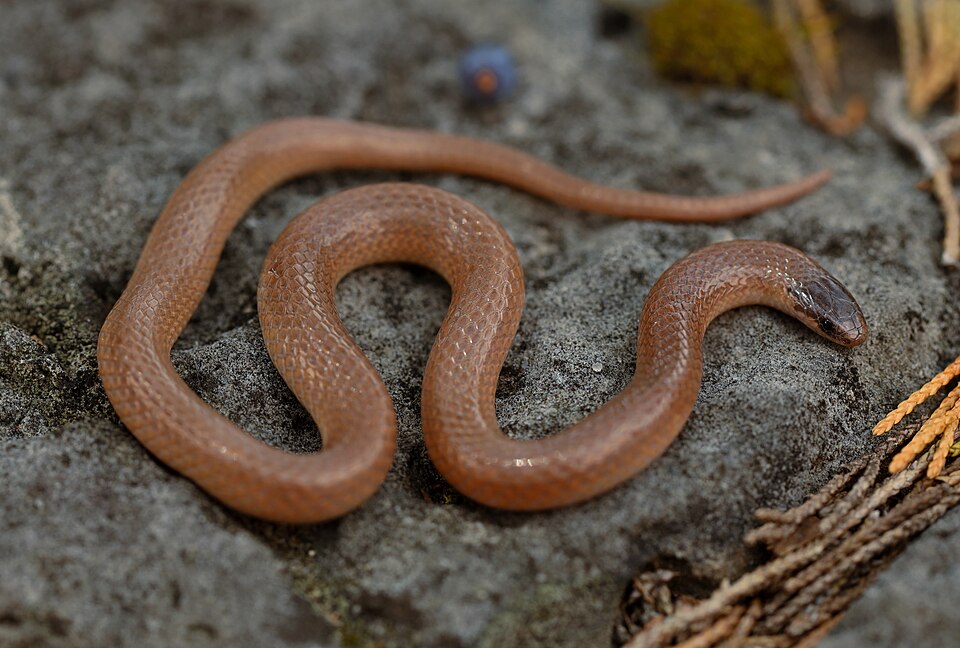

Is the flathead snake poisonous or venomous?
Mildly venomous but not dangerous: the flathead snake has enlarged rear teeth and a mild venom for its prey, and a bite causes at most local swelling, which is why many sources simply call it harmless. It is not a pit viper or coral snake, the only U.S. land snakes with medically dangerous venom. Clean any bite like a small wound.
Which states have the flathead snake?
Records are spread over 5 states; the top three, Oklahoma, Texas and Kansas, hold 97% of them.
| # | State | Records | Share of state snakes | Rank in state |
|---|---|---|---|---|
| 1 | Oklahoma | 1,297 | 9.8% | 2nd of 50 |
| 2 | Texas | 946 | 2.3% | 15th of 86 |
| 3 | Kansas | 809 | 5.5% | 4th of 44 |
| 4 | Missouri | 41 | 2.2% | 14th of 36 |
| 5 | Arkansas | 34 | 0.6% | 20th of 36 |
When is the flathead snake seen?
Across the U.S., observation records of the flathead snake run mostly February through September, peaking in April with 43% of them. Winter (December to February) holds 6% of them.
Where the flathead snake is recorded in each state
Oklahoma
Oklahoma holds 1,297 licensed records, the 2nd most recorded of 50 snakes listed there. Most of its licensed records in Oklahoma come from LeFlore County, Tulsa County and Seminole County. Next come Rogers County (75) and Wagoner County (54).
Texas
Texas holds 946 licensed records, the 15th most recorded of 86 snakes listed there. Its observation records in Texas run mostly October through June, peaking in April; most licensed records come from Bosque County, Travis County and Denton County. Next come Kimble County (28) and Hays County (24).
Kansas
Kansas holds 809 licensed records, the 4th most recorded of 44 snakes listed there. Most of its licensed records in Kansas come from Cowley County, Cherokee County and Chase County. Next come Douglas County (30) and Chautauqua County (28).
Missouri
Missouri holds 41 licensed records, the joint 14th most recorded of 36 snakes listed there. Most of its licensed records in Missouri come from Jefferson County, Taney County and Miller County. Next come Stone County (2) and Washington County (2).
Arkansas
Arkansas holds 34 licensed records, the 20th most recorded of 36 snakes listed there. Most of its licensed records in Arkansas come from Sebastian County, Lawrence County and Yell County. Next come Faulkner County (2) and Logan County (2).
Top counties in the U.S.
| # | County | State | Records | Share of U.S. |
|---|---|---|---|---|
| 1 | Cowley County | Kansas | 418 | 13.3% |
| 2 | LeFlore County | Oklahoma | 227 | 7.2% |
| 3 | Tulsa County | Oklahoma | 219 | 7.0% |
| 4 | Seminole County | Oklahoma | 212 | 6.8% |
| 5 | Bosque County | Texas | 155 | 4.9% |
| 6 | Travis County | Texas | 143 | 4.6% |
| 7 | Rogers County | Oklahoma | 75 | 2.4% |
| 8 | Wagoner County | Oklahoma | 54 | 1.7% |
| 9 | Cherokee County | Kansas | 52 | 1.7% |
| 10 | Chase County | Kansas | 42 | 1.3% |
| 11 | Creek County | Oklahoma | 40 | 1.3% |
| 12 | Okmulgee County | Oklahoma | 40 | 1.3% |
| 13 | Osage County | Oklahoma | 37 | 1.2% |
| 14 | Comanche County | Oklahoma | 31 | 1.0% |
| 15 | Douglas County | Kansas | 30 | 1.0% |
How recent are the flathead snake records?
The flathead snake record leans on older material: only 4% of dated U.S. records come from 2017–2026, and the median record is from 1941. The oldest dated record is from 1897; the busiest year was 1907, with 297 records.
| Decade | Records | Share |
|---|---|---|
| 1890s | 4 | 0.1% |
| 1900s | 301 | 10.0% |
| 1910s | 49 | 1.6% |
| 1920s | 108 | 3.6% |
| 1930s | 806 | 26.9% |
| 1940s | 574 | 19.1% |
| 1950s | 271 | 9.0% |
| 1960s | 303 | 10.1% |
| 1970s | 138 | 4.6% |
| 1980s | 92 | 3.1% |
| 1990s | 68 | 2.3% |
| 2000s | 107 | 3.6% |
| 2010s | 94 | 3.1% |
| 2020s | 84 | 2.8% |
Species recorded in the same counties
Of the 67 counties where the flathead snake is most recorded, 41 are also top counties for the speckled kingsnake, more than for any other snake. Venomous species among its neighbors: the eastern copperhead.
| Species | Shared counties |
|---|---|
| Speckled kingsnake | 41 |
| Ring-necked snake | 29 |
| Rough earthsnake | 29 |
| Rough greensnake | 29 |
| Eastern copperhead venomous | 28 |
| Plain-bellied watersnake | 28 |
| Eastern racer | 26 |
| Western worm snake | 26 |
Related species in the U.S.
Other species of the genus Tantilla with profiles here: Plains black-headed snake, Southeastern crown snake and Southwestern blackhead snake.
GBIF records read 2026-09-29. Listed: any license. Counted: CC0/CC BY only. How we count.