Rough greensnake (Opheodrys aestivus)
The rough greensnake (genus Opheodrys) is a non-venomous snake in the family Colubridae. Of the two green snakes profiled here, it is listed in fewer states than any other. Most of its 23 listed states are in the South Atlantic (8) and East South Central (4) census divisions. None is in the West. Its observation records peak in October.
Also called: greensnake (English names in GBIF). Also spelled: rough green snake, green snake
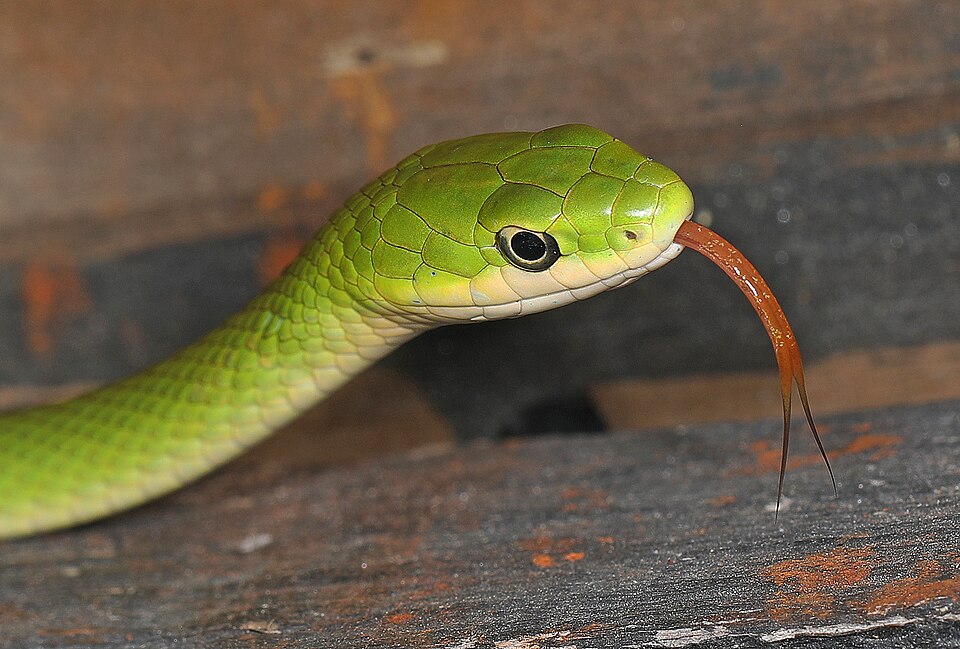

Opheodrys aestivus, commonly known as the rough green snake, is a species of nonvenomous North American snake in the subfamily Colubrinae of the family Colubridae. The species is sometimes called grass snake or green grass snake, but these names are more commonly applied to the smooth green snake (Opheodrys vernalis). The European colubrid called grass snake (Natrix natrix) is not closely related.
From Wikipedia: Opheodrys aestivus, text under CC BY-SA 4.0.
Is the rough greensnake poisonous or venomous?
No. The rough greensnake is non-venomous: it belongs to the family Colubridae, not to the pit vipers or coral snakes, the only U.S. land snakes with medically dangerous venom. It may bite if handled; clean the bite like any small wound.
Which states have the rough greensnake?
| # | State | Records | Share of state snakes | Rank in state |
|---|---|---|---|---|
| 1 | Texas | 881 | 2.1% | 16th of 86 |
| 2 | North Carolina | 875 | 4.2% | 10th of 39 |
| 3 | Virginia | 431 | 3.9% | 10th of 30 |
| 4 | Oklahoma | 341 | 2.6% | 14th of 50 |
| 5 | Florida | 215 | 1.0% | 18th of 50 |
| 6 | Louisiana | 189 | 3.7% | 9th of 41 |
| 7 | Maryland | 160 | 4.3% | 8th of 20 |
| 8 | South Carolina | 141 | 3.8% | 8th of 40 |
| 9 | Georgia | 136 | 2.2% | 12th of 44 |
| 10 | Alabama | 128 | 2.2% | 17th of 44 |
| 11 | Kansas | 102 | 0.7% | 33rd of 44 |
| 12 | Arkansas | 97 | 1.8% | 11th of 36 |
| 13 | Tennessee | 87 | 3.3% | 11th of 32 |
| 14 | Illinois | 59 | 2.0% | 15th of 34 |
| 15 | Mississippi | 54 | 2.9% | 12th of 38 |
| 16 | Ohio | 54 | 0.9% | 19th of 25 |
| 17 | Indiana | 50 | 2.2% | 12th of 27 |
| 18 | Kentucky | 45 | 3.5% | 11th of 24 |
| 19 | Missouri | 42 | 2.2% | 14th of 36 |
| 20 | West Virginia | 24 | 1.5% | 15th of 18 |
| 21 | New Jersey | 19 | 1.6% | 14th of 18 |
| 22 | Delaware | 9 | 1.3% | 11th of 15 |
| 23 | Pennsylvania | 2 | 0.0% | 20th of 20 |
When is the rough greensnake seen?
Its observation records run mostly March through October.
Season by state
Observation records run through most of the year in Florida. Where the season stays within one calendar year, it starts earliest in March (Georgia, Louisiana, Mississippi, South Carolina and Texas) and latest in May (Illinois and Maryland). April and September are the most common peak months, four states each.
| State | Main season | Peak month | Observation records |
|---|---|---|---|
| Texas | March through October | May | 454 |
| North Carolina | April through October | September | 174 |
| Virginia | April through October | October | 160 |
| Florida | most of the year | March | 86 |
| Maryland | May through October | September | 78 |
| Georgia | March through November | May | 77 |
| Tennessee | April through November | April | 67 |
| Arkansas | April through October | April | 66 |
| Louisiana | March through November | August | 55 |
| South Carolina | March through October | April | 44 |
| Illinois | May through October | October | 39 |
| Kentucky | April through September | September | 34 |
| Oklahoma | April through October | September | 33 |
| Mississippi | March through October | April | 32 |
| Missouri | April through October | October | 30 |
Where the rough greensnake is recorded in each state
| State | Licensed records | Place among the state's snakes | Most recorded counties |
|---|---|---|---|
| Texas | 881 | 16th of 86 | Travis County (86), Williamson County (71), Dallas County (51), Brazos County (39) and Tarrant County (37) |
| North Carolina | 875 | 10th of 39 | Sampson County (131), Wake County (60), Scotland County (55), Orange County (49) and Durham County (43) |
| Virginia | 431 | 10th of 30 | Fairfax County (42), Northampton County (26), Henrico County (25), Virginia Beach (23) and Accomack County (21) |
| Oklahoma | 341 | 14th of 50 | Cleveland County (28), Okmulgee County (26), LeFlore County (25), Comanche County (23) and Pottawatomie County (23) |
| Florida | 215 | 18th of 50 | Miami-Dade County (29), Alachua County (27), Monroe County (17), Palm Beach County (13) and Franklin County (12) |
| Louisiana | 189 | 9th of 41 | Jefferson Parish (57), Ouachita Parish (15), Saint Tammany Parish (12), East Baton Rouge Parish (11) and Lafayette Parish (10) |
| Maryland | 160 | 8th of 20 | Prince George's County (59), Anne Arundel County (21), Montgomery County (19), Cecil County (14) and St. Mary's County (11) |
| South Carolina | 141 | 8th of 40 | Charleston County (25), Berkeley County (22), Jasper County (17), Horry County (9) and Richland County (7) |
| Georgia | 136 | 12th of 44 | Chatham County (15), Clarke County (12), Charlton County (10), Richmond County (8) and Bryan County (6) |
| Alabama | 128 | 17th of 44 | Lee County (19), Baldwin County (8), Covington County (7), Bibb County (7) and Macon County (5) |
| Kansas | 102 | 33rd of 44 | Cherokee County (34), Anderson County (9), Labette County (7), Bourbon County (7) and Franklin County (6) |
| Arkansas | 97 | 11th of 36 | Columbia County (16), Monroe County (12), Sebastian County (8), Polk County (7) and Montgomery County (6) |
| Tennessee | 87 | 11th of 32 | Montgomery County (17), Knox County (8), Shelby County (6), Davidson County (5) and Hardeman County (5) |
| Illinois | 59 | 15th of 34 | Union County (32), Macoupin County (5), Jackson County (4), Richland County (3) and St. Clair County (3) |
| Mississippi | 54 | 12th of 38 | Jackson County (17), Lafayette County (7), Harrison County (6), Adams County (3) and Kemper County (3) |
| Ohio | 54 | 19th of 25 | Scioto County (12), Lawrence County (10), Adams County (7), Jackson County (4) and Pike County (4) |
| Indiana | 50 | 12th of 27 | Brown County (8), Clark County (5), Orange County (5), Monroe County (4) and Daviess County (2) |
| Kentucky | 45 | joint 11th of 24 | Madison County (16), Edmonson County (4), Fayette County (4), Breathitt County (3) and Pike County (3) |
| Missouri | 42 | 14th of 36 | Phelps County (6), Cape Girardeau County (4), Franklin County (4), St. Louis County (4) and Douglas County (3) |
Top counties in the U.S.
| # | County | State | Records | Share of U.S. |
|---|---|---|---|---|
| 1 | Sampson County | North Carolina | 131 | 3.2% |
| 2 | Travis County | Texas | 86 | 2.1% |
| 3 | Williamson County | Texas | 71 | 1.7% |
| 4 | Wake County | North Carolina | 60 | 1.4% |
| 5 | Prince George's County | Maryland | 59 | 1.4% |
| 6 | Jefferson Parish | Louisiana | 57 | 1.4% |
| 7 | Scotland County | North Carolina | 55 | 1.3% |
| 8 | Dallas County | Texas | 51 | 1.2% |
| 9 | Orange County | North Carolina | 49 | 1.2% |
| 10 | Durham County | North Carolina | 43 | 1.0% |
| 11 | Fairfax County | Virginia | 42 | 1.0% |
| 12 | Moore County | North Carolina | 39 | 0.9% |
| 13 | Brazos County | Texas | 39 | 0.9% |
| 14 | Dare County | North Carolina | 37 | 0.9% |
| 15 | Tarrant County | Texas | 37 | 0.9% |
How recent are the rough greensnake records?
| Decade | Records | Share |
|---|---|---|
| 1850s | 5 | 0.1% |
| 1870s | 2 | 0.1% |
| 1880s | 12 | 0.3% |
| 1890s | 16 | 0.4% |
| 1900s | 17 | 0.4% |
| 1910s | 39 | 1.0% |
| 1920s | 97 | 2.4% |
| 1930s | 219 | 5.5% |
| 1940s | 256 | 6.4% |
| 1950s | 229 | 5.7% |
| 1960s | 256 | 6.4% |
| 1970s | 249 | 6.2% |
| 1980s | 338 | 8.5% |
| 1990s | 132 | 3.3% |
| 2000s | 287 | 7.2% |
| 2010s | 509 | 12.7% |
| 2020s | 1,336 | 33.4% |
Species recorded in the same counties
| Species | Shared counties |
|---|---|
| Eastern racer | 146 |
| DeKay's brown snake | 136 |
| Eastern copperhead venomous | 135 |
| Ring-necked snake | 120 |
| Eastern rat snake | 116 |
| Common garter snake | 115 |
| Northern water snake | 102 |
| Plain-bellied watersnake | 99 |
Related species in the U.S.
GBIF records read 2026-11-05 (open these records on GBIF). Listed: any license. Counted: CC0/CC BY only. How we count.