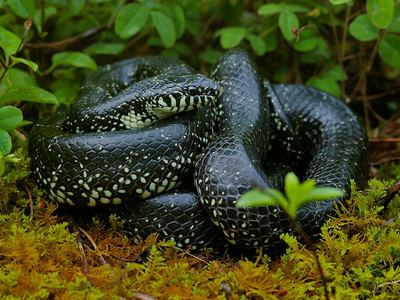
Speckled kingsnake (Lampropeltis holbrooki)
The speckled kingsnake (genus Lampropeltis) is a non-venomous snake in the family Colubridae. Among the nine kingsnakes and milksnakes profiled here, it ranks 3rd by number of states listed, level with one other. Most of its 12 listed states are in the West South Central (4) and West North Central (3) census divisions. None is in the Northeast. Its observation records peak in May.
Also spelled: speckled king snake
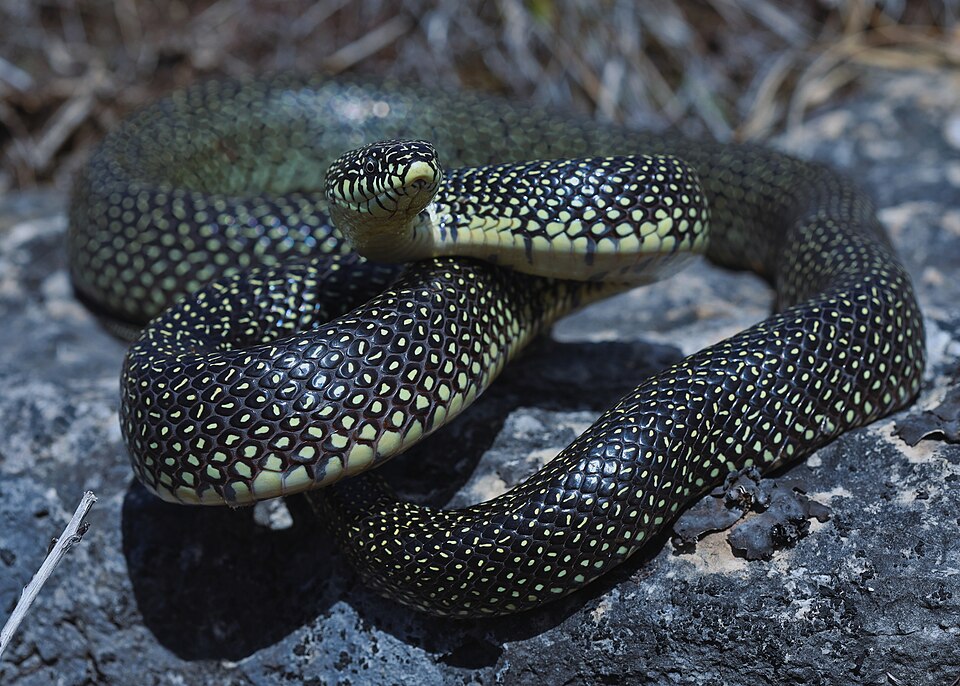

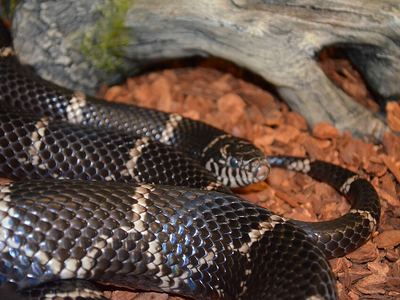
The speckled kingsnake (Lampropeltis holbrooki) is a species of nonvenomous kingsnake in the family Colubridae. The species is endemic to the United States.
From Wikipedia: Speckled kingsnake, text under CC BY-SA 4.0.
Is the speckled kingsnake poisonous or venomous?
No. The speckled kingsnake is non-venomous: it belongs to the family Colubridae, not to the pit vipers or coral snakes, the only U.S. land snakes with medically dangerous venom. It may bite if handled; clean the bite like any small wound.
Which states have the speckled kingsnake?
The count includes 242 records filed under the older name Lampropeltis getula in Arkansas (18), Iowa (3), Kansas (134), Missouri (9), Nebraska (13) and Oklahoma (65).
| # | State | Records | Share of state snakes | Rank in state |
|---|---|---|---|---|
| 1 | Oklahoma | 263 | 2.0% | 19th of 50 |
| 2 | Kansas | 254 | 1.7% | 20th of 44 |
| 3 | Texas | 176 | 0.4% | 48th of 86 |
| 4 | Arkansas | 126 | 2.4% | 8th of 36 |
| 5 | Louisiana | 118 | 2.3% | 12th of 41 |
| 6 | Missouri | 43 | 2.2% | 13th of 36 |
| 7 | Mississippi | 39 | 2.1% | 14th of 38 |
| 8 | Nebraska | 19 | 0.8% | 19th of 32 |
| 9 | Colorado | 2 | 0.1% | 24th of 26 |
| 10 | Alabama | 1 | 0.0% | 43rd of 44 |
| 11 | Tennessee | 1 | 0.0% | 30th of 32 |
| 12 | New Mexico | 0 | — | — |
When is the speckled kingsnake seen?
Its observation records run mostly March through October.
Season by state
Where the season stays within one calendar year, it starts earliest in February (Mississippi) and latest in April (Kansas and Missouri). April and May are the most common peak months, three states each.
| State | Main season | Peak month | Observation records |
|---|---|---|---|
| Arkansas | March through July | May | 94 |
| Texas | March through November | May | 92 |
| Louisiana | March through October | April | 71 |
| Kansas | April through September | April | 35 |
| Mississippi | February through October | May | 34 |
| Missouri | April through September | April | 31 |
Where the speckled kingsnake is recorded in each state
| State | Licensed records | Place among the state's snakes | Most recorded counties |
|---|---|---|---|
| Oklahoma | 263 | 19th of 50 | LeFlore County (22), Cleveland County (20), Comanche County (16), Atoka County (14) and Marshall County (12) |
| Kansas | 254 | 20th of 44 | Douglas County (23), Ellis County (16), Barton County (13), Ellsworth County (11) and Barber County (10) |
| Texas | 176 | 48th of 86 | Brazos County (20), Harrison County (11), Jefferson County (8), Bowie County (7) and Galveston County (7) |
| Arkansas | 126 | 8th of 36 | Sebastian County (19), Pulaski County (12), Washington County (10), Columbia County (8) and Polk County (7) |
| Louisiana | 118 | joint 12th of 41 | East Baton Rouge Parish (22), Saint Tammany Parish (14), Calcasieu Parish (10), Cameron Parish (10) and Jackson Parish (8) |
| Missouri | 43 | 13th of 36 | Jefferson County (9), Texas County (4), Phelps County (3), Washington County (2) and Iron County (2) |
| Mississippi | 39 | 14th of 38 | Simpson County (9), Jackson County (7), Pearl River County (5), Rankin County (4) and Lafayette County (3) |
Top counties in the U.S.
| # | County | State | Records | Share of U.S. |
|---|---|---|---|---|
| 1 | Douglas County | Kansas | 23 | 2.2% |
| 2 | East Baton Rouge Parish | Louisiana | 22 | 2.1% |
| 3 | LeFlore County | Oklahoma | 22 | 2.1% |
| 4 | Cleveland County | Oklahoma | 20 | 1.9% |
| 5 | Brazos County | Texas | 20 | 1.9% |
| 6 | Sebastian County | Arkansas | 19 | 1.8% |
| 7 | Ellis County | Kansas | 16 | 1.5% |
| 8 | Comanche County | Oklahoma | 16 | 1.5% |
| 9 | Saint Tammany Parish | Louisiana | 14 | 1.3% |
| 10 | Atoka County | Oklahoma | 14 | 1.3% |
| 11 | Barton County | Kansas | 13 | 1.2% |
| 12 | Pulaski County | Arkansas | 12 | 1.1% |
| 13 | Marshall County | Oklahoma | 12 | 1.1% |
| 14 | Ellsworth County | Kansas | 11 | 1.1% |
| 15 | Tulsa County | Oklahoma | 11 | 1.1% |
How recent are the speckled kingsnake records?
| Decade | Records | Share |
|---|---|---|
| 1850s | 2 | 0.2% |
| 1880s | 4 | 0.4% |
| 1890s | 4 | 0.4% |
| 1900s | 11 | 1.1% |
| 1910s | 5 | 0.5% |
| 1920s | 35 | 3.4% |
| 1930s | 72 | 7.1% |
| 1940s | 62 | 6.1% |
| 1950s | 60 | 5.9% |
| 1960s | 93 | 9.1% |
| 1970s | 73 | 7.2% |
| 1980s | 51 | 5.0% |
| 1990s | 31 | 3.0% |
| 2000s | 113 | 11.1% |
| 2010s | 131 | 12.8% |
| 2020s | 273 | 26.8% |
Species recorded in the same counties
| Species | Shared counties |
|---|---|
| Rough greensnake | 68 |
| DeKay's brown snake | 67 |
| Eastern racer | 66 |
| Plain-bellied watersnake | 60 |
| Eastern copperhead venomous | 59 |
| Western rat snake | 58 |
| Common garter snake | 55 |
| Ring-necked snake | 54 |
Related species in the U.S.
GBIF records read 2026-11-05 (open these records on GBIF). Listed: any license. Counted: CC0/CC BY only. How we count.