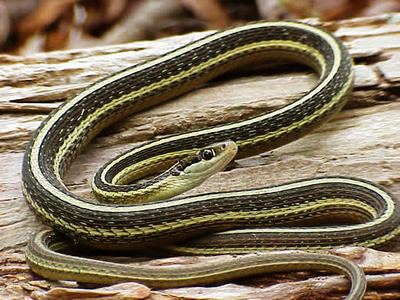
Plains garter snake (Thamnophis radix)
The plains garter snake (genus Thamnophis) is a snake in the family Colubridae with a mild venom for its prey, not dangerous to people. Among the 13 garter snakes and ribbon snakes profiled here, it ranks 3rd by number of states listed. Most of its 16 listed states are in the West North Central (7) and East North Central (4) census divisions. None is in the Northeast. Its observation records peak in May.
Also called: eastern plains garter snake, western plains garter snake (English names in GBIF)
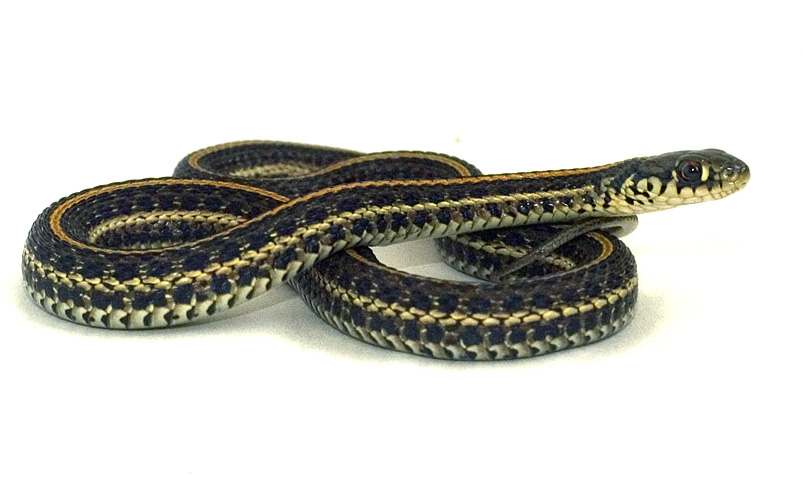

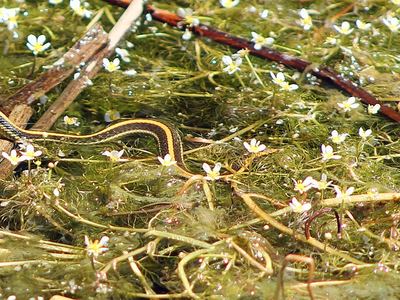
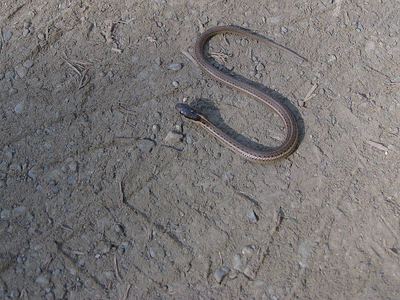
The plains garter snake (Thamnophis radix) is a species of garter snake native to most of the central United States as far north as Canada and as far south as Texas. It has a distinctive orange or yellow stripe from its head to tail, and the rest of its body is mainly a gray-green color. The snake is commonly found living near water sources such as streams and ponds, but can also be found in urban areas and vacant lots.
From Wikipedia: Plains garter snake, text under CC BY-SA 4.0.
Is the plains garter snake poisonous or venomous?
Mildly venomous but not dangerous: the plains garter snake has enlarged rear teeth and a mild venom for its prey, and a bite causes at most local swelling, which is why many sources simply call it harmless. It is not a pit viper or coral snake, the only U.S. land snakes with medically dangerous venom. Clean any bite like a small wound.
Are garter snakes venomous?
Only mildly. Every garter snake species (genus Thamnophis) has the same enlarged rear teeth and mild venom for its prey; none is dangerous to people.
Which states have the plains garter snake?
It is the most recorded snake of all in Nebraska, Iowa and North Dakota.
| # | State | Records | Share of state snakes | Rank in state |
|---|---|---|---|---|
| 1 | Kansas | 563 | 3.8% | 8th of 44 |
| 2 | South Dakota | 516 | 16.2% | 3rd of 16 |
| 3 | Nebraska | 446 | 18.0% | 1st of 32 |
| 4 | Colorado | 266 | 7.5% | 4th of 26 |
| 5 | Illinois | 262 | 8.9% | 4th of 34 |
| 6 | Iowa | 213 | 19.9% | 1st of 22 |
| 7 | North Dakota | 105 | 48.2% | 1st of 8 |
| 8 | Oklahoma | 76 | 0.6% | 36th of 50 |
| 9 | Minnesota | 60 | 6.9% | 3rd of 15 |
| 10 | Wyoming | 46 | 4.3% | 5th of 11 |
| 11 | Montana | 45 | 3.3% | 6th of 9 |
| 12 | New Mexico | 37 | 0.6% | 27th of 56 |
| 13 | Indiana | 30 | 1.3% | 17th of 27 |
| 14 | Missouri | 30 | 1.6% | 19th of 36 |
| 15 | Wisconsin | 24 | 2.3% | 10th of 16 |
| 16 | Ohio | 11 | 0.2% | 24th of 25 |
When is the plains garter snake seen?
Its observation records run mostly April through October.
Season by state
Where the season stays within one calendar year, it starts earliest in March (Illinois) and latest in June (Minnesota). June and October are the most common peak months, two states each.
| State | Main season | Peak month | Observation records |
|---|---|---|---|
| Illinois | March through September | April | 151 |
| Nebraska | April through October | October | 105 |
| South Dakota | April through October | June | 99 |
| Colorado | April through October | June | 97 |
| Kansas | May through November | October | 38 |
| Iowa | May through October | May | 36 |
| Minnesota | June through October | July | 32 |
Where the plains garter snake is recorded in each state
| State | Licensed records | Place among the state's snakes | Most recorded counties |
|---|---|---|---|
| Kansas | 563 | 8th of 44 | Barton County (72), Ellis County (63), Douglas County (42), Russell County (40) and Meade County (30) |
| South Dakota | 516 | 3rd of 16 | Clay County (82), Brookings County (35), Union County (30), Pennington County (27) and Jackson County (25) |
| Nebraska | 446 | 1st of 32 | Sioux County (63), Garden County (55), Sheridan County (24), Merrick County (23) and Custer County (22) |
| Colorado | 266 | 4th of 26 | Boulder County (61), Larimer County (45), Adams County (27), Denver County (23) and El Paso County (19) |
| Illinois | 262 | 4th of 34 | Cook County (77), Lake County (61), Will County (42), Champaign County (41) and DuPage County (13) |
| Iowa | 213 | 1st of 22 | Dickinson County (58), Palo Alto County (29), Kossuth County (27), Woodbury County (24) and Story County (9) |
| North Dakota | 105 | 1st of 8 | Sheridan County (10), Ward County (10), McKenzie County (8), Billings County (7) and Pembina County (6) |
| Oklahoma | 76 | joint 36th of 50 | Cimarron County (72), Woodward County (2), Beaver County (1) and Texas County (1) |
| Minnesota | 60 | 3rd of 15 | Dakota County (10), Hennepin County (8), Anoka County (4), Mahnomen County (3) and Polk County (3) |
| Wyoming | 46 | 5th of 11 | Laramie County (17), Campbell County (12), Goshen County (7), Carbon County (3) and Niobrara County (2) |
| Montana | 45 | 6th of 9 | Phillips County (8), Roosevelt County (7), Valley County (5), Carter County (4) and Custer County (4) |
| New Mexico | 37 | 27th of 56 | Harding County (10), Union County (9), Mora County (8), San Miguel County (5) and Colfax County (5) |
| Indiana | 30 | 17th of 27 | Jasper County (16), Lake County (4), Benton County (4), Newton County (2) and White County (2) |
| Missouri | 30 | joint 19th of 36 | Holt County (26), Buchanan County (1), Linn County (1), St. Charles County (1) and St. Louis County (1) |
Top counties in the U.S.
| # | County | State | Records | Share of U.S. |
|---|---|---|---|---|
| 1 | Clay County | South Dakota | 82 | 3.0% |
| 2 | Cook County | Illinois | 77 | 2.8% |
| 3 | Barton County | Kansas | 72 | 2.6% |
| 4 | Cimarron County | Oklahoma | 72 | 2.6% |
| 5 | Ellis County | Kansas | 63 | 2.3% |
| 6 | Sioux County | Nebraska | 63 | 2.3% |
| 7 | Boulder County | Colorado | 61 | 2.2% |
| 8 | Lake County | Illinois | 61 | 2.2% |
| 9 | Dickinson County | Iowa | 58 | 2.1% |
| 10 | Garden County | Nebraska | 55 | 2.0% |
| 11 | Larimer County | Colorado | 45 | 1.6% |
| 12 | Will County | Illinois | 42 | 1.5% |
| 13 | Douglas County | Kansas | 42 | 1.5% |
| 14 | Champaign County | Illinois | 41 | 1.5% |
| 15 | Russell County | Kansas | 40 | 1.5% |
How recent are the plains garter snake records?
| Decade | Records | Share |
|---|---|---|
| 1850s | 19 | 0.8% |
| 1860s | 1 | 0.0% |
| 1870s | 18 | 0.7% |
| 1880s | 8 | 0.3% |
| 1890s | 24 | 1.0% |
| 1900s | 61 | 2.5% |
| 1910s | 48 | 1.9% |
| 1920s | 188 | 7.6% |
| 1930s | 176 | 7.1% |
| 1940s | 167 | 6.8% |
| 1950s | 236 | 9.6% |
| 1960s | 256 | 10.4% |
| 1970s | 135 | 5.5% |
| 1980s | 88 | 3.6% |
| 1990s | 20 | 0.8% |
| 2000s | 141 | 5.7% |
| 2010s | 317 | 12.8% |
| 2020s | 567 | 23.0% |
Species recorded in the same counties
| Species | Shared counties |
|---|---|
| Gopher snake | 74 |
| Common garter snake | 55 |
| Eastern racer | 51 |
| Prairie rattlesnake venomous | 41 |
| Plains hog-nosed snake | 30 |
| Northern water snake | 29 |
| DeKay's brown snake | 23 |
| Ring-necked snake | 18 |
Related species in the U.S.
GBIF records read 2026-11-05 (open these records on GBIF). Listed: any license. Counted: CC0/CC BY only. How we count.