Plains hog-nosed snake (Heterodon nasicus)
The plains hog-nosed snake (genus Heterodon) is a snake in the family Colubridae with a mild venom for its prey, not dangerous to people. Of the two hognose snakes profiled here, it is listed in fewer states than any other. Most of its 13 listed states are in the West North Central (5) and Mountain (5) census divisions. None is in the Northeast. Its observation records peak in June.
Also called: plains hognose snake, western hog-nosed snake, dusty hognose snake (English names in GBIF)
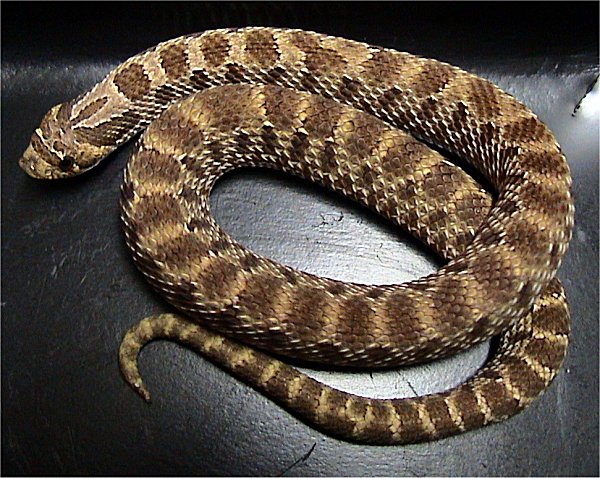

The western hognose snake (Heterodon nasicus) is a species of snake in the family Colubridae. The species is endemic to North America. There are three subspecies that are recognized as being valid, including the nominotypical subspecies.
From Wikipedia: Western hognose snake, text under CC BY-SA 4.0.
Is the plains hog-nosed snake poisonous or venomous?
Mildly venomous but not dangerous: the plains hog-nosed snake has enlarged rear teeth and a mild venom for its prey, and a bite causes at most local swelling, which is why many sources simply call it harmless. It is not a pit viper or coral snake, the only U.S. land snakes with medically dangerous venom. Clean any bite like a small wound.
Are hognose snakes venomous?
Only mildly. Every hognose snake species (genus Heterodon) has the same enlarged rear teeth and mild venom for its prey; none is dangerous to people.
Often mistaken for
The plains hog-nosed snake is not dangerous to people, but people often take it for rattlesnakes (both are recorded in 13 of its 13 states).
Which states have the plains hog-nosed snake?
| # | State | Records | Share of state snakes | Rank in state |
|---|---|---|---|---|
| 1 | Texas | 289 | 0.7% | 36th of 86 |
| 2 | Kansas | 197 | 1.3% | 24th of 44 |
| 3 | Nebraska | 110 | 4.5% | 7th of 32 |
| 4 | Oklahoma | 91 | 0.7% | 30th of 50 |
| 5 | Arizona | 72 | 0.3% | 45th of 60 |
| 6 | New Mexico | 72 | 1.1% | 17th of 56 |
| 7 | Colorado | 46 | 1.3% | 9th of 26 |
| 8 | South Dakota | 40 | 1.3% | 11th of 16 |
| 9 | Montana | 19 | 1.4% | 8th of 9 |
| 10 | North Dakota | 17 | 7.8% | 5th of 8 |
| 11 | Minnesota | 14 | 1.6% | 10th of 15 |
| 12 | Wyoming | 14 | 1.3% | 8th of 11 |
| 13 | Illinois | 1 | 0.0% | 33rd of 34 |
When is the plains hog-nosed snake seen?
Its observation records run mostly May through October.
Where the plains hog-nosed snake is recorded in each state
| State | Licensed records | Place among the state's snakes | Most recorded counties |
|---|---|---|---|
| Texas | 289 | 36th of 86 | Gaines County (23), Lubbock County (19), Coke County (11), Hudspeth County (10) and Andrews County (10) |
| Kansas | 197 | 24th of 44 | Ellis County (17), Meade County (16), Trego County (15), Morton County (13) and Logan County (9) |
| Nebraska | 110 | 7th of 32 | Cherry County (9), Lincoln County (8), Sheridan County (8), Antelope County (6) and Frontier County (6) |
| Oklahoma | 91 | 30th of 50 | Cimarron County (15), Cleveland County (14), Alfalfa County (9), Comanche County (7) and Beaver County (5) |
| Arizona | 72 | 45th of 60 | Cochise County (67), Graham County (2), Santa Cruz County (1), Yavapai County (1) and Coconino County (1) |
| New Mexico | 72 | joint 17th of 56 | Hidalgo County (12), Grant County (7), Chaves County (6), Bernalillo County (4) and Otero County (4) |
| Colorado | 46 | 9th of 26 | Weld County (12), El Paso County (10), Pueblo County (4), Yuma County (4) and Prowers County (3) |
| South Dakota | 40 | 11th of 16 | Harding County (5), Jackson County (5), Charles Mix County (2), Custer County (2) and Bennett County (2) |
Top counties in the U.S.
| # | County | State | Records | Share of U.S. |
|---|---|---|---|---|
| 1 | Cochise County | Arizona | 67 | 6.8% |
| 2 | Gaines County | Texas | 23 | 2.3% |
| 3 | Lubbock County | Texas | 19 | 1.9% |
| 4 | Ellis County | Kansas | 17 | 1.7% |
| 5 | Meade County | Kansas | 16 | 1.6% |
| 6 | Trego County | Kansas | 15 | 1.5% |
| 7 | Cimarron County | Oklahoma | 15 | 1.5% |
| 8 | Cleveland County | Oklahoma | 14 | 1.4% |
| 9 | Morton County | Kansas | 13 | 1.3% |
| 10 | Weld County | Colorado | 12 | 1.2% |
| 11 | Hidalgo County | New Mexico | 12 | 1.2% |
| 12 | Coke County | Texas | 11 | 1.1% |
| 13 | El Paso County | Colorado | 10 | 1.0% |
| 14 | Hudspeth County | Texas | 10 | 1.0% |
| 15 | Andrews County | Texas | 10 | 1.0% |
How recent are the plains hog-nosed snake records?
| Decade | Records | Share |
|---|---|---|
| 1850s | 4 | 0.4% |
| 1870s | 7 | 0.8% |
| 1880s | 1 | 0.1% |
| 1890s | 8 | 0.9% |
| 1900s | 9 | 1.0% |
| 1910s | 9 | 1.0% |
| 1920s | 79 | 8.6% |
| 1930s | 92 | 10.1% |
| 1940s | 105 | 11.5% |
| 1950s | 78 | 8.5% |
| 1960s | 144 | 15.8% |
| 1970s | 87 | 9.5% |
| 1980s | 63 | 6.9% |
| 1990s | 50 | 5.5% |
| 2000s | 68 | 7.4% |
| 2010s | 55 | 6.0% |
| 2020s | 55 | 6.0% |
Species recorded in the same counties
| Species | Shared counties |
|---|---|
| Gopher snake | 81 |
| Prairie rattlesnake venomous | 49 |
| Coachwhip | 42 |
| Glossy snake | 40 |
| Long-nosed snake | 35 |
| Eastern racer | 30 |
| Plains black-headed snake | 30 |
| Plains garter snake | 30 |
Related species in the U.S.
GBIF records read 2026-11-05 (open these records on GBIF). Listed: any license. Counted: CC0/CC BY only. How we count.