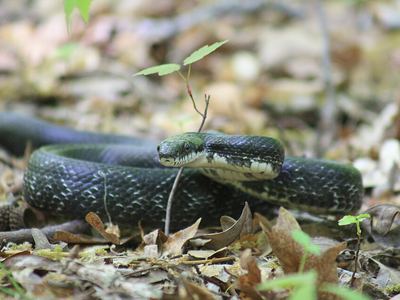
Rainbow snake (Farancia erytrogramma)
The rainbow snake (genus Farancia) is a non-venomous snake in the family Colubridae. Among the 15 water snakes and swamp snakes profiled here, it ranks 10th by number of states listed, level with one other. Its 6 listed states fall in the South Atlantic (5) and East South Central (1) census divisions. None is in the Northeast, the Midwest or the West.
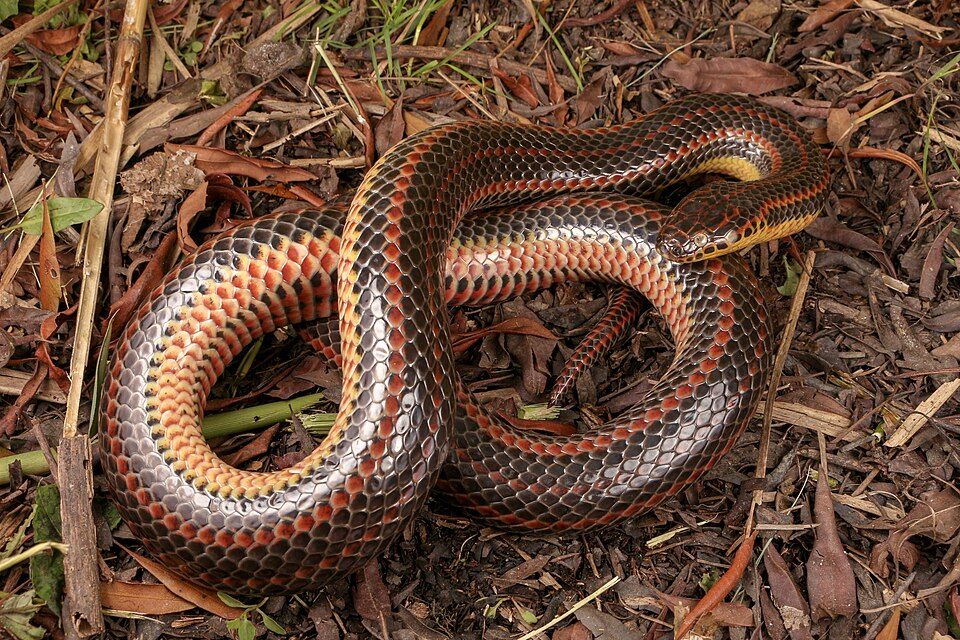

Farancia erytrogramma (also known commonly as the rainbow snake, and less frequently as the eel moccasin) is a species of large, nonvenomous, highly amphibious colubrid snake, endemic to the coastal plains of the southeastern United States. Two subspecies are recognized as being valid, one of which has been declared extinct.
From Wikipedia: Farancia erytrogramma, text under CC BY-SA 4.0.
Is the rainbow snake poisonous or venomous?
No. The rainbow snake is non-venomous: it belongs to the family Colubridae, not to the pit vipers or coral snakes, the only U.S. land snakes with medically dangerous venom. It may bite if handled; clean the bite like any small wound.
Which states have the rainbow snake?
| # | State | Records | Share of state snakes | Rank in state |
|---|---|---|---|---|
| 1 | North Carolina | 126 | 0.6% | 30th of 39 |
| 2 | Virginia | 117 | 1.1% | 22nd of 30 |
| 3 | South Carolina | 86 | 2.3% | 21st of 40 |
| 4 | Alabama | 29 | 0.5% | 37th of 44 |
| 5 | Georgia | 25 | 0.4% | 27th of 44 |
| 6 | Florida | 19 | 0.1% | 44th of 50 |
Where the rainbow snake is recorded in each state
| State | Licensed records | Place among the state's snakes | Most recorded counties |
|---|---|---|---|
| North Carolina | 126 | 30th of 39 | Sampson County (16), Currituck County (13), Craven County (11), Beaufort County (11) and New Hanover County (10) |
| Virginia | 117 | 22nd of 30 | James City County (78), New Kent County (19), Virginia Beach (7), Caroline County (4) and King William County (2) |
| South Carolina | 86 | joint 21st of 40 | Aiken County (23), Berkeley County (21), Charleston County (10), Dorchester County (5) and Georgetown County (5) |
Top counties in the U.S.
| # | County | State | Records | Share of U.S. |
|---|---|---|---|---|
| 1 | James City County | Virginia | 78 | 19.1% |
| 2 | Aiken County | South Carolina | 23 | 5.6% |
| 3 | Berkeley County | South Carolina | 21 | 5.1% |
| 4 | New Kent County | Virginia | 19 | 4.6% |
| 5 | Sampson County | North Carolina | 16 | 3.9% |
| 6 | Currituck County | North Carolina | 13 | 3.2% |
| 7 | Craven County | North Carolina | 11 | 2.7% |
| 8 | Beaufort County | North Carolina | 11 | 2.7% |
| 9 | New Hanover County | North Carolina | 10 | 2.4% |
| 10 | Charleston County | South Carolina | 10 | 2.4% |
| 11 | Pender County | North Carolina | 8 | 2.0% |
| 12 | Washington County | North Carolina | 7 | 1.7% |
| 13 | Virginia Beach | Virginia | 7 | 1.7% |
| 14 | Dare County | North Carolina | 6 | 1.5% |
| 15 | Gates County | North Carolina | 6 | 1.5% |
How recent are the rainbow snake records?
| Decade | Records | Share |
|---|---|---|
| 1900s | 2 | 0.5% |
| 1910s | 3 | 0.8% |
| 1920s | 9 | 2.3% |
| 1930s | 27 | 6.9% |
| 1940s | 49 | 12.4% |
| 1950s | 73 | 18.5% |
| 1960s | 57 | 14.5% |
| 1970s | 52 | 13.2% |
| 1980s | 40 | 10.2% |
| 1990s | 18 | 4.6% |
| 2000s | 21 | 5.3% |
| 2010s | 23 | 5.8% |
| 2020s | 20 | 5.1% |
Species recorded in the same counties
| Species | Shared counties |
|---|---|
| Eastern rat snake | 41 |
| Scarlet snake | 27 |
| Eastern ribbonsnake | 26 |
| Brown water snake | 24 |
| Eastern hog-nosed snake | 23 |
| Eastern racer | 23 |
| Corn snake | 22 |
| Eastern kingsnake | 22 |
Related species in the U.S.
GBIF records read 2026-11-05 (open these records on GBIF). Listed: any license. Counted: CC0/CC BY only. How we count.