Brown water snake (Nerodia taxispilota)
The brown water snake is a non-venomous snake in the family Colubridae. GBIF holds 4,378 licensed U.S. records of it; it reaches our listing threshold in 6 states, most of all Georgia (2,808), Virginia (479) and North Carolina (363). Its observation records peak in March.
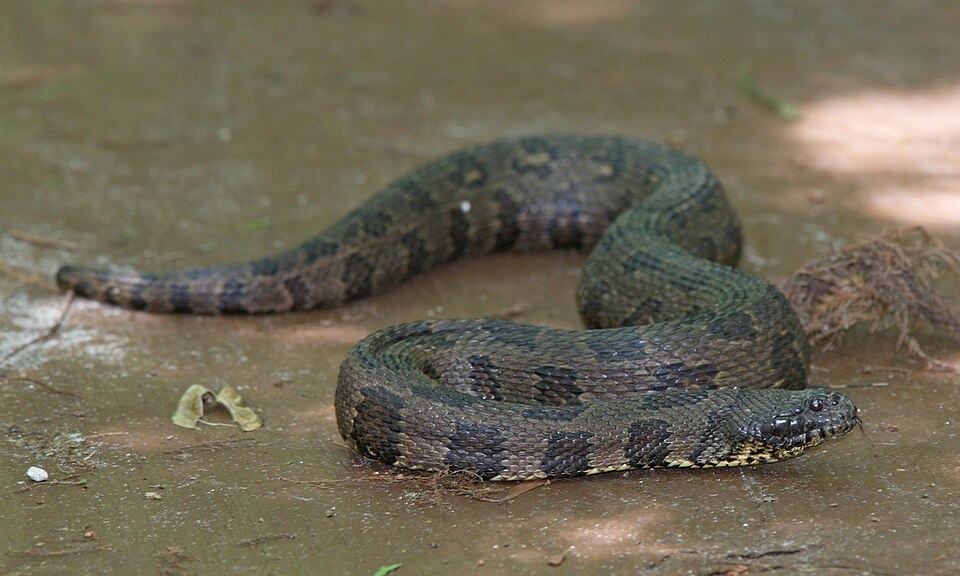

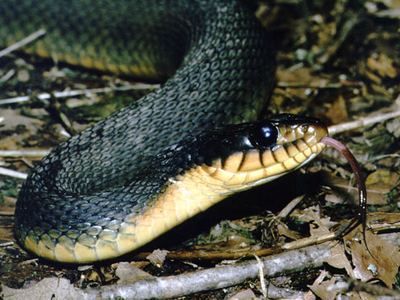
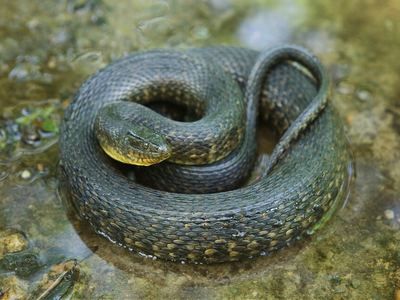
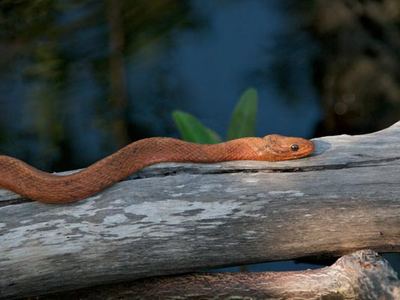
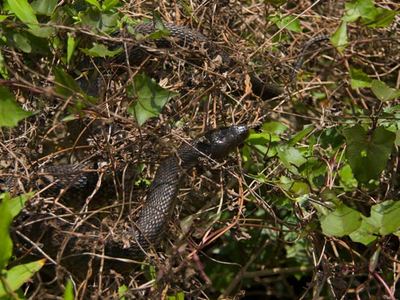
The brown water snake (Nerodia taxispilota) is a large species of nonvenomous natricine snake endemic to the southeastern United States. This snake is often one of the most abundant species of snakes found in rivers and streams of the southeastern United States, yet many aspects of its natural history are poorly known. Due to abundance and distribution throughout its biological range, this species could be used to investigate anthropogenic impacts on aquatic ecosystems by studying their movements.
From Wikipedia: Brown water snake, text under CC BY-SA 4.0.
Is the brown water snake poisonous or venomous?
No. The brown water snake is non-venomous: it belongs to the family Colubridae, not to the pit vipers or coral snakes, the only U.S. land snakes with medically dangerous venom. It may bite if handled; clean the bite like any small wound.
Often mistaken for
The brown water snake is non-venomous, but people often take it for cottonmouths (both are recorded in 6 of its 6 states).
Which states have the brown water snake?
The brown water snake's U.S. record is concentrated: Georgia alone holds 64% of licensed records. It is listed in 6 states in all; the next are Virginia (479), North Carolina (363) and Florida (350).
| # | State | Records | Share of state snakes | Rank in state |
|---|---|---|---|---|
| 1 | Georgia | 2,808 | 45.4% | 1st of 44 |
| 2 | Virginia | 479 | 4.4% | 9th of 30 |
| 3 | North Carolina | 363 | 1.8% | 19th of 39 |
| 4 | Florida | 350 | 1.7% | 14th of 49 |
| 5 | South Carolina | 266 | 7.3% | 1st of 40 |
| 6 | Alabama | 68 | 1.2% | 29th of 44 |
When is the brown water snake seen?
Across the U.S., observation records of the brown water snake run mostly December through August, peaking in March with 19% of them. Winter (December to February) holds 28% of them.
Season by state
Among states whose main season falls within one calendar year, it starts earliest in February (Georgia) and latest in March (North Carolina). Each of these states peaks in a different month: February in Georgia, March in Florida and May in North Carolina.
| State | Main season | Peak month | Observation records |
|---|---|---|---|
| Florida | December through July | March | 231 |
| North Carolina | March through September | May | 34 |
| Georgia | February through September | February | 32 |
Where the brown water snake is recorded in each state
Georgia
Georgia holds 2,808 licensed records, the most recorded of 44 snakes listed there. Its observation records in Georgia run mostly February through September, peaking in February; most licensed records come from Burke County, Columbia County and McDuffie County. Next come Richmond County (49) and Charlton County (18).
Virginia
Virginia holds 479 licensed records, the 9th most recorded of 30 snakes listed there. Most of its licensed records in Virginia come from Chesterfield County, Colonial Heights and Chesapeake. Next come Henrico County (20) and Virginia Beach (18).
North Carolina
North Carolina holds 363 licensed records, the 19th most recorded of 39 snakes listed there. Its observation records in North Carolina run mostly March through September, peaking in May; most licensed records come from Columbus County, Sampson County and Johnston County. Next come Craven County (25) and Robeson County (19).
Florida
Florida holds 350 licensed records, the 14th most recorded of 49 snakes listed there. Its observation records in Florida run mostly December through July, peaking in March; most licensed records come from Miami-Dade County, Franklin County and Palm Beach County. Next come Marion County (25) and Collier County (20).
South Carolina
South Carolina holds 266 licensed records, the most recorded of 40 snakes listed there. Most of its licensed records in South Carolina come from Barnwell County, Aiken County and Saluda County. Next come Berkeley County (7) and Horry County (5).
Alabama
Alabama holds 68 licensed records, the 29th most recorded of 44 snakes listed there. Most of its licensed records in Alabama come from Escambia County, Geneva County and Covington County. Next come Barbour County (8) and Monroe County (6).
Top counties in the U.S.
| # | County | State | Records | Share of U.S. |
|---|---|---|---|---|
| 1 | Burke County | Georgia | 2,549 | 58.2% |
| 2 | Chesterfield County | Virginia | 246 | 5.6% |
| 3 | Barnwell County | South Carolina | 117 | 2.7% |
| 4 | Colonial Heights | Virginia | 102 | 2.3% |
| 5 | Columbia County | Georgia | 75 | 1.7% |
| 6 | Aiken County | South Carolina | 72 | 1.6% |
| 7 | Columbus County | North Carolina | 69 | 1.6% |
| 8 | McDuffie County | Georgia | 63 | 1.4% |
| 9 | Richmond County | Georgia | 49 | 1.1% |
| 10 | Sampson County | North Carolina | 47 | 1.1% |
| 11 | Chesapeake | Virginia | 44 | 1.0% |
| 12 | Miami-Dade County | Florida | 37 | 0.8% |
| 13 | Saluda County | South Carolina | 34 | 0.8% |
| 14 | Franklin County | Florida | 33 | 0.8% |
| 15 | Palm Beach County | Florida | 33 | 0.8% |
How recent are the brown water snake records?
The brown water snake record leans on older material: only 8% of dated U.S. records come from 2017–2026, and the median record is from 1991. The oldest dated record is from 1875; the busiest year was 1990, with 1,083 records.
| Decade | Records | Share |
|---|---|---|
| 1870s | 2 | 0.0% |
| 1890s | 1 | 0.0% |
| 1900s | 1 | 0.0% |
| 1910s | 17 | 0.4% |
| 1920s | 11 | 0.3% |
| 1930s | 24 | 0.6% |
| 1940s | 35 | 0.8% |
| 1950s | 30 | 0.7% |
| 1960s | 111 | 2.6% |
| 1970s | 268 | 6.4% |
| 1980s | 244 | 5.8% |
| 1990s | 3,085 | 73.4% |
| 2000s | 26 | 0.6% |
| 2010s | 92 | 2.2% |
| 2020s | 255 | 6.1% |
Species recorded in the same counties
Of the 95 counties where the brown water snake is most recorded, 52 are also top counties for the eastern rat snake, more than for any other snake. Venomous species among its neighbors: the northern cottonmouth.
| Species | Shared counties |
|---|---|
| Eastern rat snake | 52 |
| Eastern ribbonsnake | 47 |
| Northern cottonmouth venomous | 47 |
| Plain-bellied watersnake | 44 |
| Rough greensnake | 43 |
| Southern watersnake | 43 |
| Eastern racer | 40 |
| Mud snake | 40 |
Related species in the U.S.
Other species of the genus Nerodia with profiles here: Northern water snake, Diamondback water snake, Southern watersnake, Plain-bellied watersnake, Green water snake, Salt marsh snake and Florida green water snake.
GBIF records read 2026-09-29. Listed: any license. Counted: CC0/CC BY only. How we count.