Brahminy blindsnake (Indotyphlops braminus)
The Brahminy blindsnake is a non-venomous snake in the family Typhlopidae. GBIF holds 446 licensed U.S. records of it; it reaches our listing threshold in 8 states, most of all Florida (206), Hawaii (128) and California (52). It is not native to the U.S.; it is introduced in Florida, Hawaii, California, Texas, Arizona, Louisiana and 2 more. Its observation records peak in April.
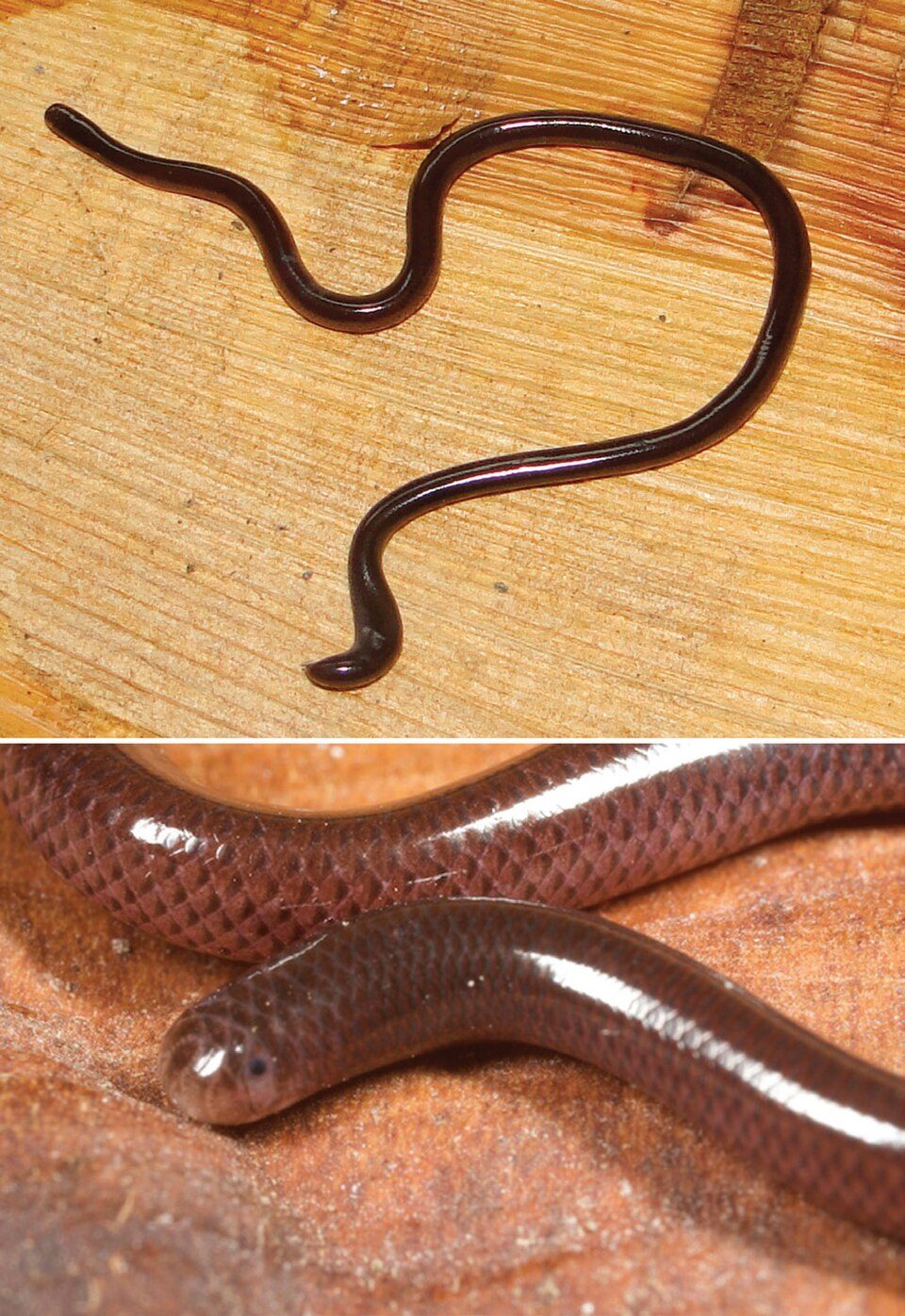

Indotyphlops braminus, commonly known as the brahminy blind snake (), is a non-venomous blind snake species, found mostly in Africa and Asia, and has been introduced in many other parts of the world. It is a completely fossorial (i.e., burrowing) reptile, with habits and appearance similar to an earthworm, for which it is often mistaken and shares convergent evolution with, although close examination reveals tiny scales and eyes rather than the annular segments characteristic of a true earthworm. The species is parthenogenetic and all known specimens have been female.
From Wikipedia: Indotyphlops braminus, text under CC BY-SA 4.0.
Is the Brahminy blindsnake poisonous or venomous?
No. The Brahminy blindsnake is a blind snake (family Typhlopidae): it has no venom, and its tiny mouth cannot bite a person. Pit vipers and coral snakes are the only U.S. land snakes with medically dangerous venom.
Which states have the Brahminy blindsnake?
Records are spread over 8 states; the top three, Florida, Hawaii and California, hold 87% of them. It is the most recorded snake of all in Hawaii.
| # | State | Records | Share of state snakes | Rank in state |
|---|---|---|---|---|
| 1 | Florida | 206 | 1.0% | 20th of 49 |
| 2 | Hawaii | 128 | 92.8% | 1st of 1 |
| 3 | California | 52 | 0.1% | 40th of 46 |
| 4 | Texas | 34 | 0.1% | 73rd of 86 |
| 5 | Arizona | 19 | 0.1% | 55th of 60 |
| 6 | Louisiana | 1 | 0.0% | 40th of 41 |
| 7 | Alabama | 0 | — | — |
| 8 | Georgia | 0 | — | — |
When is the Brahminy blindsnake seen?
Across the U.S., observation records of the Brahminy blindsnake run through most of the year, peaking in April with 18% of them. Winter (December to February) holds 21% of them.
Where the Brahminy blindsnake is recorded in each state
Florida
Florida holds 206 licensed records, the 20th most recorded of 49 snakes listed there. Its observation records in Florida run through most of the year, peaking in April; most licensed records come from Miami-Dade County, Collier County and Broward County. Next come Lee County (20) and Hillsborough County (11).
Hawaii
Hawaii holds 128 licensed records, the only snake listed there. Most of its licensed records in Hawaii come from Honolulu County, Maui County and Kauai County. Next come Hawaii County (10).
California
California holds 52 licensed records, the 40th most recorded of 46 snakes listed there. Most of its licensed records in California come from Los Angeles County, Orange County and San Diego County. Next come Riverside County (2) and San Bernardino County (1).
Texas
Texas holds 34 licensed records, the joint 73rd most recorded of 86 snakes listed there. Most of its licensed records in Texas come from Harris County, Cameron County and Bexar County. Next come Hidalgo County (3) and Montgomery County (3).
Top counties in the U.S.
| # | County | State | Records | Share of U.S. |
|---|---|---|---|---|
| 1 | Honolulu County | Hawaii | 77 | 17.3% |
| 2 | Miami-Dade County | Florida | 55 | 12.3% |
| 3 | Collier County | Florida | 25 | 5.6% |
| 4 | Broward County | Florida | 25 | 5.6% |
| 5 | Maui County | Hawaii | 25 | 5.6% |
| 6 | Los Angeles County | California | 23 | 5.2% |
| 7 | Lee County | Florida | 20 | 4.5% |
| 8 | Kauai County | Hawaii | 16 | 3.6% |
| 9 | Orange County | California | 14 | 3.1% |
| 10 | San Diego County | California | 12 | 2.7% |
| 11 | Hillsborough County | Florida | 11 | 2.5% |
| 12 | Monroe County | Florida | 11 | 2.5% |
| 13 | Orange County | Florida | 10 | 2.2% |
| 14 | Hawaii County | Hawaii | 10 | 2.2% |
| 15 | Harris County | Texas | 9 | 2.0% |
How recent are the Brahminy blindsnake records?
Records of the Brahminy blindsnake span old collections and new observations: 57% date from 2017–2026, and the median record is from 2018. The oldest dated record is from 1937; the busiest year was 2021, with 35 records.
| Decade | Records | Share |
|---|---|---|
| 1930s | 2 | 0.5% |
| 1940s | 3 | 0.8% |
| 1960s | 3 | 0.8% |
| 1970s | 1 | 0.3% |
| 1980s | 14 | 3.5% |
| 1990s | 48 | 12.1% |
| 2000s | 62 | 15.6% |
| 2010s | 88 | 22.1% |
| 2020s | 177 | 44.5% |
Species recorded in the same counties
Of the 33 counties where the Brahminy blindsnake is most recorded, 17 are also top counties for the eastern racer, more than for any other snake. Venomous species among its neighbors: the northern cottonmouth.
| Species | Shared counties |
|---|---|
| Eastern racer | 17 |
| Coachwhip | 16 |
| DeKay's brown snake | 15 |
| Ring-necked snake | 15 |
| Southern watersnake | 14 |
| Corn snake | 12 |
| Northern cottonmouth venomous | 11 |
| Rough greensnake | 11 |
GBIF records read 2026-09-29. Listed: any license. Counted: CC0/CC BY only. How we count.