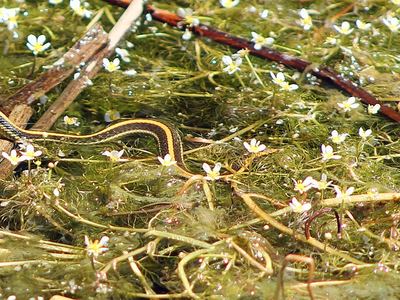
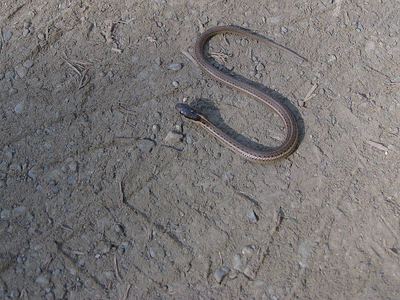
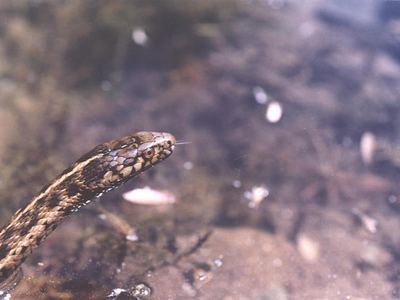
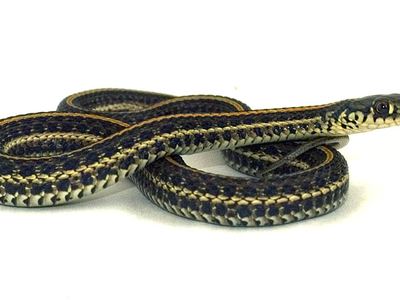
Two-striped garter snake (Thamnophis hammondii)
The two-striped garter snake (genus Thamnophis) is a snake in the family Colubridae with a mild venom for its prey, not dangerous to people. Of the 13 garter snakes and ribbon snakes profiled here, it is listed in fewer states than any other. It is listed in one state only, California, in the Pacific division. Its observation records peak in May.
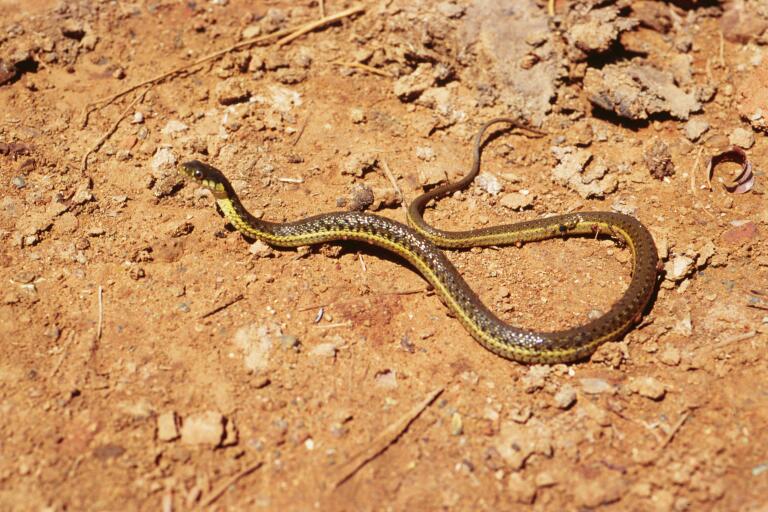

The two-striped garter snake (Thamnophis hammondii) is a species of aquatic snake in the subfamily Natricinae of the family Colubridae. The species is endemic to western North America.
From Wikipedia: Two-striped garter snake, text under CC BY-SA 4.0.
Is the two-striped garter snake poisonous or venomous?
Mildly venomous but not dangerous: the two-striped garter snake has enlarged rear teeth and a mild venom for its prey, and a bite causes at most local swelling, which is why many sources simply call it harmless. It is not a pit viper or coral snake, the only U.S. land snakes with medically dangerous venom. Clean any bite like a small wound.
Are garter snakes venomous?
Only mildly. Every garter snake species (genus Thamnophis) has the same enlarged rear teeth and mild venom for its prey; none is dangerous to people.
Which states have the two-striped garter snake?
| # | State | Records | Share of state snakes | Rank in state |
|---|---|---|---|---|
| 1 | California | 1,630 | 2.2% | 10th of 46 |
When is the two-striped garter snake seen?
Its observation records run mostly March through August.
How recent are the two-striped garter snake records?
| Decade | Records | Share |
|---|---|---|
| 1860s | 2 | 0.1% |
| 1870s | 3 | 0.2% |
| 1880s | 3 | 0.2% |
| 1890s | 30 | 1.9% |
| 1900s | 28 | 1.8% |
| 1910s | 68 | 4.4% |
| 1920s | 155 | 10.0% |
| 1930s | 219 | 14.1% |
| 1940s | 71 | 4.6% |
| 1950s | 37 | 2.4% |
| 1960s | 66 | 4.3% |
| 1970s | 312 | 20.1% |
| 1980s | 191 | 12.3% |
| 1990s | 48 | 3.1% |
| 2000s | 106 | 6.8% |
| 2010s | 56 | 3.6% |
| 2020s | 157 | 10.1% |
Species recorded in the same counties
| Species | Shared counties |
|---|---|
| California kingsnake | 15 |
| Gopher snake | 15 |
| Western rattlesnake venomous | 15 |
| Coachwhip | 12 |
| Striped racer | 12 |
| Coast nightsnake | 11 |
| Glossy snake | 11 |
| Long-nosed snake | 10 |
Related species in the U.S.
GBIF records read 2026-11-05 (open these records on GBIF). Listed: any license. Counted: CC0/CC BY only. How we count.