Long-nosed snake (Rhinocheilus lecontei)
The long-nosed snake (genus Rhinocheilus) is a non-venomous snake in the family Colubridae. Among the 28 small woodland and burrowing snakes profiled here, it ranks 12th by number of states listed. Most of its 9 listed states are in the Mountain (5) census divisions. None is in the Northeast. Its observation records peak in August.
Also called: longnose snake, western long-nosed snake (English names in GBIF)
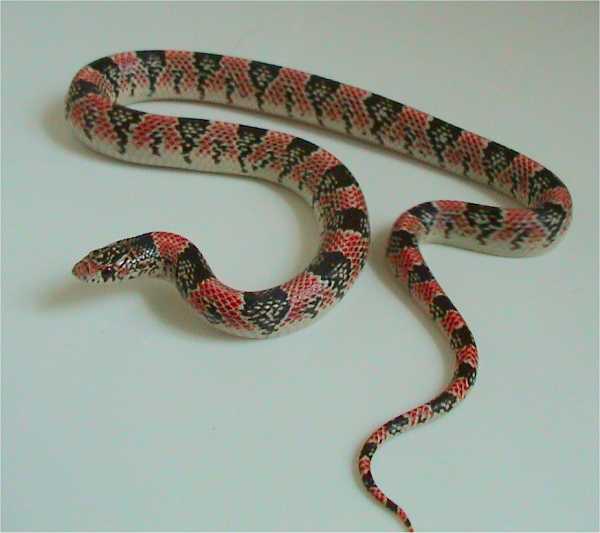

The long-nosed snake (Rhinocheilus lecontei) is a species of nonvenomous snake in the family Colubridae. The species is endemic to North America. It has two recognized subspecies.
From Wikipedia: Long-nosed snake, text under CC BY-SA 4.0.
Is the long-nosed snake poisonous or venomous?
No. The long-nosed snake is non-venomous: it belongs to the family Colubridae, not to the pit vipers or coral snakes, the only U.S. land snakes with medically dangerous venom. It may bite if handled; clean the bite like any small wound.
Often mistaken for
The long-nosed snake is non-venomous, but people often take it for coral snakes (both are recorded in 3 of its 9 states).
Which states have the long-nosed snake?
| # | State | Records | Share of state snakes | Rank in state |
|---|---|---|---|---|
| 1 | Arizona | 1,395 | 6.7% | 4th of 60 |
| 2 | California | 1,015 | 1.4% | 16th of 46 |
| 3 | Texas | 726 | 1.8% | 19th of 86 |
| 4 | Nevada | 263 | 6.3% | 6th of 27 |
| 5 | New Mexico | 173 | 2.6% | 9th of 56 |
| 6 | Kansas | 67 | 0.5% | 34th of 44 |
| 7 | Oklahoma | 30 | 0.2% | 44th of 50 |
| 8 | Utah | 17 | 0.5% | 15th of 28 |
| 9 | Colorado | 3 | 0.1% | 23rd of 26 |
When is the long-nosed snake seen?
Its observation records run mostly April through September.
Season by state
Where the season stays within one calendar year, it starts earliest in March (California) and latest in May (New Mexico). August is the most common peak month (Arizona and New Mexico).
| State | Main season | Peak month | Observation records |
|---|---|---|---|
| Arizona | April through September | August | 142 |
| Texas | April through August | June | 94 |
| California | March through July | May | 51 |
| New Mexico | May through September | August | 39 |
Where the long-nosed snake is recorded in each state
| State | Licensed records | Place among the state's snakes | Most recorded counties |
|---|---|---|---|
| Arizona | 1,395 | 4th of 60 | Pima County (633), Cochise County (221), Maricopa County (205), Pinal County (179) and Santa Cruz County (34) |
| California | 1,015 | 16th of 46 | San Diego County (347), San Bernardino County (209), Riverside County (163), Kern County (86) and Inyo County (45) |
| Texas | 726 | 19th of 86 | Brewster County (102), Tom Green County (41), Hudspeth County (39), Val Verde County (36) and Andrews County (36) |
| Nevada | 263 | 6th of 27 | Clark County (144), Nye County (90), Lincoln County (8), Mineral County (7) and Washoe County (6) |
| New Mexico | 173 | 9th of 56 | Hidalgo County (66), Doña Ana County (25), Grant County (14), Eddy County (14) and Luna County (12) |
| Kansas | 67 | 34th of 44 | Barber County (11), Meade County (11), Comanche County (6), Finney County (6) and Morton County (6) |
| Oklahoma | 30 | 44th of 50 | Ellis County (8), Harmon County (5), Harper County (3), Woodward County (3) and Cimarron County (1) |
Top counties in the U.S.
| # | County | State | Records | Share of U.S. |
|---|---|---|---|---|
| 1 | Pima County | Arizona | 633 | 17.2% |
| 2 | San Diego County | California | 347 | 9.4% |
| 3 | Cochise County | Arizona | 221 | 6.0% |
| 4 | San Bernardino County | California | 209 | 5.7% |
| 5 | Maricopa County | Arizona | 205 | 5.6% |
| 6 | Pinal County | Arizona | 179 | 4.9% |
| 7 | Riverside County | California | 163 | 4.4% |
| 8 | Clark County | Nevada | 144 | 3.9% |
| 9 | Brewster County | Texas | 102 | 2.8% |
| 10 | Nye County | Nevada | 90 | 2.4% |
| 11 | Kern County | California | 86 | 2.3% |
| 12 | Hidalgo County | New Mexico | 66 | 1.8% |
| 13 | Inyo County | California | 45 | 1.2% |
| 14 | Tom Green County | Texas | 41 | 1.1% |
| 15 | Hudspeth County | Texas | 39 | 1.1% |
How recent are the long-nosed snake records?
| Decade | Records | Share |
|---|---|---|
| 1850s | 1 | 0.0% |
| 1870s | 5 | 0.2% |
| 1880s | 2 | 0.1% |
| 1890s | 7 | 0.2% |
| 1900s | 9 | 0.3% |
| 1910s | 16 | 0.5% |
| 1920s | 34 | 1.1% |
| 1930s | 166 | 5.5% |
| 1940s | 196 | 6.5% |
| 1950s | 353 | 11.7% |
| 1960s | 565 | 18.7% |
| 1970s | 470 | 15.5% |
| 1980s | 296 | 9.8% |
| 1990s | 152 | 5.0% |
| 2000s | 214 | 7.1% |
| 2010s | 342 | 11.3% |
| 2020s | 199 | 6.6% |
Species recorded in the same counties
| Species | Shared counties |
|---|---|
| Gopher snake | 83 |
| Glossy snake | 70 |
| Coachwhip | 60 |
| Western ground snake | 45 |
| Prairie rattlesnake venomous | 41 |
| Striped whipsnake | 40 |
| Plains black-headed snake | 37 |
| Western diamondback rattlesnake venomous | 36 |
Related species in the U.S.
GBIF records read 2026-11-05 (open these records on GBIF). Listed: any license. Counted: CC0/CC BY only. How we count.