Giant crab spider (Olios giganteus)
The giant crab spider (genus Olios) is a spider in the family Sparassidae that is not dangerous to people. Its 6 listed states fall in the Mountain (4), West South Central (1) and Pacific (1) census divisions. None is in the Northeast or the Midwest. Its observation records peak in August.
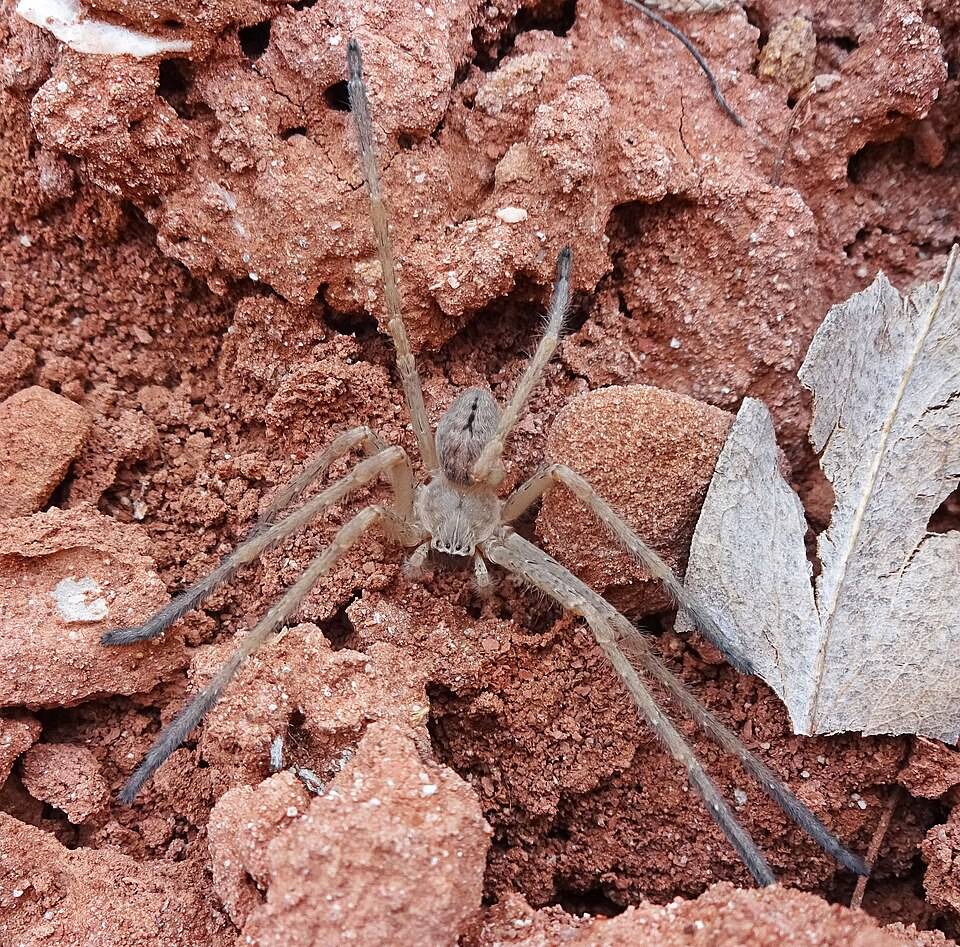

Is the giant crab spider poisonous or venomous?
Not in any medically significant way. Like almost all spiders the giant crab spider (family Sparassidae) has venom for its prey, but it is not a widow or recluse, the two U.S. groups whose bites need medical attention.
Which states have the giant crab spider?
Arizona alone holds 50% of its licensed U.S. records.
| # | State | Records | Share of state spiders | Rank in state |
|---|---|---|---|---|
| 1 | Arizona | 153 | 3.2% | 4th of 161 |
| 2 | Texas | 63 | 0.2% | 89th of 387 |
| 3 | California | 61 | 0.1% | 85th of 312 |
| 4 | New Mexico | 13 | 0.5% | 29th of 248 |
| 5 | Utah | 12 | 0.5% | 23rd of 99 |
| 6 | Nevada | 3 | 0.5% | 23rd of 51 |
When is the giant crab spider seen?
Its observation records run mostly March through November.
Season by state
Where the season stays within one calendar year, it starts earliest in March (Arizona and California) and latest in May (Texas). Each of these states peaks in a different month: April in California, August in Arizona and October in Texas.
| State | Main season | Peak month | Observation records |
|---|---|---|---|
| Arizona | March through November | August | 141 |
| Texas | May through November | October | 63 |
| California | March through November | April | 60 |
Where the giant crab spider is recorded in each state
| State | Licensed records | Place among the state's spiders | Most recorded counties |
|---|---|---|---|
| Arizona | 153 | 4th of 161 | Pima County (86), Cochise County (22), Santa Cruz County (11), Yavapai County (9) and Coconino County (9) |
| Texas | 63 | joint 89th of 387 | Brewster County (17), Edwards County (12), Val Verde County (10), Starr County (8) and Terrell County (3) |
| California | 61 | joint 85th of 312 | Tulare County (17), San Bernardino County (15), Riverside County (7), Shasta County (6) and San Diego County (4) |
Top counties in the U.S.
| # | County | State | Records | Share of U.S. |
|---|---|---|---|---|
| 1 | Pima County | Arizona | 86 | 28.1% |
| 2 | Cochise County | Arizona | 22 | 7.2% |
| 3 | Tulare County | California | 17 | 5.6% |
| 4 | Brewster County | Texas | 17 | 5.6% |
| 5 | San Bernardino County | California | 15 | 4.9% |
| 6 | Edwards County | Texas | 12 | 3.9% |
| 7 | Santa Cruz County | Arizona | 11 | 3.6% |
| 8 | Val Verde County | Texas | 10 | 3.3% |
| 9 | Yavapai County | Arizona | 9 | 2.9% |
| 10 | Coconino County | Arizona | 9 | 2.9% |
| 11 | Maricopa County | Arizona | 9 | 2.9% |
| 12 | Starr County | Texas | 8 | 2.6% |
| 13 | Riverside County | California | 7 | 2.3% |
| 14 | Shasta County | California | 6 | 2.0% |
| 15 | Pinal County | Arizona | 4 | 1.3% |
How recent are the giant crab spider records?
| Decade | Records | Share |
|---|---|---|
| 1950s | 1 | 0.3% |
| 1980s | 1 | 0.3% |
| 1990s | 2 | 0.7% |
| 2000s | 8 | 2.6% |
| 2010s | 39 | 12.8% |
| 2020s | 254 | 83.3% |
Species recorded in the same counties
| Species | Shared counties |
|---|---|
| Western black widow venomous | 18 |
| Western spotted orbweaver | 18 |
| Carolina wolf spider | 14 |
| Green lynx spider | 13 |
| Shoreline wolf spider | 13 |
| Koch's wolf spider | 11 |
| Hirsute paradise spider | 10 |
| Whitebanded crab spider | 10 |
GBIF records read 2026-11-05 (open these records on GBIF). Listed: any license. Counted: CC0/CC BY only. How we count.