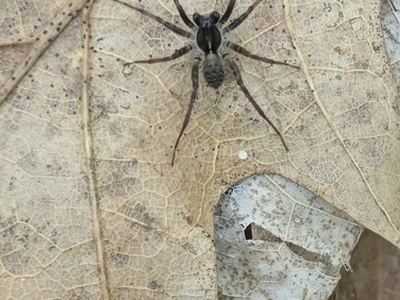
Carolina wolf spider (Hogna carolinensis)
The Carolina wolf spider is a spider in the family Lycosidae that is not dangerous to people. GBIF holds 309 licensed U.S. records of it; it reaches our listing threshold in 19 states, most of all Texas (125), Arizona (80) and New Mexico (23). Its observation records peak in May.
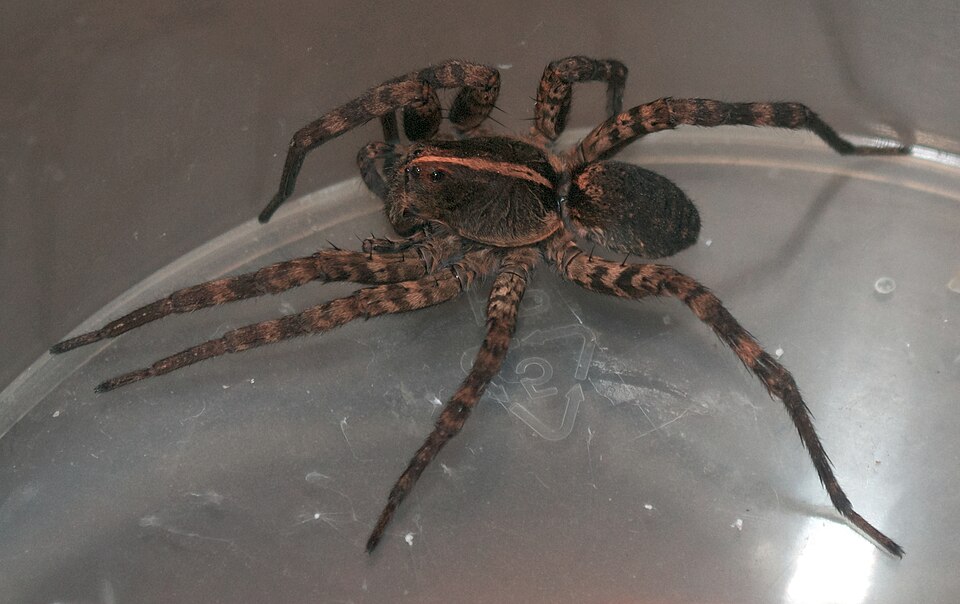

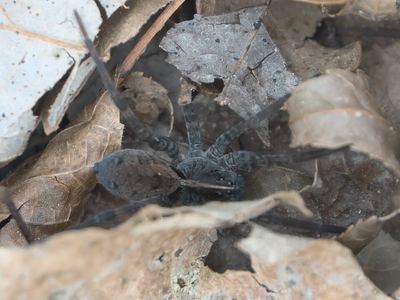
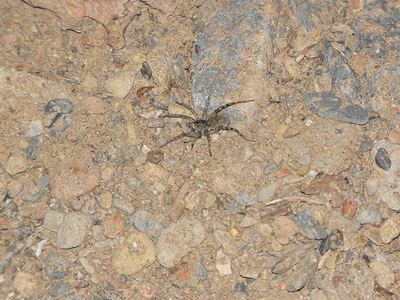
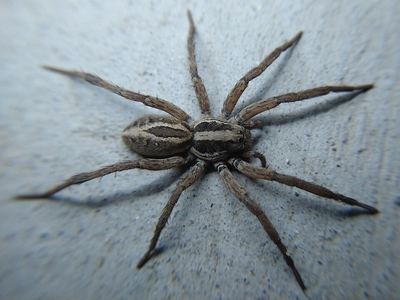
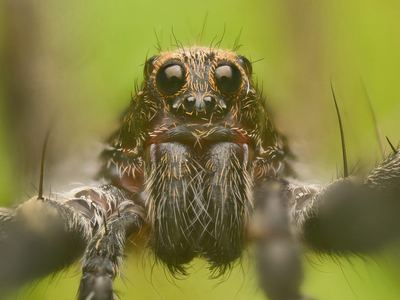
Hogna carolinensis, commonly-known as the Carolina wolf spider and giant wolf spider, is found across North America. It is the largest of the wolf spiders in North America, typically measuring at 18–20 mm (0.7–0.8 in) for males and 22–35 mm (0.9–1.4 in) for females. The Carolina wolf spider is mottled brown with a dark underside.
From Wikipedia: Hogna carolinensis, text under CC BY-SA 4.0.
Is the Carolina wolf spider poisonous or venomous?
Not in any medically significant way. Like almost all spiders the Carolina wolf spider (family Lycosidae) has venom for its prey, but it is not a widow or recluse, the two U.S. groups whose bites need medical attention.
Which states have the Carolina wolf spider?
Records are spread over 19 states; the top three, Texas, Arizona and New Mexico, hold 74% of them.
| # | State | Records | Share of state spiders | Rank in state |
|---|---|---|---|---|
| 1 | Texas | 125 | 0.4% | 47th of 386 |
| 2 | Arizona | 80 | 1.7% | 5th of 162 |
| 3 | New Mexico | 23 | 1.0% | 13th of 247 |
| 4 | Colorado | 21 | 0.5% | 24th of 378 |
| 5 | Florida | 9 | 0.1% | 148th of 237 |
| 6 | Oklahoma | 7 | 0.1% | 88th of 149 |
| 7 | Kansas | 4 | 0.2% | 59th of 94 |
| 8 | Nebraska | 4 | 0.3% | 51st of 71 |
| 9 | Georgia | 3 | 0.0% | 136th of 186 |
| 10 | Iowa | 3 | 0.4% | 33rd of 57 |
| 11 | Montana | 3 | 0.1% | 46th of 75 |
| 12 | Ohio | 3 | 0.0% | 132nd of 332 |
| 13 | South Dakota | 3 | 1.6% | 10th of 29 |
| 14 | Utah | 3 | 0.1% | 58th of 97 |
| 15 | North Carolina | 2 | 0.0% | 154th of 184 |
| 16 | Arkansas | 1 | 0.1% | 94th of 114 |
| 17 | Missouri | 1 | 0.0% | 101st of 117 |
| 18 | Alabama | 0 | — | — |
| 19 | Idaho | 0 | — | — |
When is the Carolina wolf spider seen?
Across the U.S., observation records of the Carolina wolf spider run mostly April through November, peaking in May with 16% of them. Winter (December to February) holds 3% of them.
Season by state
The main season starts in the same month, April, in all 2 states whose main season falls within one calendar year. Each of these states peaks in a different month: May in Arizona and October in Texas.
| State | Main season | Peak month | Observation records |
|---|---|---|---|
| Texas | April through November | October | 108 |
| Arizona | April through October | May | 47 |
Where the Carolina wolf spider is recorded in each state
Texas
Texas holds 125 licensed records, the 47th most recorded of 386 spiders listed there. Its observation records in Texas run mostly April through November, peaking in October; most licensed records come from Mills County, Val Verde County and Sutton County. Next come Brewster County (11) and Jeff Davis County (7).
Arizona
Arizona holds 80 licensed records, the 5th most recorded of 162 spiders listed there. Its observation records in Arizona run mostly April through October, peaking in May; most licensed records come from Pima County, Coconino County and Pinal County. Next come Santa Cruz County (4) and Cochise County (4).
Top counties in the U.S.
| # | County | State | Records | Share of U.S. |
|---|---|---|---|---|
| 1 | Pima County | Arizona | 42 | 13.6% |
| 2 | Coconino County | Arizona | 22 | 7.1% |
| 3 | Mills County | Texas | 16 | 5.2% |
| 4 | Val Verde County | Texas | 16 | 5.2% |
| 5 | Sutton County | Texas | 11 | 3.6% |
| 6 | Brewster County | Texas | 11 | 3.6% |
| 7 | Jeff Davis County | Texas | 7 | 2.3% |
| 8 | Terrell County | Texas | 7 | 2.3% |
| 9 | Starr County | Texas | 6 | 1.9% |
| 10 | Randall County | Texas | 5 | 1.6% |
| 11 | Pinal County | Arizona | 4 | 1.3% |
| 12 | Santa Cruz County | Arizona | 4 | 1.3% |
| 13 | Cochise County | Arizona | 4 | 1.3% |
| 14 | Yavapai County | Arizona | 3 | 1.0% |
| 15 | Kimble County | Texas | 3 | 1.0% |
How recent are the Carolina wolf spider records?
Most of what is known about the Carolina wolf spider is recent: 75% of dated U.S. records were made in 2017–2026, and half date from 2022 or later. The oldest dated record is from 1927; the busiest year was 2024, with 49 records.
| Decade | Records | Share |
|---|---|---|
| 1920s | 2 | 0.7% |
| 1930s | 3 | 1.0% |
| 1950s | 1 | 0.3% |
| 1970s | 2 | 0.7% |
| 1980s | 1 | 0.3% |
| 1990s | 1 | 0.3% |
| 2000s | 7 | 2.3% |
| 2010s | 85 | 27.7% |
| 2020s | 205 | 66.8% |
Species recorded in the same counties
Of the 22 counties where the Carolina wolf spider is most recorded, 14 are also top counties for both the giant crab spider and the western black widow; no other spider shares more. Venomous species among its neighbors: the western black widow.
| Species | Shared counties |
|---|---|
| Giant crab spider | 14 |
| Western black widow venomous | 14 |
| Western spotted orbweaver | 11 |
| Apache jumping spider | 7 |
| Desert blond tarantula | 7 |
| Shoreline wolf spider | 7 |
| Camptocosa parallela | 6 |
| Celer crab spider | 6 |
Related species in the U.S.
Other members of the family Lycosidae with profiles here: Rabid wolf spider, Koch's wolf spider, Wetland giant wolf spider, Georgia wolf spider, Shoreline wolf spider and McCook's split wolf spider.
GBIF records read 2026-09-29. Listed: any license. Counted: CC0/CC BY only. How we count.