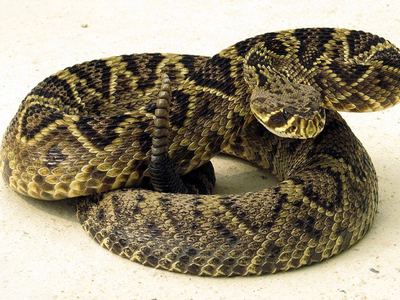
Black-tailed rattlesnake (Crotalus molossus)
The black-tailed rattlesnake (genus Crotalus) is a venomous pit viper in the family Viperidae. Among the 20 rattlesnakes profiled here, it ranks 13th by number of states listed, level with four others. All 2 states where it is listed lie in the Mountain division: Arizona and New Mexico. Its observation records peak in August.
Also called: blacktail rattlesnake, western black-tailed rattlesnake (English names in GBIF)
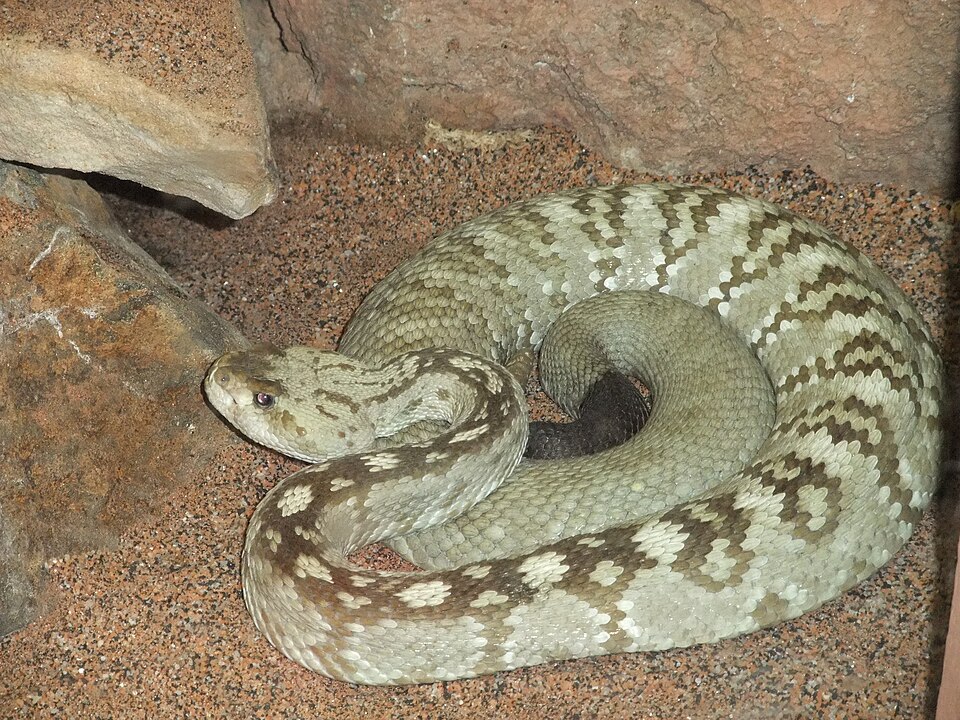

The black-tailed rattlesnake (Crotalus molossus) is a venomous pit viper species found in the southwestern United States and Mexico. Four subspecies are currently recognized, including the nominate subspecies described here.
From Wikipedia: Black-tailed rattlesnake, text under CC BY-SA 4.0.
Is the black-tailed rattlesnake poisonous or venomous?
Yes. The black-tailed rattlesnake is a pit viper (family Viperidae), like every rattlesnake, copperhead and cottonmouth in the U.S.
Is a black-tailed rattlesnake bite dangerous?
Yes. A black-tailed rattlesnake bite needs emergency care: call 911 and keep the bitten limb still. Antivenom is given in hospital.
Rattlesnake vs. gopher snake, hog-nosed snake and rat snake
| Species commonly confused with rattlesnakes | Its states where both are recorded |
|---|---|
| gopher snake | all 2 |
| plains hog-nosed snake | all 2 |
| Great Plains rat snake | 1 of 2 |
Which states have the black-tailed rattlesnake?
Arizona alone holds 83% of its licensed U.S. records.
GBIF records filed under this name in Texas (191) are counted as the eastern black-tailed rattlesnake, the species that lives there.
| # | State | Records | Share of state snakes | Rank in state |
|---|---|---|---|---|
| 1 | Arizona | 730 | 3.5% | 8th of 60 |
| 2 | New Mexico | 152 | 2.3% | 10th of 56 |
When is the black-tailed rattlesnake seen?
Its observation records run mostly April through September.
Season by state
Where the season stays within one calendar year, it starts earliest in May (Arizona) and latest in July (New Mexico). August is the most common peak month (Arizona and New Mexico).
| State | Main season | Peak month | Observation records |
|---|---|---|---|
| Arizona | May through September | August | 232 |
| New Mexico | July through October | August | 31 |
Where the black-tailed rattlesnake is recorded in each state
| State | Licensed records | Place among the state's snakes | Most recorded counties |
|---|---|---|---|
| Arizona | 730 | joint 8th of 60 | Cochise County (297), Pima County (129), Santa Cruz County (102), Yavapai County (43) and Maricopa County (39) |
| New Mexico | 152 | 10th of 56 | Hidalgo County (45), Grant County (34), Catron County (15), Doña Ana County (14) and Eddy County (14) |
Top counties in the U.S.
| # | County | State | Records | Share of U.S. |
|---|---|---|---|---|
| 1 | Cochise County | Arizona | 297 | 33.7% |
| 2 | Pima County | Arizona | 129 | 14.6% |
| 3 | Santa Cruz County | Arizona | 102 | 11.6% |
| 4 | Hidalgo County | New Mexico | 45 | 5.1% |
| 5 | Yavapai County | Arizona | 43 | 4.9% |
| 6 | Maricopa County | Arizona | 39 | 4.4% |
| 7 | Grant County | New Mexico | 34 | 3.9% |
| 8 | Gila County | Arizona | 30 | 3.4% |
| 9 | Graham County | Arizona | 28 | 3.2% |
| 10 | Pinal County | Arizona | 19 | 2.2% |
| 11 | Catron County | New Mexico | 15 | 1.7% |
| 12 | Doña Ana County | New Mexico | 14 | 1.6% |
| 13 | Eddy County | New Mexico | 14 | 1.6% |
| 14 | Greenlee County | Arizona | 13 | 1.5% |
| 15 | Navajo County | Arizona | 11 | 1.2% |
How recent are the black-tailed rattlesnake records?
| Decade | Records | Share |
|---|---|---|
| 1890s | 3 | 0.4% |
| 1900s | 4 | 0.6% |
| 1910s | 20 | 2.8% |
| 1920s | 28 | 4.0% |
| 1930s | 56 | 8.0% |
| 1940s | 16 | 2.3% |
| 1950s | 33 | 4.7% |
| 1960s | 63 | 9.0% |
| 1970s | 50 | 7.1% |
| 1980s | 54 | 7.7% |
| 1990s | 45 | 6.4% |
| 2000s | 50 | 7.1% |
| 2010s | 98 | 14.0% |
| 2020s | 182 | 25.9% |
Species recorded in the same counties
| Species | Shared counties |
|---|---|
| Gopher snake | 24 |
| Ring-necked snake | 23 |
| Glossy snake | 21 |
| Long-nosed snake | 21 |
| Striped whipsnake | 20 |
| Western diamondback rattlesnake venomous | 20 |
| Blackneck garter snake | 19 |
| Western ground snake | 18 |
Related species in the U.S.
GBIF records read 2026-11-05 (open these records on GBIF). Listed: any license. Counted: CC0/CC BY only. How we count.