Chihuahuan night snake (Hypsiglena jani)
The Chihuahuan night snake (genus Hypsiglena) is a snake in the family Colubridae with a mild venom for its prey, not dangerous to people. Among the 28 small woodland and burrowing snakes profiled here, it ranks 17th by number of states listed, level with one other. Its 6 listed states fall in the Mountain (3), West South Central (2) and West North Central (1) census divisions. None is in the Northeast. Its observation records peak in June.
Also called: san luis potosi nightsnake (English names in GBIF). Also spelled: san luis potosi night snake
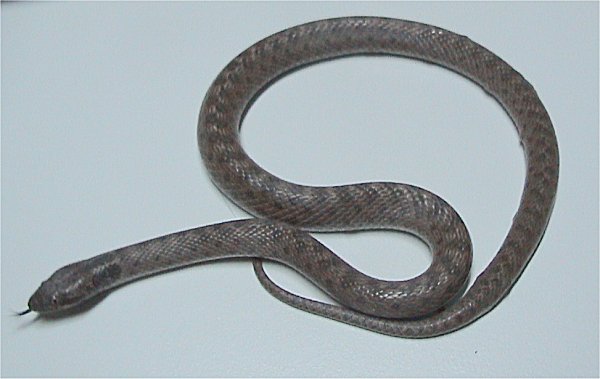

Hypsiglena jani, commonly known as the Texas night snake or the Chihuahuan night snake, is a small species of mildly venomous snake in the subfamily Dipsadinae of the family Colubridae. The species is native to the southwestern United States and adjacent northeastern Mexico.
From Wikipedia: Hypsiglena jani, text under CC BY-SA 4.0.
Is the Chihuahuan night snake poisonous or venomous?
Mildly venomous but not dangerous: the Chihuahuan night snake has enlarged rear teeth and a mild venom for its prey, and a bite causes at most local swelling, which is why many sources simply call it harmless. It is not a pit viper or coral snake, the only U.S. land snakes with medically dangerous venom. Clean any bite like a small wound.
Which states have the Chihuahuan night snake?
Texas alone holds 78% of its licensed U.S. records.
The count includes 14 records filed under the older name Hypsiglena ochrorhynchus in Texas and 359 records filed under the older name Hypsiglena torquata in Kansas (18), Oklahoma (14) and Texas (327).
| # | State | Records | Share of state snakes | Rank in state |
|---|---|---|---|---|
| 1 | Texas | 594 | 1.4% | 22nd of 86 |
| 2 | Oklahoma | 83 | 0.6% | 31st of 50 |
| 3 | New Mexico | 48 | 0.7% | 24th of 56 |
| 4 | Kansas | 27 | 0.2% | 38th of 44 |
| 5 | Arizona | 5 | 0.0% | 59th of 60 |
| 6 | Colorado | 2 | 0.1% | 24th of 26 |
When is the Chihuahuan night snake seen?
Its observation records run mostly April through September.
Where the Chihuahuan night snake is recorded in each state
| State | Licensed records | Place among the state's snakes | Most recorded counties |
|---|---|---|---|
| Texas | 594 | 22nd of 86 | Brewster County (137), Val Verde County (41), El Paso County (38), Presidio County (37) and Hudspeth County (33) |
| Oklahoma | 83 | joint 31st of 50 | Beckham County (21), Comanche County (16), Greer County (16), Ellis County (6) and Harmon County (6) |
| New Mexico | 48 | 24th of 56 | Hidalgo County (13), Doña Ana County (9), Socorro County (8), Otero County (4) and Sierra County (4) |
Top counties in the U.S.
| # | County | State | Records | Share of U.S. |
|---|---|---|---|---|
| 1 | Brewster County | Texas | 137 | 18.1% |
| 2 | Val Verde County | Texas | 41 | 5.4% |
| 3 | El Paso County | Texas | 38 | 5.0% |
| 4 | Presidio County | Texas | 37 | 4.9% |
| 5 | Hudspeth County | Texas | 33 | 4.3% |
| 6 | Beckham County | Oklahoma | 21 | 2.8% |
| 7 | Jeff Davis County | Texas | 19 | 2.5% |
| 8 | Comanche County | Oklahoma | 16 | 2.1% |
| 9 | Greer County | Oklahoma | 16 | 2.1% |
| 10 | Hidalgo County | New Mexico | 13 | 1.7% |
| 11 | Culberson County | Texas | 13 | 1.7% |
| 12 | Terrell County | Texas | 11 | 1.4% |
| 13 | Tom Green County | Texas | 11 | 1.4% |
| 14 | Garza County | Texas | 11 | 1.4% |
| 15 | Denton County | Texas | 10 | 1.3% |
How recent are the Chihuahuan night snake records?
| Decade | Records | Share |
|---|---|---|
| 1890s | 1 | 0.1% |
| 1900s | 1 | 0.1% |
| 1910s | 2 | 0.3% |
| 1920s | 3 | 0.4% |
| 1930s | 15 | 2.1% |
| 1940s | 17 | 2.4% |
| 1950s | 83 | 11.9% |
| 1960s | 123 | 17.6% |
| 1970s | 95 | 13.6% |
| 1980s | 65 | 9.3% |
| 1990s | 62 | 8.9% |
| 2000s | 73 | 10.4% |
| 2010s | 118 | 16.9% |
| 2020s | 42 | 6.0% |
Species recorded in the same counties
| Species | Shared counties |
|---|---|
| Gopher snake | 65 |
| Western massasauga venomous | 35 |
| Long-nosed snake | 33 |
| Plains black-headed snake | 33 |
| Glossy snake | 31 |
| Western ground snake | 27 |
| Coachwhip | 26 |
| Western diamondback rattlesnake venomous | 25 |
Related species in the U.S.
GBIF records read 2026-11-05 (open these records on GBIF). Listed: any license. Counted: CC0/CC BY only. How we count.