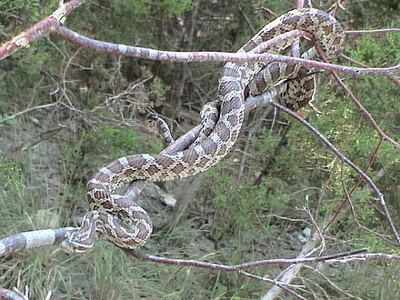
Eastern fox snake (Pantherophis vulpinus)
The eastern fox snake (genus Pantherophis) is a non-venomous snake in the family Colubridae. Among the six rat snakes and corn snakes profiled here, it ranks 3rd by number of states listed, level with one other. Its 9 listed states fall in the East North Central (5) and West North Central (4) census divisions. None is in the Northeast, the South or the West. Its observation records peak in May.
Also called: pine foxsnake (English names in GBIF). Also spelled: pine fox snake
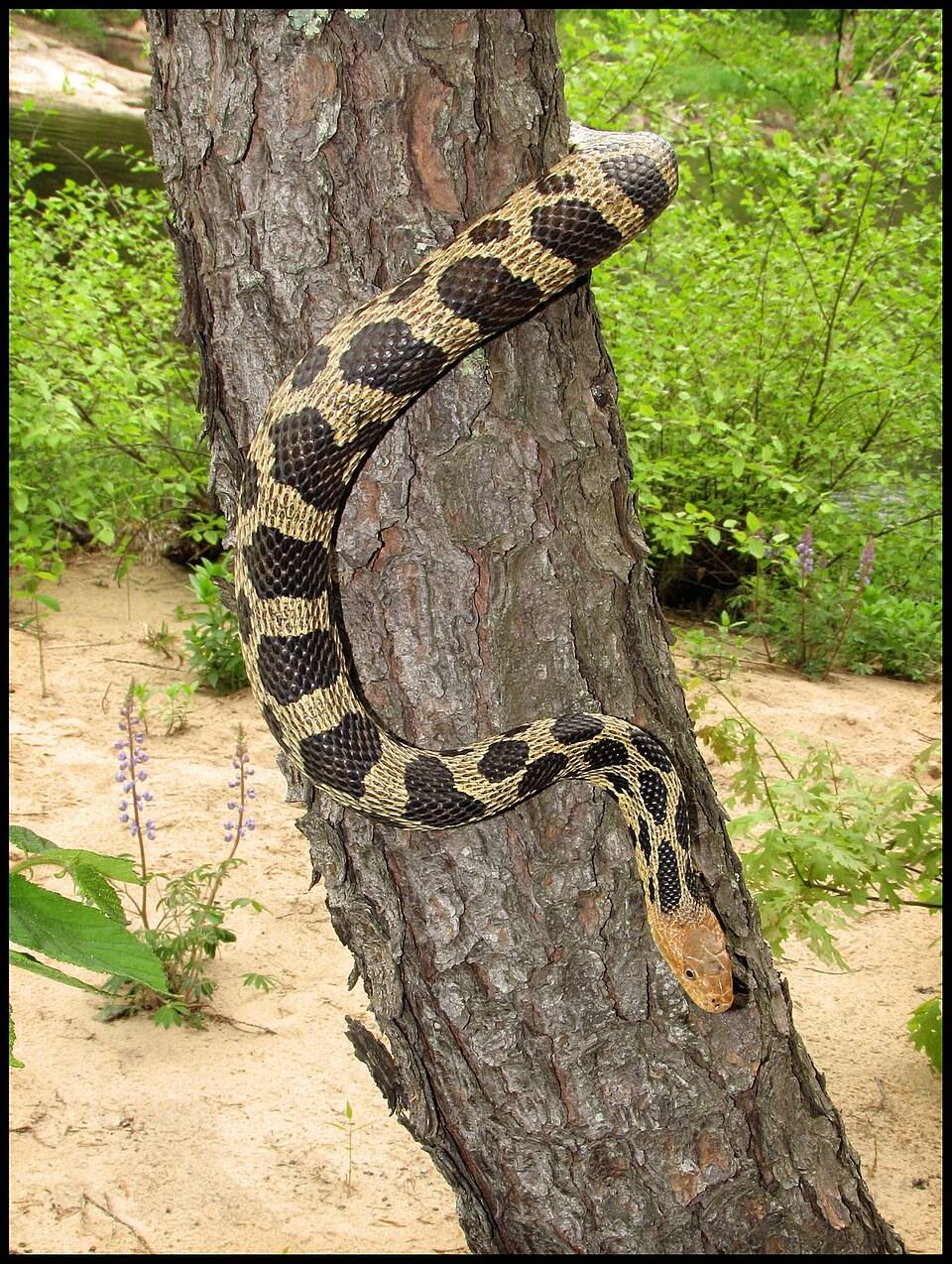

Pantherophis vulpinus, commonly known as the foxsnake or the eastern fox snake, is a species of nonvenomous rat snake in the family Colubridae. The species is native to North America.
From Wikipedia: Pantherophis vulpinus, text under CC BY-SA 4.0.
Is the eastern fox snake poisonous or venomous?
No. The eastern fox snake is non-venomous: it belongs to the family Colubridae, not to the pit vipers or coral snakes, the only U.S. land snakes with medically dangerous venom. It may bite if handled; clean the bite like any small wound.
Often mistaken for
The eastern fox snake is non-venomous, but people often take it for rattlesnakes (both are recorded in 9 of its 9 states).
Which states have the eastern fox snake?
| # | State | Records | Share of state snakes | Rank in state |
|---|---|---|---|---|
| 1 | Ohio | 127 | 2.0% | 9th of 25 |
| 2 | Illinois | 88 | 3.0% | 8th of 34 |
| 3 | Wisconsin | 80 | 7.8% | 4th of 16 |
| 4 | Michigan | 68 | 1.3% | 13th of 17 |
| 5 | Iowa | 48 | 4.5% | 7th of 22 |
| 6 | South Dakota | 31 | 1.0% | 12th of 16 |
| 7 | Indiana | 29 | 1.3% | 18th of 27 |
| 8 | Nebraska | 15 | 0.6% | 23rd of 32 |
| 9 | Minnesota | 10 | 1.1% | 14th of 15 |
When is the eastern fox snake seen?
Its observation records run mostly April through September.
Season by state
Where the season stays within one calendar year, it starts earliest in April (Illinois and Wisconsin) and latest in May (Ohio). May is the most common peak month (Ohio and Wisconsin).
| State | Main season | Peak month | Observation records |
|---|---|---|---|
| Illinois | April through October | June | 70 |
| Ohio | May through September | May | 55 |
| Wisconsin | April through September | May | 47 |
Where the eastern fox snake is recorded in each state
| State | Licensed records | Place among the state's snakes | Most recorded counties |
|---|---|---|---|
| Ohio | 127 | 9th of 25 | Erie County (36), Lucas County (28), Ottawa County (21), Wyandot County (2) and Delaware County (1) |
| Illinois | 88 | joint 8th of 34 | Will County (29), DuPage County (10), Champaign County (7), Cook County (7) and McHenry County (7) |
| Wisconsin | 80 | 4th of 16 | Door County (8), Dunn County (7), Green Lake County (7), La Crosse County (5) and Manitowoc County (5) |
| Michigan | 68 | 13th of 17 | Monroe County (14), Delta County (10), Huron County (8), Wayne County (8) and Schoolcraft County (6) |
| Iowa | 48 | 7th of 22 | Story County (6), Jones County (4), Woodbury County (4), Louisa County (3) and Franklin County (2) |
| South Dakota | 31 | joint 12th of 16 | Clay County (23), Union County (6) and Bon Homme County (2) |
Top counties in the U.S.
| # | County | State | Records | Share of U.S. |
|---|---|---|---|---|
| 1 | Erie County | Ohio | 36 | 7.2% |
| 2 | Will County | Illinois | 29 | 5.8% |
| 3 | Lucas County | Ohio | 28 | 5.6% |
| 4 | Clay County | South Dakota | 23 | 4.6% |
| 5 | Ottawa County | Ohio | 21 | 4.2% |
| 6 | Monroe County | Michigan | 14 | 2.8% |
| 7 | DuPage County | Illinois | 10 | 2.0% |
| 8 | Delta County | Michigan | 10 | 2.0% |
| 9 | Huron County | Michigan | 8 | 1.6% |
| 10 | Wayne County | Michigan | 8 | 1.6% |
| 11 | Door County | Wisconsin | 8 | 1.6% |
| 12 | Champaign County | Illinois | 7 | 1.4% |
| 13 | Cook County | Illinois | 7 | 1.4% |
| 14 | McHenry County | Illinois | 7 | 1.4% |
| 15 | Dunn County | Wisconsin | 7 | 1.4% |
How recent are the eastern fox snake records?
| Decade | Records | Share |
|---|---|---|
| 1870s | 1 | 0.2% |
| 1890s | 2 | 0.4% |
| 1900s | 22 | 4.8% |
| 1910s | 7 | 1.5% |
| 1920s | 14 | 3.1% |
| 1930s | 32 | 7.0% |
| 1940s | 36 | 7.9% |
| 1950s | 37 | 8.1% |
| 1960s | 31 | 6.8% |
| 1970s | 37 | 8.1% |
| 1980s | 20 | 4.4% |
| 1990s | 6 | 1.3% |
| 2000s | 9 | 2.0% |
| 2010s | 51 | 11.2% |
| 2020s | 150 | 33.0% |
Species recorded in the same counties
| Species | Shared counties |
|---|---|
| DeKay's brown snake | 30 |
| Common garter snake | 28 |
| Smooth green snake | 21 |
| Northern water snake | 20 |
| Red-bellied snake | 17 |
| Plains garter snake | 16 |
| Ring-necked snake | 15 |
| Eastern racer | 13 |
Related species in the U.S.
GBIF records read 2026-11-05 (open these records on GBIF). Listed: any license. Counted: CC0/CC BY only. How we count.