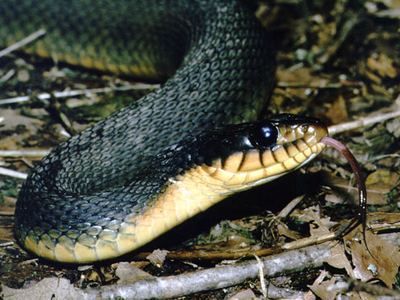
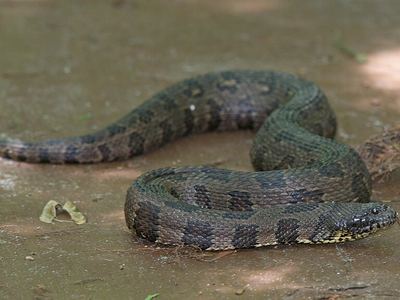
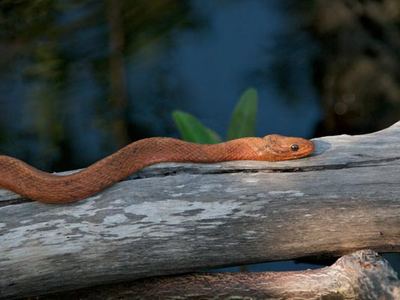
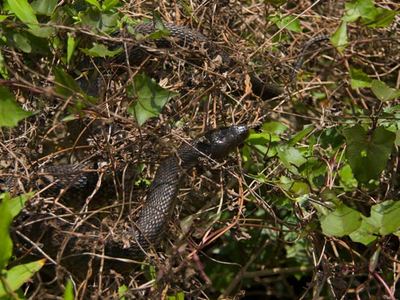
Green water snake (Nerodia cyclopion)
The green water snake is a non-venomous snake in the family Colubridae. GBIF holds 791 licensed U.S. records of it; it reaches our listing threshold in 8 states, most of all Louisiana (450), Texas (141) and Florida (111). Its observation records peak in March.
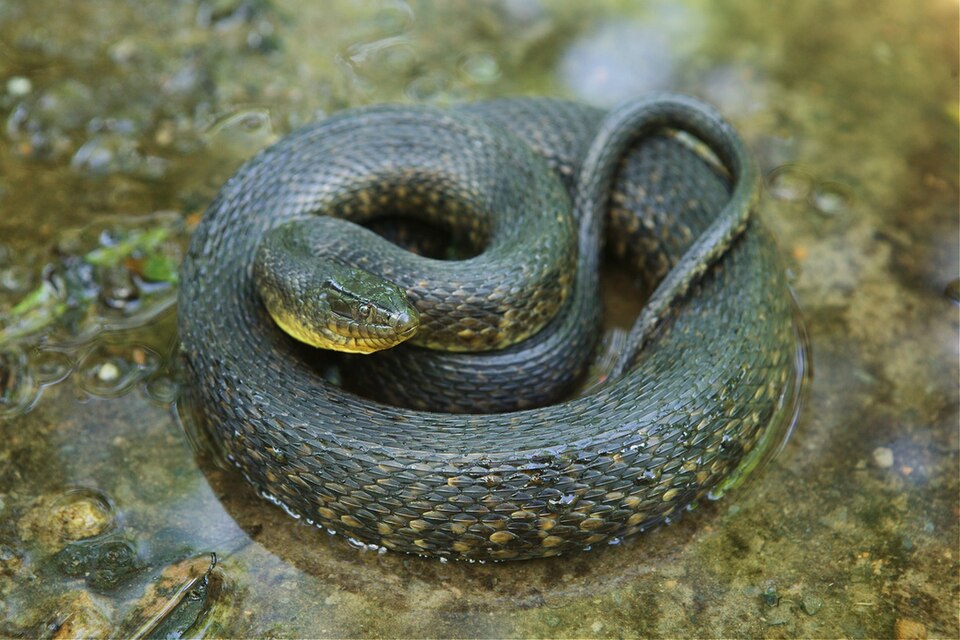

The green water snake (Nerodia cyclopion) is a common species of nonvenomous natricine snake endemic to the southeastern United States.
From Wikipedia: Green water snake, text under CC BY-SA 4.0.
Is the green water snake poisonous or venomous?
No. The green water snake is non-venomous: it belongs to the family Colubridae, not to the pit vipers or coral snakes, the only U.S. land snakes with medically dangerous venom. It may bite if handled; clean the bite like any small wound.
Often mistaken for
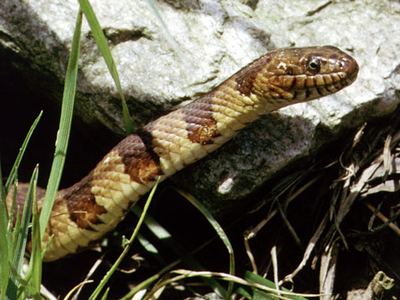
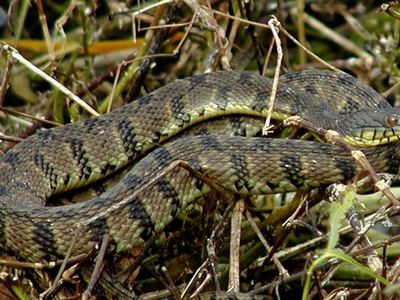
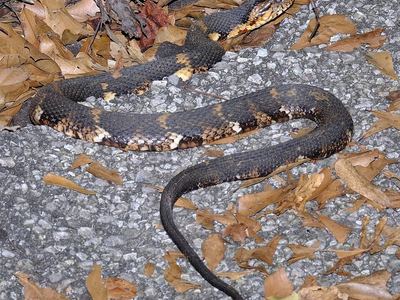
The green water snake is non-venomous, but people often take it for cottonmouths (both are recorded in 8 of its 8 states).
Which states have the green water snake?
The green water snake's U.S. record is concentrated: Louisiana alone holds 57% of licensed records. It is listed in 8 states in all; the next are Texas (141), Florida (111) and Alabama (30).
| # | State | Records | Share of state snakes | Rank in state |
|---|---|---|---|---|
| 1 | Louisiana | 450 | 9.0% | 3rd of 41 |
| 2 | Texas | 141 | 0.3% | 51st of 86 |
| 3 | Florida | 111 | 0.5% | 27th of 49 |
| 4 | Alabama | 30 | 0.5% | 34th of 44 |
| 5 | Mississippi | 25 | 1.3% | 21st of 38 |
| 6 | Arkansas | 12 | 0.2% | 28th of 36 |
| 7 | Missouri | 10 | 0.5% | 31st of 36 |
| 8 | Illinois | 4 | 0.1% | 31st of 33 |
When is the green water snake seen?
Across the U.S., observation records of the green water snake run mostly February through October, peaking in March with 24% of them. Winter (December to February) holds 19% of them.
Season by state
Among states whose main season falls within one calendar year, it starts earliest in January (Louisiana) and latest in March (Texas). Each of these states peaks in a different month: March in Texas and April in Louisiana.
| State | Main season | Peak month | Observation records |
|---|---|---|---|
| Louisiana | January through May | April | 62 |
| Texas | March through August | March | 44 |
Where the green water snake is recorded in each state
Louisiana
Louisiana holds 450 licensed records, the 3rd most recorded of 41 snakes listed there. Its observation records in Louisiana run mostly January through May, peaking in April; most licensed records come from Iberville Parish, Saint James Parish and Saint Mary Parish. Next come Cameron Parish (39) and Saint Tammany Parish (33).
Texas
Texas holds 141 licensed records, the 51st most recorded of 86 snakes listed there. Its observation records in Texas run mostly March through August, peaking in March; most licensed records come from Chambers County, Jefferson County and Brazoria County. Next come Fort Bend County (7) and Harris County (6).
Florida
Florida holds 111 licensed records, the 27th most recorded of 49 snakes listed there. Most of its licensed records in Florida come from Orange County, Escambia County and Miami-Dade County. Next come Pinellas County (6) and Alachua County (5).
Alabama
Alabama holds 30 licensed records, the joint 34th most recorded of 44 snakes listed there. Most of its licensed records in Alabama come from Baldwin County and Mobile County.
Top counties in the U.S.
| # | County | State | Records | Share of U.S. |
|---|---|---|---|---|
| 1 | Orange County | Florida | 61 | 7.7% |
| 2 | Iberville Parish | Louisiana | 61 | 7.7% |
| 3 | Saint James Parish | Louisiana | 61 | 7.7% |
| 4 | Chambers County | Texas | 50 | 6.3% |
| 5 | Saint Mary Parish | Louisiana | 47 | 5.9% |
| 6 | Jefferson County | Texas | 46 | 5.8% |
| 7 | Cameron Parish | Louisiana | 39 | 4.9% |
| 8 | Saint Tammany Parish | Louisiana | 33 | 4.2% |
| 9 | Livingston Parish | Louisiana | 32 | 4.0% |
| 10 | East Baton Rouge Parish | Louisiana | 29 | 3.7% |
| 11 | Baldwin County | Alabama | 25 | 3.2% |
| 12 | Plaquemines Parish | Louisiana | 21 | 2.7% |
| 13 | Saint John the Baptist Parish | Louisiana | 19 | 2.4% |
| 14 | Jefferson Parish | Louisiana | 16 | 2.0% |
| 15 | Iberia Parish | Louisiana | 13 | 1.6% |
How recent are the green water snake records?
The green water snake record leans on older material: only 22% of dated U.S. records come from 2017–2026, and the median record is from 1985. The oldest dated record is from 1860; the busiest year was 1945, with 58 records.
| Decade | Records | Share |
|---|---|---|
| 1860s | 1 | 0.2% |
| 1900s | 1 | 0.2% |
| 1910s | 14 | 2.4% |
| 1920s | 18 | 3.1% |
| 1930s | 14 | 2.4% |
| 1940s | 96 | 16.5% |
| 1950s | 31 | 5.3% |
| 1960s | 54 | 9.3% |
| 1970s | 47 | 8.1% |
| 1980s | 85 | 14.6% |
| 1990s | 62 | 10.6% |
| 2000s | 19 | 3.3% |
| 2010s | 34 | 5.8% |
| 2020s | 107 | 18.4% |
Species recorded in the same counties
Of the 46 counties where the green water snake is most recorded, 25 are also top counties for the northern cottonmouth, more than for any other snake. Venomous species among its neighbors: the northern cottonmouth.
| Species | Shared counties |
|---|---|
| Northern cottonmouth venomous | 25 |
| Mud snake | 24 |
| Southern watersnake | 24 |
| Common garter snake | 19 |
| DeKay's brown snake | 19 |
| Rough greensnake | 18 |
| Crayfish snake | 17 |
| Eastern racer | 17 |
Related species in the U.S.
Other species of the genus Nerodia with profiles here: Northern water snake, Diamondback water snake, Southern watersnake, Plain-bellied watersnake, Brown water snake, Salt marsh snake and Florida green water snake.
GBIF records read 2026-09-29. Listed: any license. Counted: CC0/CC BY only. How we count.