Lined snake (Tropidoclonion lineatum)
The lined snake (genus Tropidoclonion) is a non-venomous snake in the family Colubridae. Among the 28 small woodland and burrowing snakes profiled here, it ranks 8th by number of states listed, level with three others. Most of its 10 listed states are in the West North Central (5) and West South Central (2) census divisions. None is in the Northeast. Its observation records peak in May.
Also called: Mertens' lined snake (English names in GBIF)
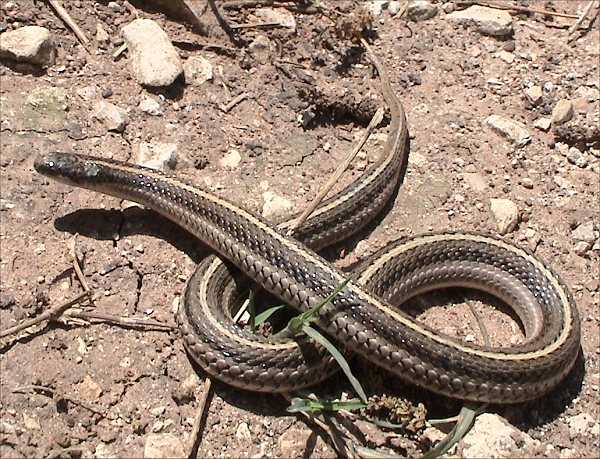

Is the lined snake poisonous or venomous?
No. The lined snake is non-venomous: it belongs to the family Colubridae, not to the pit vipers or coral snakes, the only U.S. land snakes with medically dangerous venom. It may bite if handled; clean the bite like any small wound.
Which states have the lined snake?
| # | State | Records | Share of state snakes | Rank in state |
|---|---|---|---|---|
| 1 | Oklahoma | 481 | 3.6% | 10th of 50 |
| 2 | Kansas | 480 | 3.3% | 10th of 44 |
| 3 | Texas | 287 | 0.7% | 37th of 86 |
| 4 | New Mexico | 68 | 1.0% | 20th of 56 |
| 5 | Nebraska | 61 | 2.5% | 11th of 32 |
| 6 | Missouri | 29 | 1.5% | 21st of 36 |
| 7 | Colorado | 21 | 0.6% | 14th of 26 |
| 8 | South Dakota | 20 | 0.6% | 14th of 16 |
| 9 | Iowa | 13 | 1.2% | 19th of 22 |
| 10 | Illinois | 10 | 0.3% | 30th of 34 |
When is the lined snake seen?
Its observation records run mostly April through October.
Where the lined snake is recorded in each state
| State | Licensed records | Place among the state's snakes | Most recorded counties |
|---|---|---|---|
| Oklahoma | 481 | 10th of 50 | Okmulgee County (256), Tulsa County (112), Pottawatomie County (22), Cleveland County (17) and Payne County (11) |
| Kansas | 480 | 10th of 44 | Cowley County (70), Russell County (48), Jewell County (32), Chase County (28) and Leavenworth County (20) |
| Texas | 287 | 37th of 86 | McLennan County (24), Tarrant County (23), Dallas County (23), Travis County (21) and Grayson County (18) |
| New Mexico | 68 | 20th of 56 | Mora County (25), San Miguel County (23), Bernalillo County (7), Union County (5) and Guadalupe County (4) |
| Nebraska | 61 | 11th of 32 | Jefferson County (21), Lancaster County (18), Pawnee County (6), Gage County (4) and Richardson County (3) |
Top counties in the U.S.
| # | County | State | Records | Share of U.S. |
|---|---|---|---|---|
| 1 | Okmulgee County | Oklahoma | 256 | 17.3% |
| 2 | Tulsa County | Oklahoma | 112 | 7.6% |
| 3 | Cowley County | Kansas | 70 | 4.7% |
| 4 | Russell County | Kansas | 48 | 3.2% |
| 5 | Jewell County | Kansas | 32 | 2.2% |
| 6 | Chase County | Kansas | 28 | 1.9% |
| 7 | Mora County | New Mexico | 25 | 1.7% |
| 8 | McLennan County | Texas | 24 | 1.6% |
| 9 | San Miguel County | New Mexico | 23 | 1.6% |
| 10 | Tarrant County | Texas | 23 | 1.6% |
| 11 | Dallas County | Texas | 23 | 1.6% |
| 12 | Pottawatomie County | Oklahoma | 22 | 1.5% |
| 13 | Jefferson County | Nebraska | 21 | 1.4% |
| 14 | Travis County | Texas | 21 | 1.4% |
| 15 | Leavenworth County | Kansas | 20 | 1.4% |
How recent are the lined snake records?
| Decade | Records | Share |
|---|---|---|
| 1870s | 1 | 0.1% |
| 1880s | 2 | 0.1% |
| 1900s | 5 | 0.4% |
| 1910s | 9 | 0.6% |
| 1920s | 138 | 9.9% |
| 1930s | 254 | 18.2% |
| 1940s | 86 | 6.2% |
| 1950s | 206 | 14.8% |
| 1960s | 192 | 13.8% |
| 1970s | 108 | 7.8% |
| 1980s | 81 | 5.8% |
| 1990s | 48 | 3.4% |
| 2000s | 53 | 3.8% |
| 2010s | 75 | 5.4% |
| 2020s | 134 | 9.6% |
Species recorded in the same counties
| Species | Shared counties |
|---|---|
| Gopher snake | 31 |
| Common garter snake | 29 |
| Speckled kingsnake | 27 |
| Ring-necked snake | 26 |
| Western massasauga venomous | 25 |
| Eastern racer | 21 |
| Western rat snake | 19 |
| Western ground snake | 18 |
Related species in the U.S.
GBIF records read 2026-11-05 (open these records on GBIF). Listed: any license. Counted: CC0/CC BY only. How we count.