Northern yellow sac spider (Cheiracanthium mildei)
The northern yellow sac spider is a spider in the family Cheiracanthiidae that is not dangerous to people. GBIF holds 394 licensed U.S. records of it; it reaches our listing threshold in 23 states, most of all California (234), Michigan (21) and Pennsylvania (20). Its observation records peak in May.
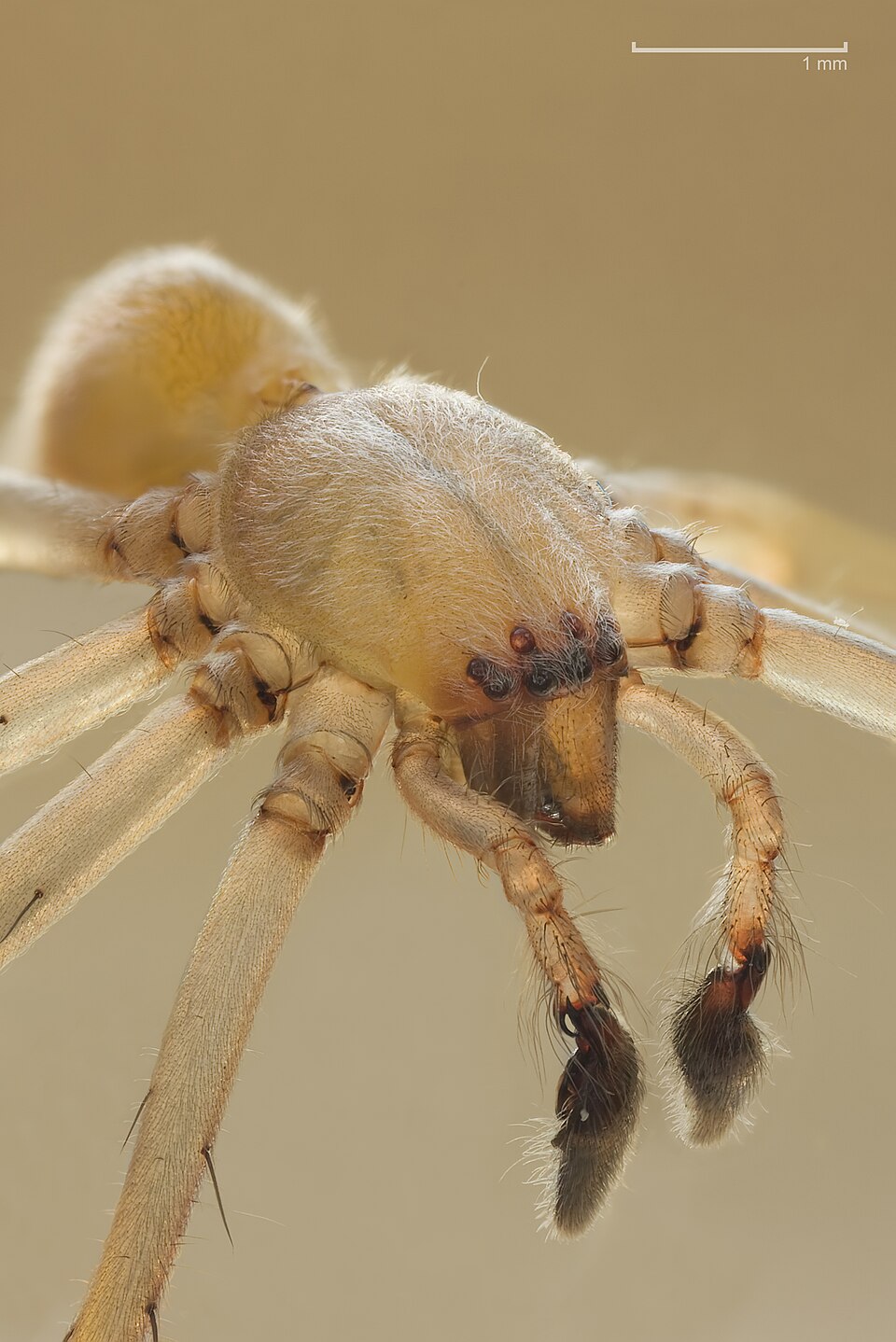

Cheiracanthium mildei is a species of spider from the family Cheiracanthiidae. C. mildei is commonly known as the northern yellow sac spider, a name it partially shares with many other spiders of its genus. Alternatively, it is also called the long-legged sac spider.
From Wikipedia: Cheiracanthium mildei, text under CC BY-SA 4.0.
Is the northern yellow sac spider poisonous or venomous?
Not in any medically significant way. Like almost all spiders the northern yellow sac spider (family Cheiracanthiidae) has venom for its prey, but it is not a widow or recluse, the two U.S. groups whose bites need medical attention.
Which states have the northern yellow sac spider?
The northern yellow sac spider's U.S. record is concentrated: California alone holds 59% of licensed records. It is listed in 23 states in all; the next are Michigan (21), Pennsylvania (20) and New York (18).
| # | State | Records | Share of state spiders | Rank in state |
|---|---|---|---|---|
| 1 | California | 234 | 0.5% | 34th of 309 |
| 2 | Michigan | 21 | 0.9% | 28th of 122 |
| 3 | Pennsylvania | 20 | 0.3% | 58th of 164 |
| 4 | New York | 18 | 0.3% | 62nd of 149 |
| 5 | Illinois | 15 | 0.1% | 155th of 243 |
| 6 | Indiana | 10 | 0.2% | 85th of 133 |
| 7 | Massachusetts | 10 | 0.2% | 77th of 189 |
| 8 | Delaware | 8 | 0.4% | 53rd of 71 |
| 9 | Ohio | 8 | 0.1% | 96th of 332 |
| 10 | New Jersey | 6 | 0.3% | 69th of 127 |
| 11 | Oregon | 6 | 0.2% | 46th of 88 |
| 12 | Washington | 6 | 0.2% | 69th of 157 |
| 13 | Wisconsin | 5 | 0.2% | 102nd of 149 |
| 14 | Maryland | 4 | 0.1% | 118th of 153 |
| 15 | Utah | 3 | 0.1% | 58th of 97 |
| 16 | Vermont | 3 | 0.2% | 46th of 74 |
| 17 | Colorado | 2 | 0.0% | 117th of 378 |
| 18 | Idaho | 2 | 0.4% | 32nd of 56 |
| 19 | Maine | 2 | 0.2% | 46th of 297 |
| 20 | Connecticut | 1 | 0.1% | 69th of 86 |
| 21 | Virginia | 1 | 0.0% | 167th of 176 |
| 22 | Rhode Island | 0 | — | — |
| 23 | Texas | 0 | — | — |
When is the northern yellow sac spider seen?
Across the U.S., observation records of the northern yellow sac spider run through most of the year, peaking in May with 16% of them. Winter (December to February) holds 23% of them.
How recent are the northern yellow sac spider records?
Records of the northern yellow sac spider span old collections and new observations: 50% date from 2017–2026, and the median record is from 2016. The oldest dated record is from 1965; the busiest year was 2002, with 84 records.
| Decade | Records | Share |
|---|---|---|
| 1960s | 2 | 0.5% |
| 1980s | 1 | 0.3% |
| 2000s | 137 | 35.1% |
| 2010s | 117 | 30.0% |
| 2020s | 133 | 34.1% |
Species recorded in the same counties
Of the 13 counties where the northern yellow sac spider is most recorded, 11 are also top counties for each of the first four spiders in the table below; no other spider shares more. None of its closest neighbors is venomous.
| Species | Shared counties |
|---|---|
| Buttonhook leafbeetle jumping spider | 11 |
| False black widow | 11 |
| Flatmesh weaver | 11 |
| Mouse spider | 11 |
| Arabesque orbweaver | 10 |
| Banded garden spider | 10 |
| Dysdera crocata | 10 |
| Striped lynx spider | 10 |
GBIF records read 2026-09-29. Listed: any license. Counted: CC0/CC BY only. How we count.