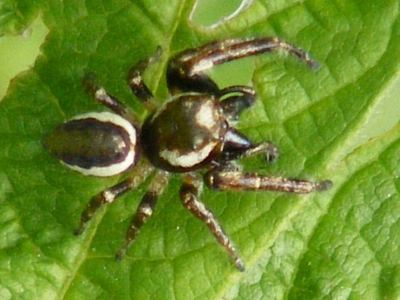
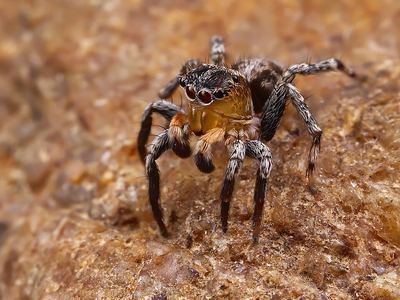
Buttonhook leafbeetle jumping spider (Sassacus vitis)
The buttonhook leafbeetle jumping spider (genus Sassacus) is a spider in the family Salticidae that is not dangerous to people. Among the 30 jumping spiders profiled here, it ranks 23rd by number of states listed. Most of its 12 listed states are in the Mountain (6) and Pacific (3) census divisions. None is in the Northeast or the Midwest. Its observation records peak in August.
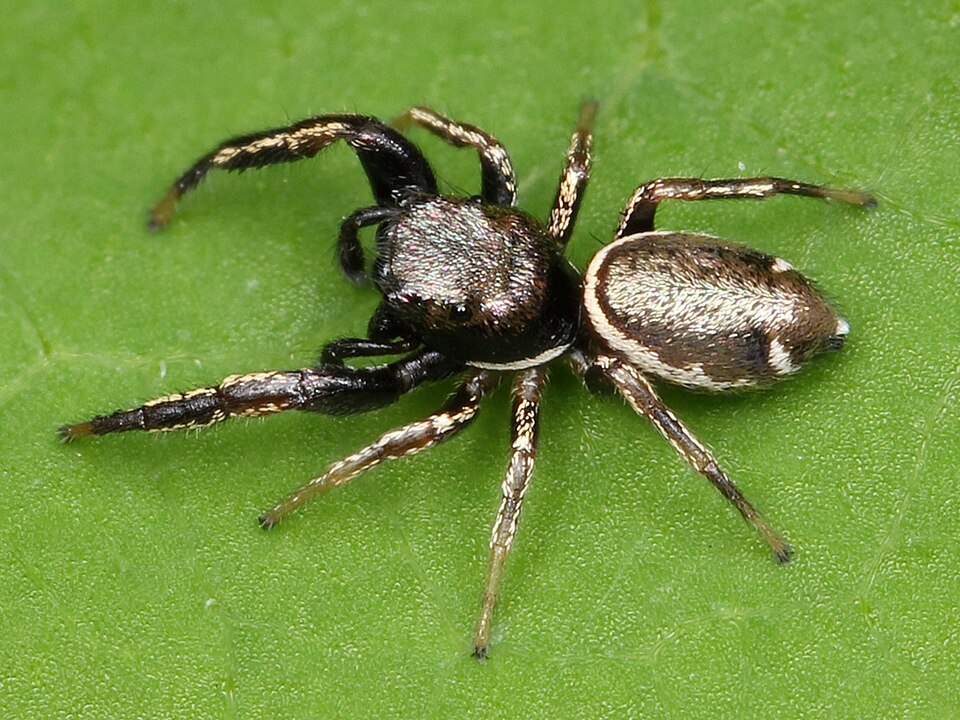

Sassacus vitis is a species of jumping spider. It is native to North America, with a range spanning from Canada to Panama. These spiders are normally no larger than five millimetres, with females being much larger than males, and duller in color.
From Wikipedia: Sassacus vitis, text under CC BY-SA 4.0.
Is the buttonhook leafbeetle jumping spider poisonous or venomous?
Not in any medically significant way. Like almost all spiders the buttonhook leafbeetle jumping spider (family Salticidae) has venom for its prey, but it is not a widow or recluse, the two U.S. groups whose bites need medical attention.
Which states have the buttonhook leafbeetle jumping spider?
California alone holds 92% of its licensed U.S. records.
| # | State | Records | Share of state spiders | Rank in state |
|---|---|---|---|---|
| 1 | California | 869 | 1.7% | 10th of 312 |
| 2 | Texas | 16 | 0.1% | 169th of 387 |
| 3 | Arizona | 14 | 0.3% | 37th of 161 |
| 4 | Colorado | 13 | 0.3% | 32nd of 372 |
| 5 | Oklahoma | 9 | 0.2% | 83rd of 151 |
| 6 | Florida | 8 | 0.1% | 163rd of 241 |
| 7 | Idaho | 5 | 0.9% | 20th of 58 |
| 8 | New Mexico | 4 | 0.2% | 99th of 248 |
| 9 | Utah | 4 | 0.2% | 51st of 99 |
| 10 | Washington | 4 | 0.1% | 83rd of 159 |
| 11 | Oregon | 3 | 0.1% | 68th of 89 |
| 12 | Nevada | 0 | — | — |
When is the buttonhook leafbeetle jumping spider seen?
Its observation records run through most of the year. December to February still holds 11% of them.
How recent are the buttonhook leafbeetle jumping spider records?
| Decade | Records | Share |
|---|---|---|
| 1920s | 1 | 0.1% |
| 1940s | 6 | 0.6% |
| 1950s | 1 | 0.1% |
| 1960s | 1 | 0.1% |
| 1970s | 1 | 0.1% |
| 1980s | 4 | 0.4% |
| 1990s | 6 | 0.6% |
| 2000s | 13 | 1.3% |
| 2010s | 192 | 19.8% |
| 2020s | 746 | 76.8% |
Species recorded in the same counties
| Species | Shared counties |
|---|---|
| Dysdera crocata | 12 |
| False black widow | 12 |
| Flatmesh weaver | 12 |
| Habronattus pyrrithrix | 12 |
| Banded garden spider | 11 |
| Bold jumper | 11 |
| Hairy tufted jumping spider | 11 |
| Johnson jumper | 11 |
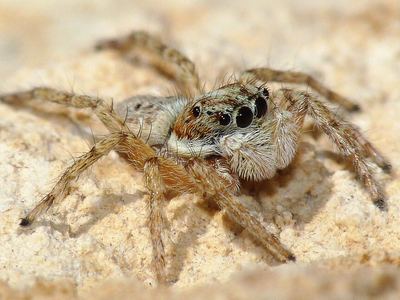
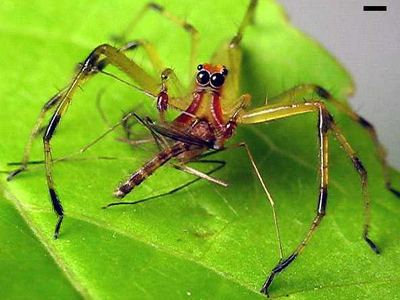
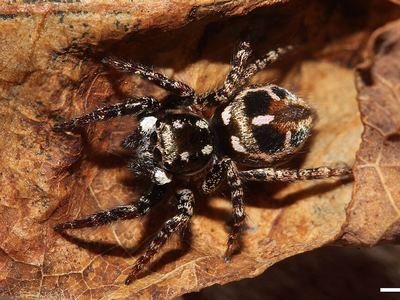
Related species in the U.S.
GBIF records read 2026-11-05 (open these records on GBIF). Listed: any license. Counted: CC0/CC BY only. How we count.