Pale sheetweb weaver (Bathyphantes pallidus)
The pale sheetweb weaver (genus Bathyphantes) is a spider in the family Linyphiidae that is not dangerous to people. Of the four sheetweb and dwarf spiders profiled here, it is listed in fewer states than any other. Most of its 6 listed states are in the East North Central (3) and New England (1) census divisions. None is in the South.
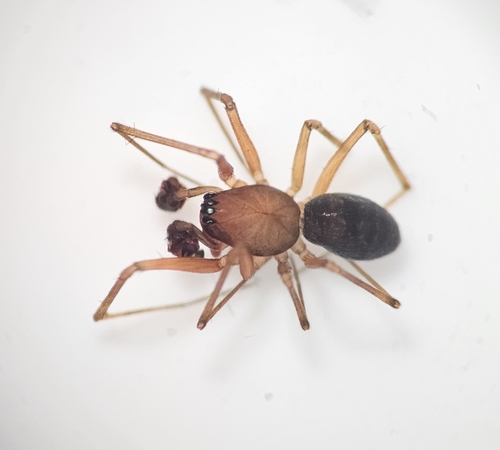
Bathyphantes pallidus is a species of sheetweb spider in the family Linyphiidae. It is found in the United States and Canada.
From Wikipedia: Bathyphantes pallidus, text under CC BY-SA 4.0.
Is the pale sheetweb weaver poisonous or venomous?
Not in any medically significant way. Like almost all spiders the pale sheetweb weaver (family Linyphiidae) has venom for its prey, but it is not a widow or recluse, the two U.S. groups whose bites need medical attention.
Which states have the pale sheetweb weaver?
Illinois alone holds 63% of its licensed U.S. records.
| # | State | Records | Share of state spiders | Rank in state |
|---|---|---|---|---|
| 1 | Illinois | 196 | 1.0% | 5th of 243 |
| 2 | Alaska | 69 | 0.3% | 68th of 280 |
| 3 | Wisconsin | 21 | 0.7% | 40th of 148 |
| 4 | Maine | 0 | — | — |
| 5 | North Dakota | 0 | — | — |
| 6 | Ohio | 0 | — | — |
Where the pale sheetweb weaver is recorded in each state
| State | Licensed records | Place among the state's spiders | Most recorded counties |
|---|---|---|---|
| Illinois | 196 | 5th of 243 | Jo Daviess County (121), Cook County (44), Will County (12), McHenry County (6) and Carroll County (6) |
| Alaska | 69 | joint 68th of 280 | Denali Borough (29), Fairbanks North Star Borough (22), Yukon-Koyukuk Census Area (6), Kodiak Island Borough (4) and Matanuska-Susitna Borough (4) |
Top counties in the U.S.
| # | County | State | Records | Share of U.S. |
|---|---|---|---|---|
| 1 | Jo Daviess County | Illinois | 121 | 39.2% |
| 2 | Cook County | Illinois | 44 | 14.2% |
| 3 | Denali Borough | Alaska | 29 | 9.4% |
| 4 | Fairbanks North Star Borough | Alaska | 22 | 7.1% |
| 5 | Will County | Illinois | 12 | 3.9% |
| 6 | Yukon-Koyukuk Census Area | Alaska | 6 | 1.9% |
| 7 | McHenry County | Illinois | 6 | 1.9% |
| 8 | Carroll County | Illinois | 6 | 1.9% |
| 9 | Kodiak Island Borough | Alaska | 4 | 1.3% |
| 10 | Matanuska-Susitna Borough | Alaska | 4 | 1.3% |
| 11 | Union County | Illinois | 4 | 1.3% |
| 12 | Kenai Peninsula Borough | Alaska | 2 | 0.6% |
| 13 | Southeast Fairbanks Census Area | Alaska | 2 | 0.6% |
| 14 | Fulton County | Illinois | 2 | 0.6% |
| 15 | Vermilion County | Illinois | 1 | 0.3% |
How recent are the pale sheetweb weaver records?
| Decade | Records | Share |
|---|---|---|
| 1950s | 1 | 0.3% |
| 1970s | 2 | 0.7% |
| 1990s | 50 | 16.4% |
| 2000s | 51 | 16.7% |
| 2010s | 177 | 58.0% |
| 2020s | 24 | 7.9% |
Species recorded in the same counties
| Species | Shared counties |
|---|---|
| Shiny wolf spider | 13 |
| Long-jawed orb weaver | 11 |
| Trochosa terricola | 10 |
| Bronze jumper | 8 |
| Brush-legged split wolf spider | 8 |
| Marbled orbweaver | 8 |
| Phrurotimpus alarius | 8 |
| Tan crab spider | 8 |
Related species in the U.S.
GBIF records read 2026-11-05 (open these records on GBIF). Listed: any license. Counted: CC0/CC BY only. How we count.