Filmy dome spider (Neriene radiata)
The filmy dome spider (genus Neriene) is a spider in the family Linyphiidae that is not dangerous to people. Of the four sheetweb and dwarf spiders profiled here, it is listed in more states than any other. It is listed in 41 states, spread over all nine census divisions. Its observation records peak in June.
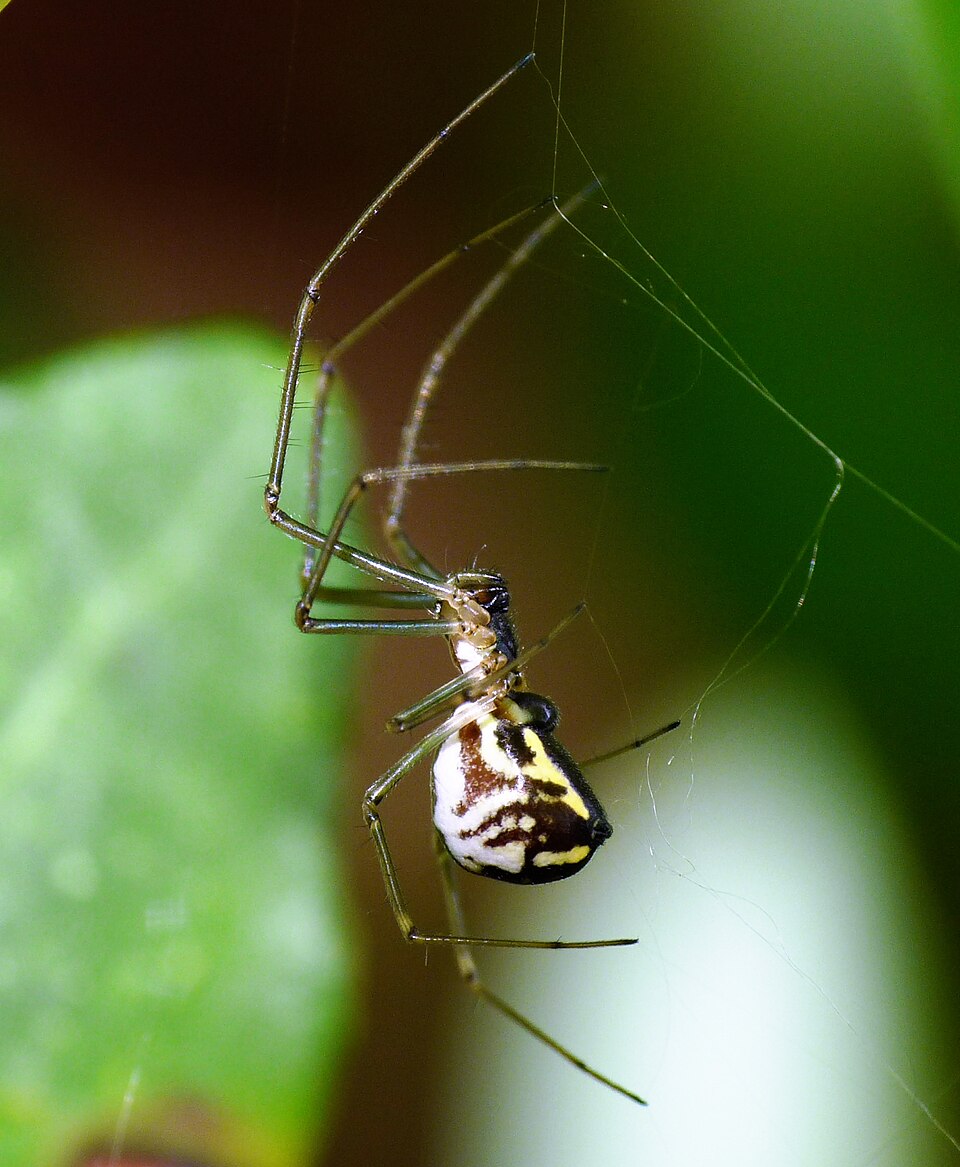

The filmy dome spider (Neriene radiata) is a sheet weaver: a spider in the family Linyphiidae with a holarctic distribution. These spiders construct a dome of fine spider silk and hang upside-down under it, waiting for their prey. It is a preferential host for the kleptoparasitic Argyrodes trigonum.
From Wikipedia: Filmy dome spider, text under CC BY-SA 4.0.
Is the filmy dome spider poisonous or venomous?
Not in any medically significant way. Like almost all spiders the filmy dome spider (family Linyphiidae) has venom for its prey, but it is not a widow or recluse, the two U.S. groups whose bites need medical attention.
Which states have the filmy dome spider?
| # | State | Records | Share of state spiders | Rank in state |
|---|---|---|---|---|
| 1 | Texas | 93 | 0.3% | 66th of 387 |
| 2 | Massachusetts | 91 | 1.8% | 9th of 191 |
| 3 | Alaska | 62 | 0.2% | 80th of 280 |
| 4 | Virginia | 58 | 0.5% | 49th of 178 |
| 5 | New York | 56 | 0.9% | 30th of 152 |
| 6 | New Hampshire | 37 | 2.6% | 10th of 74 |
| 7 | Alabama | 34 | 0.9% | 28th of 146 |
| 8 | Wisconsin | 24 | 0.7% | 31st of 148 |
| 9 | Oklahoma | 23 | 0.4% | 47th of 151 |
| 10 | Illinois | 22 | 0.1% | 119th of 243 |
| 11 | Minnesota | 22 | 0.7% | 30th of 145 |
| 12 | Nebraska | 21 | 1.6% | 11th of 72 |
| 13 | Michigan | 20 | 0.8% | 29th of 123 |
| 14 | Pennsylvania | 19 | 0.2% | 58th of 169 |
| 15 | Florida | 18 | 0.1% | 100th of 241 |
| 16 | Louisiana | 18 | 0.4% | 43rd of 108 |
| 17 | Maryland | 18 | 0.3% | 69th of 155 |
| 18 | Ohio | 18 | 0.2% | 71st of 333 |
| 19 | Tennessee | 17 | 0.4% | 51st of 143 |
| 20 | Montana | 15 | 0.7% | 17th of 73 |
| 21 | Maine | 14 | 1.4% | 18th of 298 |
| 22 | Vermont | 13 | 0.8% | 28th of 73 |
| 23 | Missouri | 12 | 0.5% | 41st of 117 |
| 24 | North Carolina | 12 | 0.1% | 83rd of 189 |
| 25 | Arkansas | 10 | 0.6% | 42nd of 114 |
| 26 | Indiana | 8 | 0.2% | 98th of 134 |
| 27 | Kansas | 8 | 0.5% | 39th of 93 |
| 28 | Connecticut | 7 | 0.7% | 35th of 85 |
| 29 | New Jersey | 7 | 0.3% | 64th of 127 |
| 30 | Washington | 7 | 0.2% | 68th of 159 |
| 31 | Colorado | 6 | 0.1% | 61st of 372 |
| 32 | Georgia | 6 | 0.1% | 119th of 190 |
| 33 | Mississippi | 6 | 0.4% | 46th of 117 |
| 34 | New Mexico | 6 | 0.2% | 76th of 248 |
| 35 | Oregon | 6 | 0.2% | 47th of 89 |
| 36 | Idaho | 4 | 0.7% | 23rd of 58 |
| 37 | Iowa | 4 | 0.6% | 28th of 58 |
| 38 | Kentucky | 3 | 0.1% | 80th of 104 |
| 39 | Rhode Island | 3 | 1.7% | 15th of 52 |
| 40 | South Carolina | 3 | 0.1% | 92nd of 124 |
| 41 | Wyoming | 0 | — | — |
When is the filmy dome spider seen?
Its observation records run mostly March through September.
Season by state
Where the season stays within one calendar year, it starts earliest in March (Alabama, Texas and Virginia) and latest in May (Massachusetts). May is the most common peak month (New Hampshire and Virginia).
| State | Main season | Peak month | Observation records |
|---|---|---|---|
| Texas | March through October | March | 92 |
| Massachusetts | May through September | August | 75 |
| Virginia | March through September | May | 58 |
| New York | April through October | June | 56 |
| New Hampshire | April through August | May | 36 |
| Alabama | March through September | April | 34 |
Where the filmy dome spider is recorded in each state
| State | Licensed records | Place among the state's spiders | Most recorded counties |
|---|---|---|---|
| Texas | 93 | 66th of 387 | Dallas County (12), Travis County (11), Denton County (10), Jasper County (9) and Harris County (8) |
| Massachusetts | 91 | 9th of 191 | Dukes County (19), Barnstable County (16), Plymouth County (13), Worcester County (13) and Middlesex County (13) |
| Alaska | 62 | joint 80th of 280 | Fairbanks North Star Borough (22), Kenai Peninsula Borough (18), Anchorage Municipality (8), Matanuska-Susitna Borough (5) and Yukon-Koyukuk Census Area (5) |
| Virginia | 58 | joint 49th of 178 | Goochland County (11), Louisa County (10), Prince William County (7), Hanover County (7) and Buckingham County (4) |
| New York | 56 | 30th of 152 | Tompkins County (10), Dutchess County (8), Suffolk County (8), Putnam County (6) and Tioga County (4) |
| New Hampshire | 37 | joint 10th of 74 | Rockingham County (10), Cheshire County (9), Grafton County (8), Sullivan County (4) and Hillsborough County (3) |
| Alabama | 34 | 28th of 146 | Blount County (11), Tuscaloosa County (9), Mobile County (5), Jefferson County (3) and DeKalb County (2) |
Top counties in the U.S.
| # | County | State | Records | Share of U.S. |
|---|---|---|---|---|
| 1 | Fairbanks North Star Borough | Alaska | 22 | 2.6% |
| 2 | Dukes County | Massachusetts | 19 | 2.2% |
| 3 | Kenai Peninsula Borough | Alaska | 18 | 2.1% |
| 4 | Barnstable County | Massachusetts | 16 | 1.9% |
| 5 | Plymouth County | Massachusetts | 13 | 1.5% |
| 6 | Worcester County | Massachusetts | 13 | 1.5% |
| 7 | Middlesex County | Massachusetts | 13 | 1.5% |
| 8 | Dallas County | Texas | 12 | 1.4% |
| 9 | Blount County | Alabama | 11 | 1.3% |
| 10 | Travis County | Texas | 11 | 1.3% |
| 11 | Goochland County | Virginia | 11 | 1.3% |
| 12 | Norfolk County | Massachusetts | 10 | 1.2% |
| 13 | Rockingham County | New Hampshire | 10 | 1.2% |
| 14 | Tompkins County | New York | 10 | 1.2% |
| 15 | Denton County | Texas | 10 | 1.2% |
How recent are the filmy dome spider records?
| Decade | Records | Share |
|---|---|---|
| 1920s | 9 | 1.1% |
| 1930s | 1 | 0.1% |
| 1940s | 1 | 0.1% |
| 1950s | 2 | 0.2% |
| 1970s | 14 | 1.7% |
| 1980s | 20 | 2.4% |
| 1990s | 5 | 0.6% |
| 2000s | 34 | 4.0% |
| 2010s | 165 | 19.5% |
| 2020s | 596 | 70.4% |
Species recorded in the same counties
| Species | Shared counties |
|---|---|
| Nursery web spider | 48 |
| Black-and-yellow argiope | 47 |
| Bronze jumper | 43 |
| Dark fishing spider | 41 |
| Spotted orbweaver | 40 |
| Orchard orbweaver | 39 |
| Familiar jumping spider | 38 |
| Rabid wolf spider | 36 |
Related species in the U.S.
GBIF records read 2026-11-05 (open these records on GBIF). Listed: any license. Counted: CC0/CC BY only. How we count.