Broad-faced sac spider (Trachelas tranquillus)
The broad-faced sac spider is a spider in the family Trachelidae that is not dangerous to people. GBIF holds 321 licensed U.S. records of it; it reaches our listing threshold in 23 states, most of all Illinois (34), Maryland (34) and Pennsylvania (34). Its observation records peak in September.
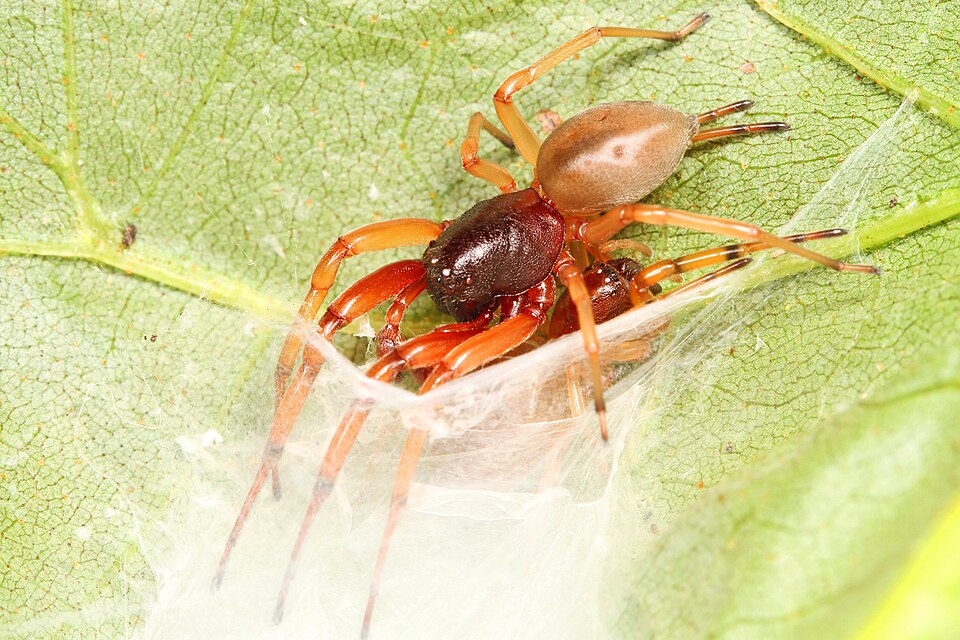

Trachelas tranquillus, the broad-faced sac spider, is a species of true spider in the family Trachelidae. It is found in the United States and Canada.
From Wikipedia: Trachelas tranquillus, text under CC BY-SA 4.0.
Is the broad-faced sac spider poisonous or venomous?
Not in any medically significant way. Like almost all spiders the broad-faced sac spider (family Trachelidae) has venom for its prey, but it is not a widow or recluse, the two U.S. groups whose bites need medical attention.
Which states have the broad-faced sac spider?
Records are spread over 23 states; the top three, Illinois, Maryland and Pennsylvania, hold 32% of them.
| # | State | Records | Share of state spiders | Rank in state |
|---|---|---|---|---|
| 1 | Illinois | 34 | 0.2% | 82nd of 243 |
| 2 | Maryland | 34 | 0.6% | 43rd of 153 |
| 3 | Pennsylvania | 34 | 0.5% | 42nd of 164 |
| 4 | Delaware | 32 | 1.5% | 17th of 71 |
| 5 | Ohio | 22 | 0.3% | 65th of 332 |
| 6 | Virginia | 22 | 0.2% | 79th of 176 |
| 7 | New York | 21 | 0.3% | 58th of 149 |
| 8 | New Jersey | 20 | 0.9% | 30th of 127 |
| 9 | Indiana | 17 | 0.4% | 51st of 133 |
| 10 | Nebraska | 15 | 1.2% | 17th of 71 |
| 11 | Massachusetts | 13 | 0.3% | 67th of 189 |
| 12 | Minnesota | 10 | 0.3% | 58th of 145 |
| 13 | Michigan | 8 | 0.3% | 48th of 122 |
| 14 | Wisconsin | 7 | 0.2% | 87th of 149 |
| 15 | Connecticut | 6 | 0.6% | 35th of 86 |
| 16 | Iowa | 6 | 0.9% | 18th of 57 |
| 17 | Kansas | 6 | 0.4% | 48th of 94 |
| 18 | Vermont | 5 | 0.3% | 37th of 74 |
| 19 | New Hampshire | 3 | 0.2% | 53rd of 72 |
| 20 | Kentucky | 1 | 0.1% | 93rd of 103 |
| 21 | Missouri | 0 | — | — |
| 22 | Rhode Island | 0 | — | — |
| 23 | West Virginia | 0 | — | — |
When is the broad-faced sac spider seen?
Across the U.S., observation records of the broad-faced sac spider run mostly August through November, peaking in September with 30% of them. Almost none are from December to February.
Season by state
Among states whose main season falls within one calendar year, it starts earliest in April (Maryland) and latest in August (Pennsylvania). Each of these states peaks in a different month: August in Pennsylvania, September in Delaware and October in Maryland.
| State | Main season | Peak month | Observation records |
|---|---|---|---|
| Maryland | April through October | October | 33 |
| Pennsylvania | August through October | August | 33 |
| Delaware | July through November | September | 32 |
Where the broad-faced sac spider is recorded in each state
Illinois
Illinois holds 34 licensed records, the joint 82nd most recorded of 243 spiders listed there. Most of its licensed records in Illinois come from Champaign County, Jo Daviess County and Cook County. Next come McLean County (3) and Will County (2).
Maryland
Maryland holds 34 licensed records, the joint 43rd most recorded of 153 spiders listed there. Its observation records in Maryland run mostly April through October, peaking in October; most licensed records come from Montgomery County, Prince George's County and Harford County. Next come Howard County (3) and Anne Arundel County (3).
Pennsylvania
Pennsylvania holds 34 licensed records, the joint 42nd most recorded of 164 spiders listed there. Its observation records in Pennsylvania run mostly August through October, peaking in August; most licensed records come from Bucks County, Berks County and Lancaster County. Next come Montgomery County (3) and Centre County (2).
Delaware
Delaware holds 32 licensed records, the 17th most recorded of 71 spiders listed there. Its observation records in Delaware run mostly July through November, peaking in September; most licensed records come from Sussex County and Kent County.
Top counties in the U.S.
| # | County | State | Records | Share of U.S. |
|---|---|---|---|---|
| 1 | Sussex County | Delaware | 31 | 9.7% |
| 2 | Champaign County | Illinois | 12 | 3.7% |
| 3 | Jo Daviess County | Illinois | 9 | 2.8% |
| 4 | Montgomery County | Maryland | 9 | 2.8% |
| 5 | Prince George's County | Maryland | 8 | 2.5% |
| 6 | Bucks County | Pennsylvania | 7 | 2.2% |
| 7 | Cook County | Illinois | 6 | 1.9% |
| 8 | Berks County | Pennsylvania | 4 | 1.2% |
| 9 | McLean County | Illinois | 3 | 0.9% |
| 10 | Harford County | Maryland | 3 | 0.9% |
| 11 | Howard County | Maryland | 3 | 0.9% |
| 12 | Anne Arundel County | Maryland | 3 | 0.9% |
| 13 | Baltimore County | Maryland | 3 | 0.9% |
| 14 | Lancaster County | Pennsylvania | 3 | 0.9% |
| 15 | Montgomery County | Pennsylvania | 3 | 0.9% |
How recent are the broad-faced sac spider records?
Most of what is known about the broad-faced sac spider is recent: 86% of dated U.S. records were made in 2017–2026, and half date from 2022 or later. The oldest dated record is from 1951; the busiest year was 2025, with 66 records.
| Decade | Records | Share |
|---|---|---|
| 1950s | 1 | 0.3% |
| 1960s | 4 | 1.2% |
| 1970s | 1 | 0.3% |
| 1980s | 9 | 2.6% |
| 1990s | 7 | 2.0% |
| 2000s | 1 | 0.3% |
| 2010s | 65 | 19.0% |
| 2020s | 255 | 74.3% |
Species recorded in the same counties
Of the 33 counties where the broad-faced sac spider is most recorded, 26 are also top counties for both the familiar jumping spider and the spined micrathena; no other spider shares more. None of its closest neighbors is venomous.
| Species | Shared counties |
|---|---|
| Familiar jumping spider | 26 |
| Spined micrathena | 26 |
| Bold jumper | 25 |
| Dark fishing spider | 25 |
| Furrow orbweaver | 25 |
| Orchard orbweaver | 25 |
| Paraphidippus aurantius | 24 |
| Spotted orbweaver | 24 |
GBIF records read 2026-09-29. Listed: any license. Counted: CC0/CC BY only. How we count.