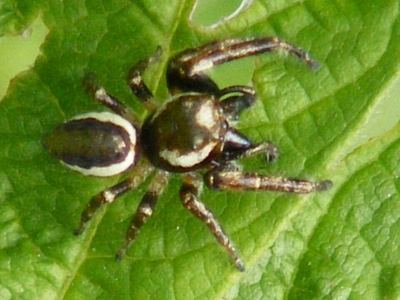
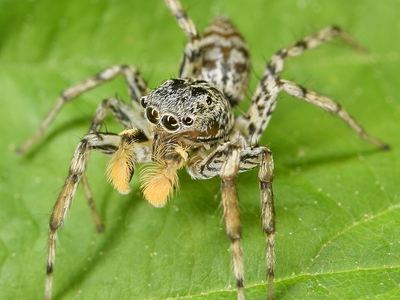
Twin-flagged jumping spider (Anasaitis canosa)
The twin-flagged jumping spider is a spider in the family Salticidae that is not dangerous to people. GBIF holds 1,989 licensed U.S. records of it; it reaches our listing threshold in 11 states, most of all Texas (669), Louisiana (367) and Georgia (254). Its observation records peak in April.
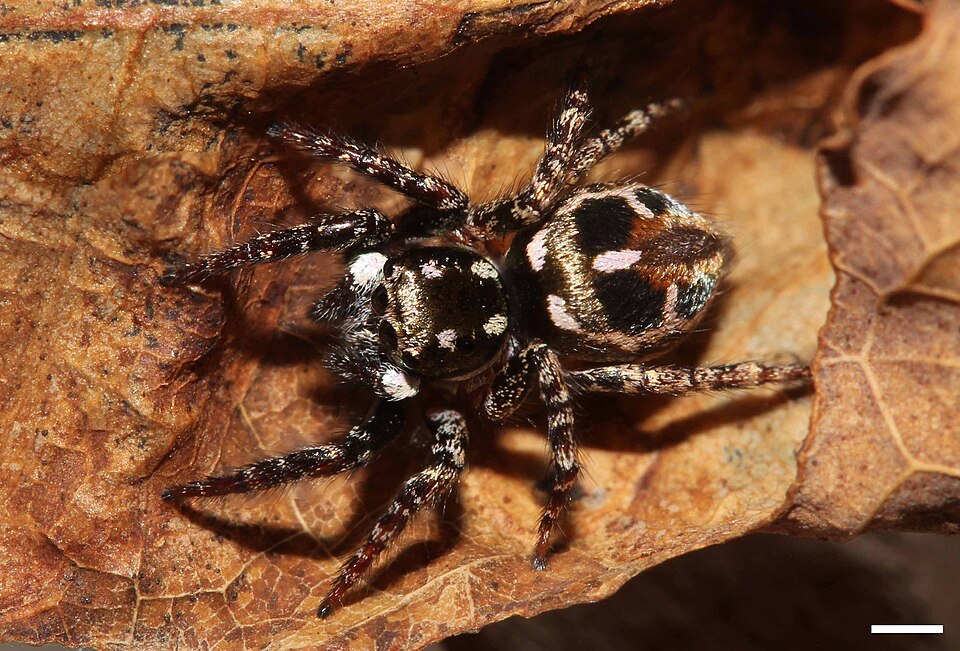

Anasaitis canosus, previously of the genus Corythalia, is a small jumping spider that can typically be found atop leaf-litter or man-made structures such as fences and exterior walls. This species is more commonly known as the twin-flagged jumping spider due to the two pennant shaped markings on the dorsal side of the cephalothorax. Typical of the genus Anasaitis, this species has iridescent setae ("scales") which may appear white, green or pink which create the "flags" as well as patches on the male pedipalps used in courtship and intraspecific signaling.
From Wikipedia: Anasaitis canosus, text under CC BY-SA 4.0.
Is the twin-flagged jumping spider poisonous or venomous?
Not in any medically significant way. Like almost all spiders the twin-flagged jumping spider (family Salticidae) has venom for its prey, but it is not a widow or recluse, the two U.S. groups whose bites need medical attention.
Which states have the twin-flagged jumping spider?
Records are spread over 11 states; the top three, Texas, Louisiana and Georgia, hold 65% of them. It is the most recorded spider of all in Louisiana.
| # | State | Records | Share of state spiders | Rank in state |
|---|---|---|---|---|
| 1 | Texas | 669 | 2.3% | 7th of 386 |
| 2 | Louisiana | 367 | 9.1% | 1st of 107 |
| 3 | Georgia | 254 | 3.8% | 5th of 186 |
| 4 | Florida | 247 | 2.0% | 10th of 237 |
| 5 | Alabama | 200 | 5.6% | 2nd of 143 |
| 6 | South Carolina | 97 | 4.1% | 4th of 121 |
| 7 | North Carolina | 93 | 1.1% | 23rd of 184 |
| 8 | Mississippi | 52 | 3.7% | 4th of 117 |
| 9 | Arkansas | 2 | 0.1% | 86th of 114 |
| 10 | Tennessee | 1 | 0.0% | 123rd of 138 |
| 11 | Virginia | 1 | 0.0% | 167th of 176 |
When is the twin-flagged jumping spider seen?
Across the U.S., observation records of the twin-flagged jumping spider run mostly March through November, peaking in April with 18% of them. Winter (December to February) holds 7% of them.
Season by state
Observation records run through most of the year in Florida. Among states whose main season falls within one calendar year, it starts earliest in February (Mississippi) and latest in March (Alabama, Georgia, Louisiana, North Carolina, South Carolina and Texas). The most common peak month is April, shared by Alabama, Georgia, South Carolina and Texas.
| State | Main season | Peak month | Observation records |
|---|---|---|---|
| Texas | March through November | April | 668 |
| Louisiana | March through October | May | 364 |
| Georgia | March through October | April | 244 |
| Florida | most of the year | July | 230 |
| Alabama | March through October | April | 200 |
| North Carolina | March through October | May | 93 |
| South Carolina | March through November | April | 92 |
| Mississippi | February through September | August | 52 |
Where the twin-flagged jumping spider is recorded in each state
Texas
Texas holds 669 licensed records, the 7th most recorded of 386 spiders listed there. Its observation records in Texas run mostly March through November, peaking in April; most licensed records come from Harris County, Travis County and Dallas County. Next come Bexar County (53) and Tarrant County (37).
Louisiana
Louisiana holds 367 licensed records, the most recorded of 107 spiders listed there. Its observation records in Louisiana run mostly March through October, peaking in May; most licensed records come from Saint Tammany Parish, East Baton Rouge Parish and Calcasieu Parish. Next come Orleans Parish (10) and Washington Parish (6).
Georgia
Georgia holds 254 licensed records, the 5th most recorded of 186 spiders listed there. Its observation records in Georgia run mostly March through October, peaking in April; most licensed records come from Chatham County, Clarke County and Fulton County. Next come Gwinnett County (27) and DeKalb County (25).
Florida
Florida holds 247 licensed records, the 10th most recorded of 237 spiders listed there. Its observation records in Florida run through most of the year, peaking in July; most licensed records come from Alachua County, Orange County and Seminole County. Next come Duval County (10) and Leon County (9).
Alabama
Alabama holds 200 licensed records, the 2nd most recorded of 143 spiders listed there. Its observation records in Alabama run mostly March through October, peaking in April; most licensed records come from Mobile County, Jefferson County and Blount County. Next come Tuscaloosa County (15) and St. Clair County (13).
South Carolina
South Carolina holds 97 licensed records, the 4th most recorded of 121 spiders listed there. Its observation records in South Carolina run mostly March through November, peaking in April; most licensed records come from Richland County, Lexington County and Charleston County. Next come Spartanburg County (11) and Greenville County (8).
North Carolina
North Carolina holds 93 licensed records, the 23rd most recorded of 184 spiders listed there. Its observation records in North Carolina run mostly March through October, peaking in May; most licensed records come from Gaston County, Cumberland County and Mecklenburg County. Next come New Hanover County (8) and Dare County (7).
Mississippi
Mississippi holds 52 licensed records, the 4th most recorded of 117 spiders listed there. Its observation records in Mississippi run mostly February through September, peaking in August; most licensed records come from Jackson County, Rankin County and Simpson County. Next come Hinds County (4) and Oktibbeha County (4).
Top counties in the U.S.
| # | County | State | Records | Share of U.S. |
|---|---|---|---|---|
| 1 | Saint Tammany Parish | Louisiana | 232 | 11.7% |
| 2 | Harris County | Texas | 119 | 6.0% |
| 3 | Travis County | Texas | 108 | 5.4% |
| 4 | Dallas County | Texas | 104 | 5.2% |
| 5 | Alachua County | Florida | 83 | 4.2% |
| 6 | Mobile County | Alabama | 54 | 2.7% |
| 7 | Jefferson County | Alabama | 53 | 2.7% |
| 8 | East Baton Rouge Parish | Louisiana | 53 | 2.7% |
| 9 | Bexar County | Texas | 53 | 2.7% |
| 10 | Chatham County | Georgia | 38 | 1.9% |
| 11 | Clarke County | Georgia | 38 | 1.9% |
| 12 | Tarrant County | Texas | 37 | 1.9% |
| 13 | Fulton County | Georgia | 30 | 1.5% |
| 14 | Montgomery County | Texas | 30 | 1.5% |
| 15 | Blount County | Alabama | 28 | 1.4% |
How recent are the twin-flagged jumping spider records?
Most of what is known about the twin-flagged jumping spider is recent: 97% of dated U.S. records were made in 2017–2026, and half date from 2022 or later. The oldest dated record is from 1935; the busiest year was 2025, with 316 records.
| Decade | Records | Share |
|---|---|---|
| 1930s | 1 | 0.0% |
| 1950s | 3 | 0.1% |
| 1960s | 4 | 0.2% |
| 1980s | 4 | 0.2% |
| 1990s | 4 | 0.2% |
| 2000s | 2 | 0.1% |
| 2010s | 443 | 21.5% |
| 2020s | 1,598 | 77.6% |
Species recorded in the same counties
Of the 118 counties where the twin-flagged jumping spider is most recorded, 72 are also top counties for the black-and-yellow argiope, more than for any other spider. None of its closest neighbors is venomous.
| Species | Shared counties |
|---|---|
| Black-and-yellow argiope | 72 |
| Spiny-backed orbweaver | 69 |
| Magnolia green jumper | 68 |
| Spotted orbweaver | 67 |
| Green lynx spider | 65 |
| Familiar jumping spider | 60 |
| Rabid wolf spider | 55 |
| Arrowhead orbweaver | 53 |
Related species in the U.S.
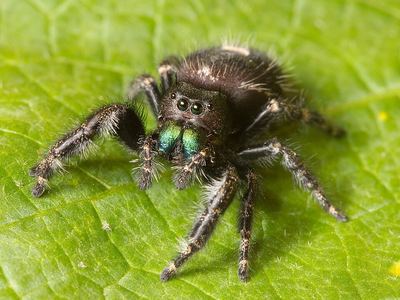
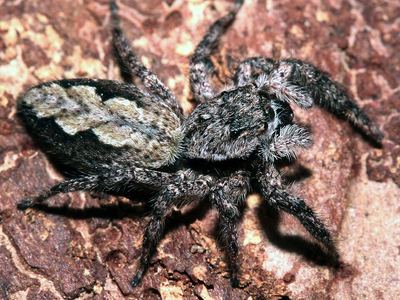
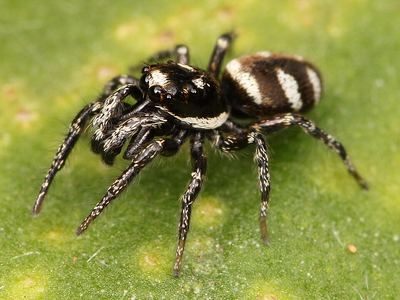
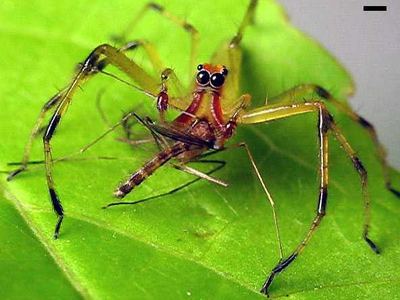
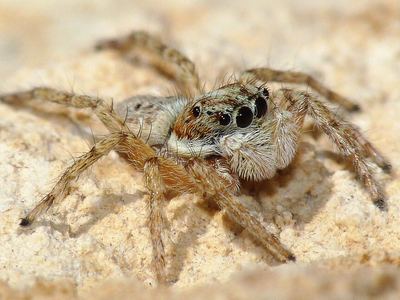
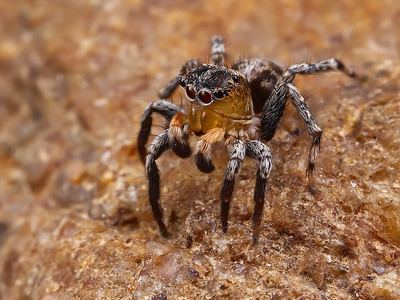
Other members of the family Salticidae with profiles here: Bold jumper, Familiar jumping spider, Zebra spider, Bronze jumper, Magnolia green jumper and Half-edged wall jumping spider.
GBIF records read 2026-09-29. Listed: any license. Counted: CC0/CC BY only. How we count.