Red-femured spotted orbweaver (Neoscona domiciliorum)
The red-femured spotted orbweaver (genus Neoscona) is a spider in the family Araneidae that is not dangerous to people. Among the 31 orb weavers profiled here, it ranks 21st by number of states listed, level with one other. Most of its 22 listed states are in the South Atlantic (7), Middle Atlantic (3) and East North Central (3) census divisions. None is in the West. Its observation records peak in September.
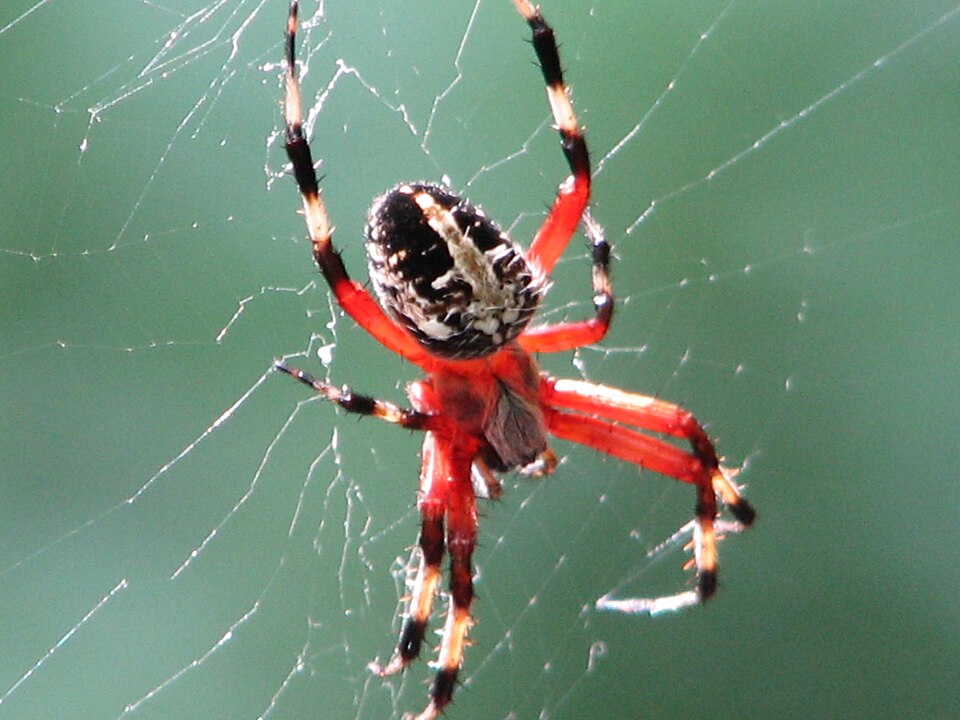

Neoscona domiciliorum, commonly known as the spotted orbweaver or redfemured spotted orbweaver, is a spider in the family Araneidae. The specific epithet domiciliorum means "of dwellings" in Latin and refers to the fact that this species is often found living on buildings. Their bites are not known to cause serious harm in humans.
From Wikipedia: Neoscona domiciliorum, text under CC BY-SA 4.0.
Is the red-femured spotted orbweaver poisonous or venomous?
Not in any medically significant way. Like almost all spiders the red-femured spotted orbweaver (family Araneidae) has venom for its prey, but it is not a widow or recluse, the two U.S. groups whose bites need medical attention.
Which states have the red-femured spotted orbweaver?
| # | State | Records | Share of state spiders | Rank in state |
|---|---|---|---|---|
| 1 | Florida | 126 | 1.0% | 16th of 241 |
| 2 | North Carolina | 116 | 1.3% | 19th of 189 |
| 3 | Georgia | 101 | 1.4% | 18th of 190 |
| 4 | South Carolina | 62 | 2.3% | 8th of 124 |
| 5 | Virginia | 61 | 0.5% | 47th of 178 |
| 6 | Maryland | 23 | 0.4% | 56th of 155 |
| 7 | Delaware | 20 | 0.9% | 28th of 73 |
| 8 | Alabama | 13 | 0.3% | 68th of 146 |
| 9 | Tennessee | 11 | 0.3% | 63rd of 143 |
| 10 | Texas | 11 | 0.0% | 204th of 387 |
| 11 | Illinois | 9 | 0.0% | 201st of 243 |
| 12 | Ohio | 9 | 0.1% | 94th of 333 |
| 13 | Louisiana | 8 | 0.2% | 68th of 108 |
| 14 | Mississippi | 5 | 0.3% | 54th of 117 |
| 15 | Missouri | 5 | 0.2% | 65th of 117 |
| 16 | New Jersey | 5 | 0.2% | 82nd of 127 |
| 17 | New York | 5 | 0.1% | 107th of 152 |
| 18 | Connecticut | 4 | 0.4% | 42nd of 85 |
| 19 | Massachusetts | 4 | 0.1% | 108th of 191 |
| 20 | Pennsylvania | 4 | 0.1% | 122nd of 169 |
| 21 | Indiana | 2 | 0.0% | 127th of 134 |
| 22 | Arkansas | 1 | 0.1% | 95th of 114 |
When is the red-femured spotted orbweaver seen?
Its observation records run mostly July through November.
Season by state
Where the season stays within one calendar year, it starts earliest in June (Florida) and latest in August (Virginia). August and September are the most common peak months, two states each.
| State | Main season | Peak month | Observation records |
|---|---|---|---|
| Florida | June through December | September | 120 |
| North Carolina | July through October | September | 115 |
| Georgia | July through October | August | 101 |
| South Carolina | July through October | October | 61 |
| Virginia | August through October | August | 61 |
Where the red-femured spotted orbweaver is recorded in each state
| State | Licensed records | Place among the state's spiders | Most recorded counties |
|---|---|---|---|
| Florida | 126 | 16th of 241 | Alachua County (20), Collier County (11), Orange County (11), Gadsden County (10) and Polk County (10) |
| North Carolina | 116 | 19th of 189 | Wake County (36), Chatham County (13), Orange County (10), Durham County (9) and Brunswick County (5) |
| Georgia | 101 | 18th of 190 | Clarke County (30), DeKalb County (11), Cobb County (8), Newton County (6) and Charlton County (5) |
| South Carolina | 62 | 8th of 124 | Richland County (23), Aiken County (5), Chesterfield County (4), Lexington County (4) and Oconee County (4) |
| Virginia | 61 | joint 47th of 178 | Fairfax County (19), Arlington County (5), Richmond (4), Accomack County (4) and Prince William County (3) |
Top counties in the U.S.
| # | County | State | Records | Share of U.S. |
|---|---|---|---|---|
| 1 | Wake County | North Carolina | 36 | 5.9% |
| 2 | Clarke County | Georgia | 30 | 4.9% |
| 3 | Richland County | South Carolina | 23 | 3.8% |
| 4 | Alachua County | Florida | 20 | 3.3% |
| 5 | Fairfax County | Virginia | 19 | 3.1% |
| 6 | Chatham County | North Carolina | 13 | 2.1% |
| 7 | Collier County | Florida | 11 | 1.8% |
| 8 | Orange County | Florida | 11 | 1.8% |
| 9 | DeKalb County | Georgia | 11 | 1.8% |
| 10 | Gadsden County | Florida | 10 | 1.6% |
| 11 | Polk County | Florida | 10 | 1.6% |
| 12 | Orange County | North Carolina | 10 | 1.6% |
| 13 | Durham County | North Carolina | 9 | 1.5% |
| 14 | Cobb County | Georgia | 8 | 1.3% |
| 15 | Duval County | Florida | 6 | 1.0% |
How recent are the red-femured spotted orbweaver records?
| Decade | Records | Share |
|---|---|---|
| 1920s | 3 | 0.5% |
| 1930s | 1 | 0.2% |
| 1950s | 1 | 0.2% |
| 1960s | 1 | 0.2% |
| 1980s | 1 | 0.2% |
| 1990s | 1 | 0.2% |
| 2000s | 6 | 1.0% |
| 2010s | 109 | 17.3% |
| 2020s | 507 | 80.5% |
Species recorded in the same counties
| Species | Shared counties |
|---|---|
| Black-and-yellow argiope | 48 |
| Spiny-backed orbweaver | 46 |
| Magnolia green jumper | 44 |
| Sixspotted fishing spider | 43 |
| Spotted orbweaver | 43 |
| White-banded fishing spider | 41 |
| Arrowhead orbweaver | 40 |
| Familiar jumping spider | 37 |
Related species in the U.S.
GBIF records read 2026-11-05 (open these records on GBIF). Listed: any license. Counted: CC0/CC BY only. How we count.