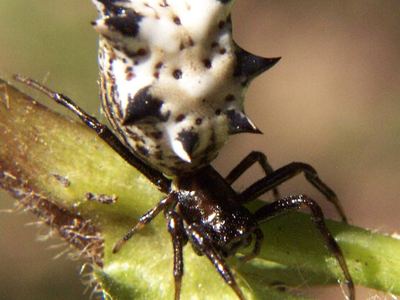
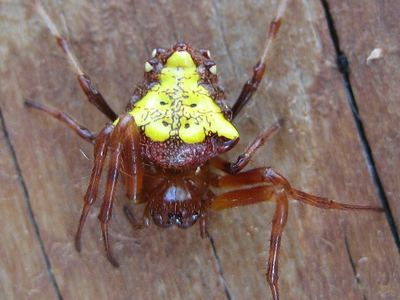
Spiny-backed orbweaver (Gasteracantha cancriformis)
The spiny-backed orbweaver (genus Gasteracantha) is a spider in the family Araneidae that is not dangerous to people. Among the 31 orb weavers profiled here, it ranks 25th by number of states listed. Most of its 17 listed states are in the South Atlantic (7) and West South Central (4) census divisions. None is in the Midwest. Its observation records peak in September.
Also called: jewel box spider, spiny-backed kite spider, spinybacked spider, crab-like spiny orbweaver (English names in GBIF)
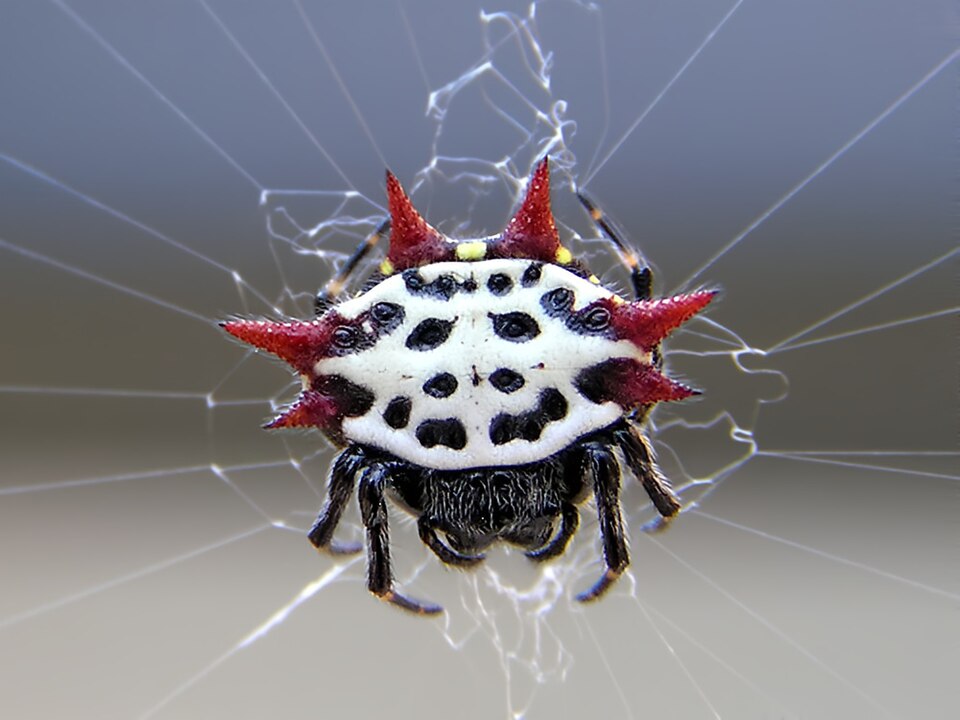

Gasteracantha cancriformis (spinybacked orbweaver) is a species of orb-weaver spider (family Araneidae). It is widely distributed in the New World. The genus name Gasteracantha derives from the Ancient Greek γαστήρ (gastḗr), meaning "belly", and ἄκανθα (ákantha), meaning "thorn", while the specific epithet cancriformis derives from the Latin words cancer ("crab") and forma ("shape, form, appearance").
From Wikipedia: Gasteracantha cancriformis, text under CC BY-SA 4.0.
Is the spiny-backed orbweaver poisonous or venomous?
Not in any medically significant way. Like almost all spiders the spiny-backed orbweaver (family Araneidae) has venom for its prey, but it is not a widow or recluse, the two U.S. groups whose bites need medical attention.
Which states have the spiny-backed orbweaver?
| # | State | Records | Share of state spiders | Rank in state |
|---|---|---|---|---|
| 1 | Florida | 892 | 6.9% | 2nd of 241 |
| 2 | Texas | 789 | 2.7% | 6th of 387 |
| 3 | Georgia | 151 | 2.2% | 8th of 190 |
| 4 | Louisiana | 136 | 3.3% | 6th of 108 |
| 5 | North Carolina | 130 | 1.5% | 13th of 189 |
| 6 | Alabama | 127 | 3.2% | 6th of 146 |
| 7 | South Carolina | 93 | 3.4% | 5th of 124 |
| 8 | Virginia | 67 | 0.6% | 42nd of 178 |
| 9 | Mississippi | 54 | 3.7% | 4th of 117 |
| 10 | Hawaii | 31 | 0.6% | 23rd of 57 |
| 11 | Maryland | 21 | 0.4% | 61st of 155 |
| 12 | Delaware | 20 | 0.9% | 28th of 73 |
| 13 | California | 17 | 0.0% | 183rd of 312 |
| 14 | Tennessee | 11 | 0.3% | 63rd of 143 |
| 15 | Arkansas | 8 | 0.5% | 51st of 114 |
| 16 | New Jersey | 2 | 0.1% | 104th of 127 |
| 17 | Oklahoma | 2 | 0.0% | 127th of 151 |
When is the spiny-backed orbweaver seen?
Its observation records run through most of the year. December to February still holds 19% of them.
Season by state
Observation records run through most of the year in Florida. Where the season stays within one calendar year, it starts earliest in April (Louisiana and Texas) and latest in August (Alabama). September is the most common peak month (Alabama, Georgia, Louisiana, Mississippi and North Carolina).
| State | Main season | Peak month | Observation records |
|---|---|---|---|
| Florida | most of the year | January | 857 |
| Texas | April through December | October | 775 |
| Georgia | May through November | September | 151 |
| Louisiana | April through October | September | 136 |
| Alabama | August through November | September | 126 |
| North Carolina | June through October | September | 121 |
| South Carolina | May through November | August | 82 |
| Virginia | June through October | July | 67 |
| Mississippi | May through October | September | 54 |
| Hawaii | October through May | April | 31 |
Where the spiny-backed orbweaver is recorded in each state
| State | Licensed records | Place among the state's spiders | Most recorded counties |
|---|---|---|---|
| Florida | 892 | 2nd of 241 | Broward County (163), Monroe County (113), Miami-Dade County (104), Alachua County (69) and Lee County (65) |
| Texas | 789 | 6th of 387 | Hidalgo County (174), Harris County (80), Travis County (44), Cameron County (42) and Bexar County (41) |
| Georgia | 151 | 8th of 190 | Chatham County (16), DeKalb County (14), Cobb County (10), Bryan County (9) and Richmond County (8) |
| Louisiana | 136 | 6th of 108 | East Baton Rouge Parish (31), Orleans Parish (19), Saint Tammany Parish (14), Jefferson Parish (11) and Calcasieu Parish (7) |
| North Carolina | 130 | 13th of 189 | Wake County (17), New Hanover County (15), Mecklenburg County (12), Orange County (10) and Durham County (9) |
| Alabama | 127 | 6th of 146 | Blount County (26), Tuscaloosa County (12), Jefferson County (9), St. Clair County (9) and Lee County (8) |
| South Carolina | 93 | 5th of 124 | Charleston County (30), Richland County (9), Chesterfield County (6), Beaufort County (6) and Greenville County (5) |
| Virginia | 67 | 42nd of 178 | Virginia Beach (11), Norfolk (8), Accomack County (5), Stafford County (4) and Sussex County (4) |
| Mississippi | 54 | 4th of 117 | Jackson County (12), Pearl River County (4), Adams County (3), Madison County (3) and Noxubee County (3) |
| Hawaii | 31 | 23rd of 57 | Kauai County (15), Maui County (15) and Hawaii County (1) |
Top counties in the U.S.
| # | County | State | Records | Share of U.S. |
|---|---|---|---|---|
| 1 | Hidalgo County | Texas | 174 | 6.8% |
| 2 | Broward County | Florida | 163 | 6.4% |
| 3 | Monroe County | Florida | 113 | 4.4% |
| 4 | Miami-Dade County | Florida | 104 | 4.1% |
| 5 | Harris County | Texas | 80 | 3.1% |
| 6 | Alachua County | Florida | 69 | 2.7% |
| 7 | Lee County | Florida | 65 | 2.5% |
| 8 | Palm Beach County | Florida | 57 | 2.2% |
| 9 | Travis County | Texas | 44 | 1.7% |
| 10 | Pinellas County | Florida | 42 | 1.6% |
| 11 | Cameron County | Texas | 42 | 1.6% |
| 12 | Bexar County | Texas | 41 | 1.6% |
| 13 | Brazos County | Texas | 39 | 1.5% |
| 14 | East Baton Rouge Parish | Louisiana | 31 | 1.2% |
| 15 | Charleston County | South Carolina | 30 | 1.2% |
How recent are the spiny-backed orbweaver records?
| Decade | Records | Share |
|---|---|---|
| 1930s | 1 | 0.0% |
| 1980s | 14 | 0.5% |
| 2000s | 23 | 0.9% |
| 2010s | 592 | 22.5% |
| 2020s | 1,996 | 76.0% |
Species recorded in the same counties
| Species | Shared counties |
|---|---|
| Black-and-yellow argiope | 82 |
| Magnolia green jumper | 81 |
| Spotted orbweaver | 75 |
| Familiar jumping spider | 74 |
| Twin-flagged jumping spider | 70 |
| Tigrosa annexa | 66 |
| American golden orb weaver | 64 |
| Green lynx spider | 64 |
Related species in the U.S.
GBIF records read 2026-11-05 (open these records on GBIF). Listed: any license. Counted: CC0/CC BY only. How we count.