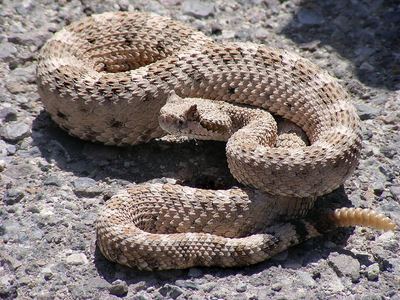
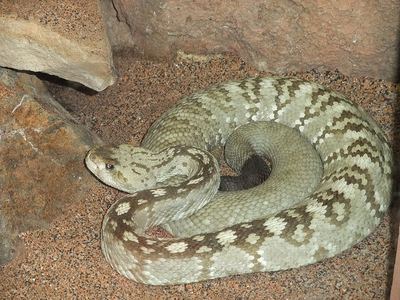
Southwestern speckled rattlesnake (Crotalus pyrrhus)
The southwestern speckled rattlesnake (genus Crotalus) is a venomous pit viper in the family Viperidae. Among the 20 rattlesnakes profiled here, it ranks 10th by number of states listed, level with one other. Its 4 listed states fall in the Mountain (3) and Pacific (1) census divisions. None is in the Northeast, the Midwest or the South. Its observation records peak in May.
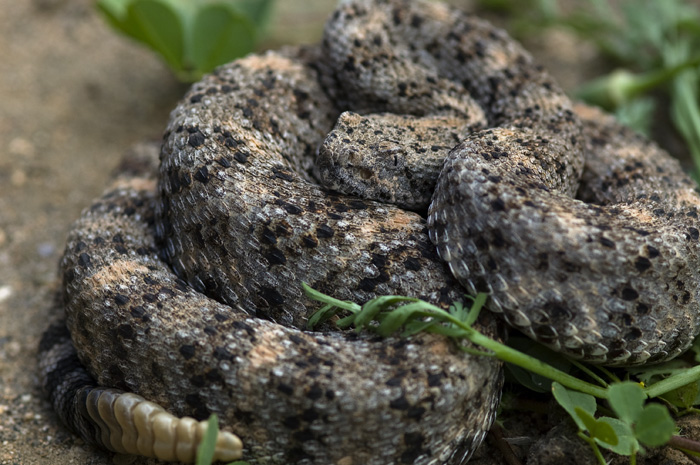

Common names: southwestern speckled rattlesnake, Mitchell's rattlesnake, more. Crotalus pyrrhus is a venomous pitviper species found in the southwestern United States and northwestern Mexico. A medium-sized snake, it is found mostly in rocky country, active at night and feeding on small mammals.
From Wikipedia: Crotalus pyrrhus, text under CC BY-SA 4.0.
Is the southwestern speckled rattlesnake poisonous or venomous?
Yes. The southwestern speckled rattlesnake is a pit viper (family Viperidae), like every rattlesnake, copperhead and cottonmouth in the U.S.
Is a southwestern speckled rattlesnake bite dangerous?
Yes. A southwestern speckled rattlesnake bite needs emergency care: call 911 and keep the bitten limb still. Antivenom is given in hospital.
Rattlesnake vs. gopher snake, hog-nosed snake and rat snake
| Species commonly confused with rattlesnakes | Its states where both are recorded |
|---|---|
| gopher snake | all 4 |
| Great Plains rat snake | 1 of 4 |
| plains hog-nosed snake | 1 of 4 |
Which states have the southwestern speckled rattlesnake?
California alone holds 55% of its licensed U.S. records.
The count includes 135 records filed under the older name Crotalus mitchellii in Arizona.
| # | State | Records | Share of state snakes | Rank in state |
|---|---|---|---|---|
| 1 | California | 276 | 0.4% | 27th of 46 |
| 2 | Arizona | 187 | 0.9% | 28th of 60 |
| 3 | Nevada | 35 | 0.8% | 20th of 27 |
| 4 | Utah | 1 | 0.0% | 27th of 28 |
When is the southwestern speckled rattlesnake seen?
Its observation records run mostly March through September.
Where the southwestern speckled rattlesnake is recorded in each state
| State | Licensed records | Place among the state's snakes | Most recorded counties |
|---|---|---|---|
| California | 276 | 27th of 46 | Riverside County (114), San Diego County (75), San Bernardino County (70), Imperial County (9) and Orange County (7) |
| Arizona | 187 | 28th of 60 | Maricopa County (79), Mohave County (32), Yavapai County (28), Yuma County (28) and La Paz County (11) |
| Nevada | 35 | 20th of 27 | Clark County (35) |
Top counties in the U.S.
| # | County | State | Records | Share of U.S. |
|---|---|---|---|---|
| 1 | Riverside County | California | 114 | 22.8% |
| 2 | Maricopa County | Arizona | 79 | 15.8% |
| 3 | San Diego County | California | 75 | 15.0% |
| 4 | San Bernardino County | California | 70 | 14.0% |
| 5 | Clark County | Nevada | 35 | 7.0% |
| 6 | Mohave County | Arizona | 32 | 6.4% |
| 7 | Yavapai County | Arizona | 28 | 5.6% |
| 8 | Yuma County | Arizona | 28 | 5.6% |
| 9 | La Paz County | Arizona | 11 | 2.2% |
| 10 | Imperial County | California | 9 | 1.8% |
| 11 | Orange County | California | 7 | 1.4% |
| 12 | Pima County | Arizona | 4 | 0.8% |
| 13 | Pinal County | Arizona | 3 | 0.6% |
| 14 | Coconino County | Arizona | 2 | 0.4% |
| 15 | Madera County | California | 1 | 0.2% |
How recent are the southwestern speckled rattlesnake records?
| Decade | Records | Share |
|---|---|---|
| 1890s | 1 | 0.2% |
| 1910s | 6 | 1.4% |
| 1920s | 5 | 1.2% |
| 1930s | 24 | 5.8% |
| 1940s | 4 | 1.0% |
| 1950s | 30 | 7.2% |
| 1960s | 40 | 9.6% |
| 1970s | 14 | 3.4% |
| 1980s | 5 | 1.2% |
| 1990s | 19 | 4.6% |
| 2000s | 19 | 4.6% |
| 2010s | 90 | 21.6% |
| 2020s | 159 | 38.2% |
Species recorded in the same counties
| Species | Shared counties |
|---|---|
| California kingsnake | 15 |
| Gopher snake | 15 |
| Glossy snake | 14 |
| Long-nosed snake | 14 |
| Western patch-nosed snake | 14 |
| Coachwhip | 13 |
| Mohave rattlesnake venomous | 13 |
| Sidewinder venomous | 13 |
Related species in the U.S.
GBIF records read 2026-11-05 (open these records on GBIF). Listed: any license. Counted: CC0/CC BY only. How we count.