Brown recluse (Loxosceles reclusa)
The brown recluse is a venomous spider in the family Sicariidae. GBIF holds 1,117 licensed U.S. records of it; it reaches our listing threshold in 16 states, most of all Illinois (313), Missouri (174) and Indiana (138). Its observation records peak in July.
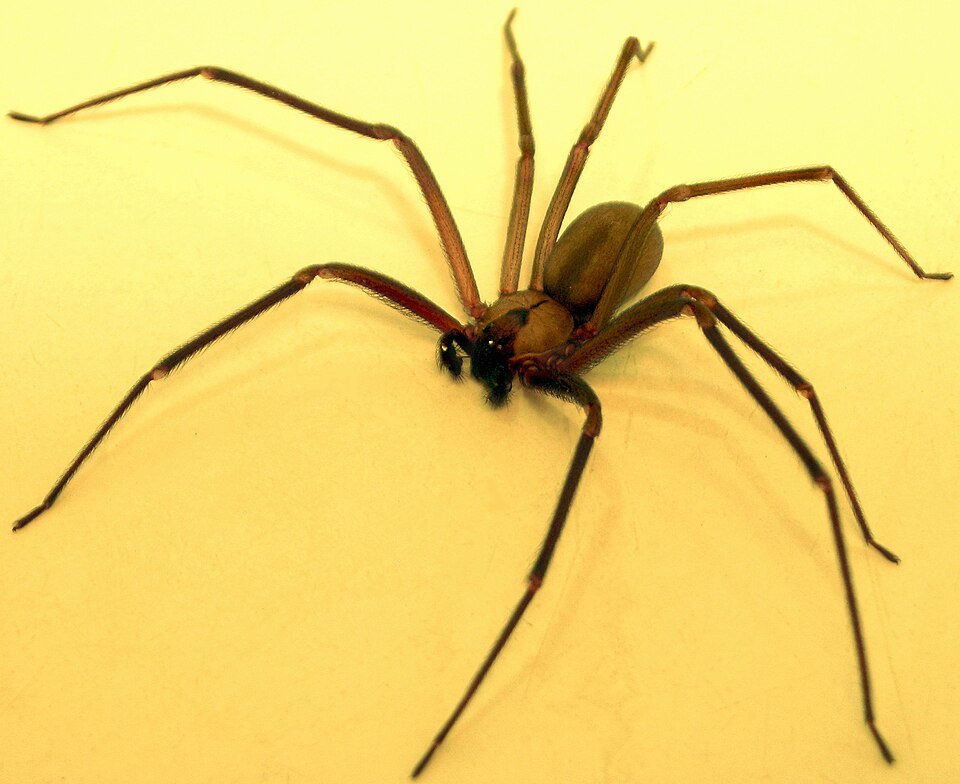
The brown recluse (Loxosceles reclusa, Sicariidae, formerly placed in a family "Loxoscelidae") is a recluse spider with necrotic venom. Similar to those of other recluse spiders, their bites sometimes require medical attention. The brown recluse is one of two spiders in North America with dangerous venom, the other being the black widow.
From Wikipedia: Brown recluse spider, text under CC BY-SA 4.0.
Is the brown recluse poisonous or venomous?
Yes. The brown recluse is a recluse spider (genus Loxosceles). Most bites heal alone, but some cause a slowly spreading wound. Call Poison Help at 1-800-222-1222 for advice.
Spiders often mistaken for it
Species commonly confused with recluse spiders and recorded in the same states: longbodied cellar spider (recorded in all 16 of its states), southern house spider (recorded in 7 of its 16 states), dark-legged grass spider (recorded in 5 of its 16 states), spitting spider (recorded in 5 of its 16 states) and Pennsylvania grass spider (recorded in 3 of its 16 states).
Which states have the brown recluse?
Records are spread over 16 states; the top three, Illinois, Missouri and Indiana, hold 56% of them. It is the most recorded spider of all in Missouri.
Records filed under this name in North Carolina and Virginia are not counted: there the name stands for another species, or the record lies outside this species’ range.
| # | State | Records | Share of state spiders | Rank in state |
|---|---|---|---|---|
| 1 | Illinois | 313 | 1.6% | 3rd of 243 |
| 2 | Missouri | 174 | 7.5% | 1st of 117 |
| 3 | Indiana | 138 | 3.1% | 5th of 133 |
| 4 | Oklahoma | 137 | 2.7% | 7th of 149 |
| 5 | Texas | 112 | 0.4% | 53rd of 386 |
| 6 | Kansas | 84 | 5.1% | 2nd of 94 |
| 7 | Arkansas | 39 | 2.4% | 7th of 114 |
| 8 | Tennessee | 37 | 1.0% | 25th of 138 |
| 9 | Kentucky | 22 | 1.2% | 22nd of 103 |
| 10 | Alabama | 17 | 0.5% | 54th of 143 |
| 11 | Nebraska | 13 | 1.0% | 25th of 71 |
| 12 | Mississippi | 5 | 0.4% | 52nd of 117 |
| 13 | Ohio | 4 | 0.1% | 124th of 332 |
| 14 | Georgia | 3 | 0.0% | 136th of 186 |
| 15 | Iowa | 2 | 0.3% | 38th of 57 |
| 16 | Louisiana | 1 | 0.0% | 100th of 107 |
When is the brown recluse seen?
Across the U.S., observation records of the brown recluse run mostly March through October, peaking in July with 19% of them. Winter (December to February) holds 7% of them.
Season by state
Observation records run through most of the year in Texas. Among states whose main season falls within one calendar year, it starts earliest in February (Oklahoma) and latest in April (Missouri). The most common peak months are June and July, each shared by two states.
| State | Main season | Peak month | Observation records |
|---|---|---|---|
| Missouri | April through October | July | 126 |
| Oklahoma | February through September | August | 117 |
| Texas | most of the year | May | 102 |
| Kansas | March through August | July | 76 |
| Arkansas | March through October | June | 36 |
| Tennessee | March through August | June | 34 |
Where the brown recluse is recorded in each state
Illinois
Illinois holds 313 licensed records, the 3rd most recorded of 243 spiders listed there. Most of its licensed records in Illinois come from Warren County, DeKalb County and Champaign County. Next come Knox County (12) and Monroe County (12).
Missouri
Missouri holds 174 licensed records, the most recorded of 117 spiders listed there. Its observation records in Missouri run mostly April through October, peaking in July; most licensed records come from Johnson County, St. Louis County and Boone County. Next come Texas County (5) and Greene County (4).
Indiana
Indiana holds 138 licensed records, the 5th most recorded of 133 spiders listed there. Most of its licensed records in Indiana come from Vigo County, Jefferson County and Vanderburgh County. Next come Gibson County (4) and Harrison County (3).
Oklahoma
Oklahoma holds 137 licensed records, the 7th most recorded of 149 spiders listed there. Its observation records in Oklahoma run mostly February through September, peaking in August; most licensed records come from Mayes County, Cleveland County and Woodward County. Next come Osage County (9) and Rogers County (8).
Texas
Texas holds 112 licensed records, the 53rd most recorded of 386 spiders listed there. Its observation records in Texas run through most of the year, peaking in May; most licensed records come from Denton County, Dallas County and Randall County. Next come Tarrant County (6) and Hays County (5).
Kansas
Kansas holds 84 licensed records, the 2nd most recorded of 94 spiders listed there. Its observation records in Kansas run mostly March through August, peaking in July; most licensed records come from Douglas County, Leavenworth County and Shawnee County. Next come Johnson County (7) and Riley County (6).
Arkansas
Arkansas holds 39 licensed records, the 7th most recorded of 114 spiders listed there. Its observation records in Arkansas run mostly March through October, peaking in June; most licensed records come from Craighead County, Clay County and Washington County. Next come Benton County (3) and Pulaski County (2).
Tennessee
Tennessee holds 37 licensed records, the joint 25th most recorded of 138 spiders listed there. Its observation records in Tennessee run mostly March through August, peaking in June; most licensed records come from Davidson County, Williamson County and Montgomery County. Next come Rutherford County (2) and Wilson County (2).
Top counties in the U.S.
| # | County | State | Records | Share of U.S. |
|---|---|---|---|---|
| 1 | Warren County | Illinois | 100 | 9.0% |
| 2 | Vigo County | Indiana | 96 | 8.6% |
| 3 | Johnson County | Missouri | 68 | 6.1% |
| 4 | St. Louis County | Missouri | 51 | 4.6% |
| 5 | DeKalb County | Illinois | 29 | 2.6% |
| 6 | Mayes County | Oklahoma | 29 | 2.6% |
| 7 | Douglas County | Kansas | 22 | 2.0% |
| 8 | Leavenworth County | Kansas | 20 | 1.8% |
| 9 | Cleveland County | Oklahoma | 20 | 1.8% |
| 10 | Davidson County | Tennessee | 17 | 1.5% |
| 11 | Craighead County | Arkansas | 16 | 1.4% |
| 12 | Woodward County | Oklahoma | 16 | 1.4% |
| 13 | Jefferson County | Indiana | 15 | 1.3% |
| 14 | Champaign County | Illinois | 14 | 1.3% |
| 15 | Knox County | Illinois | 12 | 1.1% |
How recent are the brown recluse records?
Records of the brown recluse span old collections and new observations: 56% date from 2017–2026, and the median record is from 2019. The oldest dated record is from 1915; the busiest year was 2014, with 152 records.
| Decade | Records | Share |
|---|---|---|
| 1910s | 1 | 0.1% |
| 1930s | 1 | 0.1% |
| 1950s | 2 | 0.2% |
| 1960s | 60 | 5.8% |
| 1970s | 45 | 4.3% |
| 1980s | 4 | 0.4% |
| 1990s | 5 | 0.5% |
| 2000s | 81 | 7.8% |
| 2010s | 336 | 32.3% |
| 2020s | 506 | 48.6% |
Species recorded in the same counties
Of the 107 counties where the brown recluse is most recorded, 51 are also top counties for the bold jumper, more than for any other spider. None of its closest neighbors is venomous.
| Species | Shared counties |
|---|---|
| Bold jumper | 51 |
| Familiar jumping spider | 50 |
| Black-and-yellow argiope | 49 |
| Spotted orbweaver | 49 |
| Rabid wolf spider | 43 |
| Spined micrathena | 38 |
| Furrow orbweaver | 33 |
| Nursery web spider | 33 |
Related species in the U.S.
Other species of the genus Loxosceles with profiles here: Texas recluse and Desert recluse.
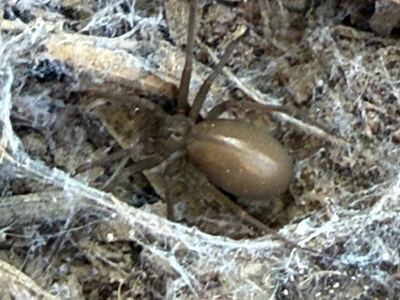
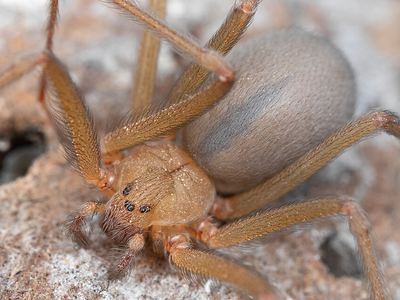

GBIF records read 2026-09-29. Listed: any license. Counted: CC0/CC BY only. How we count.