Longbodied cellar spider (Pholcus phalangioides)
The longbodied cellar spider is a spider in the family Pholcidae that is not dangerous to people. GBIF holds 1,369 licensed U.S. records of it; it reaches our listing threshold in 43 states, most of all California (688), Oregon (62) and North Carolina (61). Its observation records peak in June.
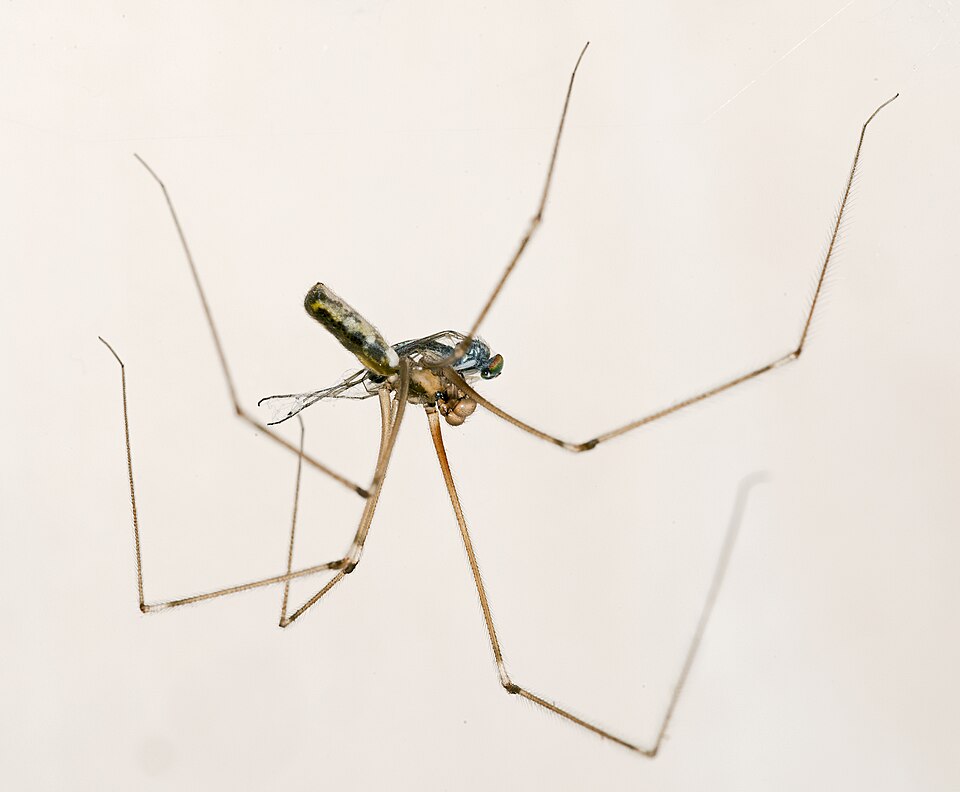
Pholcus phalangioides, commonly known as the cosmopolitan cellar spider, long-bodied cellar spider, or one of various types called a daddy long-legs spider, is a spider of the family Pholcidae. It was first described in 1775 by the Swiss entomologist Johann Kaspar Füssli (his surname is also spelled Fuesslin) as Aranea phalangoides. Its common name of "daddy long-legs" should not be confused with a different arachnid group with the same common name, the harvestman (Opiliones), or the crane flies of the superfamily Tipuloidea.
From Wikipedia: Pholcus phalangioides, text under CC BY-SA 4.0.
Is the longbodied cellar spider poisonous or venomous?
Not in any medically significant way. Like almost all spiders the longbodied cellar spider (family Pholcidae) has venom for its prey, but it is not a widow or recluse, the two U.S. groups whose bites need medical attention.
Often mistaken for
The longbodied cellar spider is not dangerous to people, but people often take it for recluse spiders (both are recorded in 17 of its 43 states).
Which states have the longbodied cellar spider?
The longbodied cellar spider's U.S. record is concentrated: California alone holds 50% of licensed records. It is listed in 43 states in all; the next are Oregon (62), North Carolina (61) and New York (48).
| # | State | Records | Share of state spiders | Rank in state |
|---|---|---|---|---|
| 1 | California | 688 | 1.4% | 15th of 309 |
| 2 | Oregon | 62 | 2.2% | 7th of 88 |
| 3 | North Carolina | 61 | 0.7% | 33rd of 184 |
| 4 | New York | 48 | 0.8% | 33rd of 149 |
| 5 | Washington | 48 | 1.2% | 14th of 157 |
| 6 | Pennsylvania | 34 | 0.5% | 42nd of 164 |
| 7 | Massachusetts | 32 | 0.7% | 33rd of 189 |
| 8 | Illinois | 29 | 0.2% | 91st of 243 |
| 9 | Virginia | 27 | 0.2% | 69th of 176 |
| 10 | Indiana | 24 | 0.5% | 38th of 133 |
| 11 | Texas | 24 | 0.1% | 140th of 386 |
| 12 | Wisconsin | 24 | 0.8% | 29th of 149 |
| 13 | Alabama | 23 | 0.6% | 40th of 143 |
| 14 | Maryland | 22 | 0.4% | 58th of 153 |
| 15 | Ohio | 22 | 0.3% | 65th of 332 |
| 16 | Georgia | 20 | 0.3% | 65th of 186 |
| 17 | Minnesota | 17 | 0.6% | 37th of 145 |
| 18 | Tennessee | 16 | 0.4% | 52nd of 138 |
| 19 | Kentucky | 15 | 0.8% | 33rd of 103 |
| 20 | Arkansas | 13 | 0.8% | 32nd of 114 |
| 21 | Vermont | 13 | 0.8% | 26th of 74 |
| 22 | Maine | 11 | 1.2% | 23rd of 297 |
| 23 | Alaska | 10 | 0.0% | 261st of 280 |
| 24 | Oklahoma | 10 | 0.2% | 80th of 149 |
| 25 | Missouri | 9 | 0.4% | 50th of 117 |
| 26 | Connecticut | 7 | 0.7% | 30th of 86 |
| 27 | Michigan | 7 | 0.3% | 52nd of 122 |
| 28 | Louisiana | 6 | 0.1% | 75th of 107 |
| 29 | Nebraska | 6 | 0.5% | 42nd of 71 |
| 30 | New Jersey | 6 | 0.3% | 69th of 127 |
| 31 | Colorado | 5 | 0.1% | 75th of 378 |
| 32 | Delaware | 5 | 0.2% | 60th of 71 |
| 33 | Utah | 4 | 0.2% | 51st of 97 |
| 34 | Iowa | 3 | 0.4% | 33rd of 57 |
| 35 | Kansas | 3 | 0.2% | 67th of 94 |
| 36 | New Hampshire | 3 | 0.2% | 53rd of 72 |
| 37 | South Carolina | 3 | 0.1% | 82nd of 121 |
| 38 | South Dakota | 3 | 1.6% | 10th of 29 |
| 39 | West Virginia | 2 | 0.3% | 48th of 90 |
| 40 | Florida | 1 | 0.0% | 225th of 237 |
| 41 | Idaho | 1 | 0.2% | 35th of 56 |
| 42 | Mississippi | 0 | — | — |
| 43 | Rhode Island | 0 | — | — |
When is the longbodied cellar spider seen?
Across the U.S., observation records of the longbodied cellar spider run through most of the year, peaking in June with 12% of them. Winter (December to February) holds 16% of them.
Season by state
Observation records run through most of the year in California, Massachusetts, New York, North Carolina, Pennsylvania and Washington. The most common peak months are June, July and August, each shared by two states.
| State | Main season | Peak month | Observation records |
|---|---|---|---|
| California | most of the year | April | 360 |
| Oregon | April through December | August | 62 |
| North Carolina | most of the year | June | 61 |
| New York | most of the year | June | 48 |
| Washington | most of the year | July | 47 |
| Pennsylvania | most of the year | July | 34 |
| Massachusetts | most of the year | August | 32 |
Where the longbodied cellar spider is recorded in each state
California
California holds 688 licensed records, the 15th most recorded of 309 spiders listed there. Its observation records in California run through most of the year, peaking in April; most licensed records come from Los Angeles County, San Diego County and Alameda County. Next come Santa Clara County (28) and San Francisco County (26).
Oregon
Oregon holds 62 licensed records, the 7th most recorded of 88 spiders listed there. Its observation records in Oregon run mostly April through December, peaking in August; most licensed records come from Multnomah County, Lincoln County and Benton County. Next come Lane County (5) and Polk County (3).
North Carolina
North Carolina holds 61 licensed records, the 33rd most recorded of 184 spiders listed there. Its observation records in North Carolina run through most of the year, peaking in June; most licensed records come from Wake County, Durham County and Orange County. Next come Mecklenburg County (6) and Rutherford County (3).
New York
New York holds 48 licensed records, the 33rd most recorded of 149 spiders listed there. Its observation records in New York run through most of the year, peaking in June; most licensed records come from Erie County, Tompkins County and Monroe County. Next come Dutchess County (3) and Kings County (3).
Washington
Washington holds 48 licensed records, the 14th most recorded of 157 spiders listed there. Its observation records in Washington run through most of the year, peaking in July; most licensed records come from King County, Jefferson County and Thurston County. Next come Pierce County (4) and Snohomish County (3).
Pennsylvania
Pennsylvania holds 34 licensed records, the joint 42nd most recorded of 164 spiders listed there. Its observation records in Pennsylvania run through most of the year, peaking in July; most licensed records come from Allegheny County, Montgomery County and Westmoreland County. Next come Centre County (2) and Adams County (2).
Massachusetts
Massachusetts holds 32 licensed records, the joint 33rd most recorded of 189 spiders listed there. Its observation records in Massachusetts run through most of the year, peaking in August; most licensed records come from Middlesex County, Dukes County and Worcester County. Next come Barnstable County (3) and Norfolk County (2).
Top counties in the U.S.
| # | County | State | Records | Share of U.S. |
|---|---|---|---|---|
| 1 | Los Angeles County | California | 394 | 28.8% |
| 2 | San Diego County | California | 59 | 4.3% |
| 3 | Alameda County | California | 34 | 2.5% |
| 4 | Multnomah County | Oregon | 29 | 2.1% |
| 5 | Santa Clara County | California | 28 | 2.0% |
| 6 | San Francisco County | California | 26 | 1.9% |
| 7 | King County | Washington | 21 | 1.5% |
| 8 | Orange County | California | 20 | 1.5% |
| 9 | San Mateo County | California | 17 | 1.2% |
| 10 | Wake County | North Carolina | 14 | 1.0% |
| 11 | Sonoma County | California | 13 | 0.9% |
| 12 | Erie County | New York | 13 | 0.9% |
| 13 | Santa Barbara County | California | 12 | 0.9% |
| 14 | Middlesex County | Massachusetts | 11 | 0.8% |
| 15 | Tompkins County | New York | 10 | 0.7% |
How recent are the longbodied cellar spider records?
Most of what is known about the longbodied cellar spider is recent: 75% of dated U.S. records were made in 2017–2026, and half date from 2021 or later. The oldest dated record is from 1931; the busiest year was 2002, with 184 records.
| Decade | Records | Share |
|---|---|---|
| 1930s | 2 | 0.1% |
| 1950s | 1 | 0.1% |
| 1960s | 8 | 0.6% |
| 1980s | 1 | 0.1% |
| 1990s | 5 | 0.4% |
| 2000s | 247 | 17.4% |
| 2010s | 302 | 21.2% |
| 2020s | 856 | 60.2% |
Species recorded in the same counties
Of the 94 counties where the longbodied cellar spider is most recorded, 55 are also top counties for both the bold jumper and the zebra spider; no other spider shares more. None of its closest neighbors is venomous.
| Species | Shared counties |
|---|---|
| Bold jumper | 55 |
| Zebra spider | 55 |
| Garden spider | 47 |
| Sixspotted orbweaver | 45 |
| Bronze jumper | 44 |
| Dysdera crocata | 42 |
| Spotted orbweaver | 41 |
| Triangulate bud spider | 40 |
Related species in the U.S.
Other members of the family Pholcidae with profiles here: Marbled cellar spider.
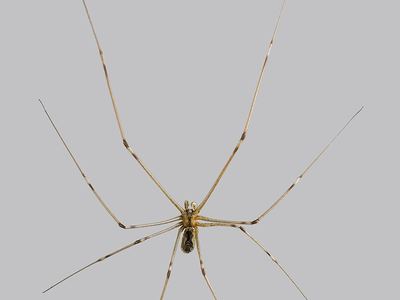

GBIF records read 2026-09-29. Listed: any license. Counted: CC0/CC BY only. How we count.