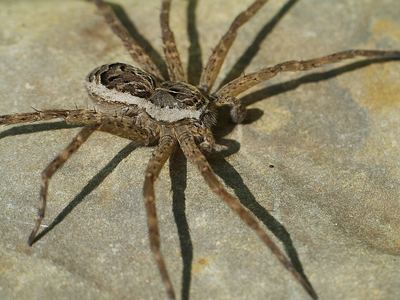
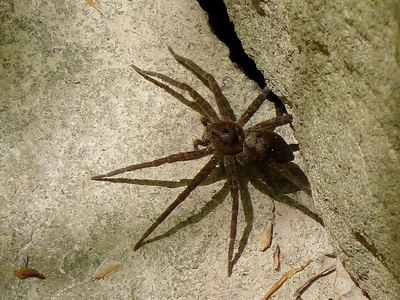
Nursery web spider (Pisaurina mira)
The nursery web spider (genus Pisaurina) is a spider in the family Pisauridae that is not dangerous to people. Among the six fishing and nursery web spiders profiled here, it ranks 3rd by number of states listed. Most of its 35 listed states are in the South Atlantic (8), New England (6) and East North Central (5) census divisions. None is in the West. Its observation records peak in September.
Also called: American nursery web spider (English names in GBIF)
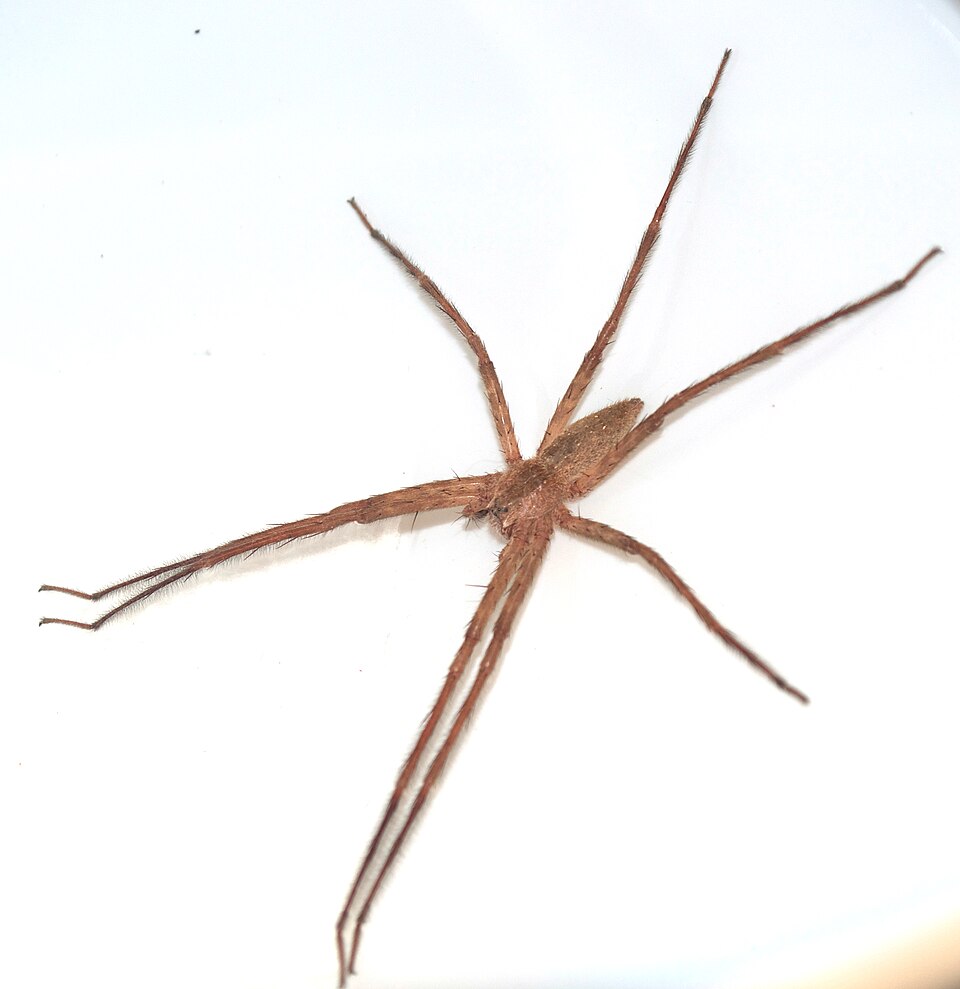

Pisaurina mira, also known as the American nursery web spider, due to the web it raises young in, is a species of spider in the family Pisauridae. They are often mistaken for wolf spiders (Lycosidae) due to their physical resemblance. P. mira is distinguished by its unique eye arrangement of two rows.
From Wikipedia: Pisaurina mira, text under CC BY-SA 4.0.
Is the nursery web spider poisonous or venomous?
Not in any medically significant way. Like almost all spiders the nursery web spider (family Pisauridae) has venom for its prey, but it is not a widow or recluse, the two U.S. groups whose bites need medical attention.
Which states have the nursery web spider?
It is the most recorded spider of all in New Hampshire.
| # | State | Records | Share of state spiders | Rank in state |
|---|---|---|---|---|
| 1 | Virginia | 493 | 4.1% | 3rd of 178 |
| 2 | Texas | 426 | 1.4% | 14th of 387 |
| 3 | Massachusetts | 293 | 5.8% | 3rd of 191 |
| 4 | Maryland | 236 | 4.0% | 4th of 155 |
| 5 | New York | 224 | 3.5% | 4th of 152 |
| 6 | Ohio | 220 | 3.0% | 6th of 333 |
| 7 | Pennsylvania | 215 | 2.8% | 4th of 169 |
| 8 | North Carolina | 209 | 2.4% | 6th of 189 |
| 9 | Illinois | 137 | 0.7% | 18th of 243 |
| 10 | Indiana | 129 | 2.8% | 6th of 134 |
| 11 | New Hampshire | 124 | 8.7% | 1st of 74 |
| 12 | Georgia | 99 | 1.4% | 19th of 190 |
| 13 | Tennessee | 96 | 2.5% | 7th of 143 |
| 14 | Delaware | 95 | 4.4% | 4th of 73 |
| 15 | Alabama | 92 | 2.3% | 8th of 146 |
| 16 | Minnesota | 89 | 2.8% | 7th of 145 |
| 17 | Michigan | 86 | 3.4% | 5th of 123 |
| 18 | Missouri | 81 | 3.3% | 5th of 117 |
| 19 | New Jersey | 74 | 3.1% | 5th of 127 |
| 20 | Kentucky | 71 | 3.5% | 6th of 104 |
| 21 | Oklahoma | 71 | 1.3% | 15th of 151 |
| 22 | Vermont | 71 | 4.4% | 5th of 73 |
| 23 | Connecticut | 69 | 6.6% | 2nd of 85 |
| 24 | Louisiana | 65 | 1.6% | 16th of 108 |
| 25 | Wisconsin | 62 | 1.9% | 5th of 148 |
| 26 | South Carolina | 40 | 1.5% | 17th of 124 |
| 27 | Arkansas | 39 | 2.3% | 8th of 114 |
| 28 | Maine | 39 | 4.0% | 3rd of 298 |
| 29 | Nebraska | 30 | 2.3% | 4th of 72 |
| 30 | Florida | 28 | 0.2% | 69th of 241 |
| 31 | Kansas | 20 | 1.2% | 16th of 93 |
| 32 | Mississippi | 20 | 1.4% | 15th of 117 |
| 33 | West Virginia | 18 | 2.3% | 12th of 90 |
| 34 | Iowa | 14 | 2.0% | 9th of 58 |
| 35 | Rhode Island | 3 | 1.7% | 15th of 52 |
When is the nursery web spider seen?
Its observation records run mostly March through October.
Season by state
Observation records run through most of the year in Louisiana, South Carolina and Texas. Where the season stays within one calendar year, it starts earliest in March (Kentucky, North Carolina and Tennessee) and latest in May (Connecticut, Delaware, Massachusetts, Michigan, Minnesota, Missouri and 7 more). September is the most common peak month (Alabama, Arkansas, Connecticut, Delaware, Illinois, Indiana and 11 more).
| State | Main season | Peak month | Observation records |
|---|---|---|---|
| Virginia | May through October | September | 491 |
| Texas | most of the year | February | 423 |
| Massachusetts | May through October | August | 291 |
| Maryland | April through October | September | 236 |
| New York | May through October | August | 221 |
| Ohio | May through October | September | 220 |
| North Carolina | March through October | September | 208 |
| Pennsylvania | May through October | September | 204 |
| New Hampshire | May through September | July | 124 |
| Illinois | April through October | September | 119 |
| Indiana | April through October | September | 116 |
| Georgia | April through November | August | 98 |
| Delaware | May through November | September | 95 |
| Tennessee | March through October | September | 95 |
| Alabama | April through October | September | 91 |
| Minnesota | May through September | September | 88 |
| Michigan | May through November | June | 85 |
| New Jersey | April through October | September | 74 |
| Missouri | May through October | August | 73 |
| Vermont | May through October | August | 71 |
| Connecticut | May through September | September | 69 |
| Kentucky | March through October | September | 69 |
| Oklahoma | April through October | September | 68 |
| Louisiana | most of the year | April | 63 |
| Wisconsin | May through September | September | 62 |
| South Carolina | most of the year | October | 40 |
| Maine | April through November | July | 39 |
| Arkansas | April through October | September | 36 |
Where the nursery web spider is recorded in each state
| State | Licensed records | Place among the state's spiders | Most recorded counties |
|---|---|---|---|
| Virginia | 493 | 3rd of 178 | Fairfax County (267), Loudoun County (35), Prince William County (34), Arlington County (16) and Accomack County (12) |
| Texas | 426 | 14th of 387 | Parker County (116), Travis County (49), Dallas County (33), Tarrant County (23) and Williamson County (20) |
| Massachusetts | 293 | 3rd of 191 | Middlesex County (80), Barnstable County (33), Norfolk County (31), Dukes County (31) and Worcester County (29) |
| Maryland | 236 | 4th of 155 | Montgomery County (55), Harford County (47), Prince George's County (39), Baltimore County (23) and Anne Arundel County (15) |
| New York | 224 | joint 4th of 152 | Tompkins County (51), Westchester County (21), Onondaga County (19), Rockland County (16) and Greene County (15) |
| Ohio | 220 | 6th of 333 | Franklin County (21), Montgomery County (21), Summit County (19), Hamilton County (13) and Portage County (12) |
| Pennsylvania | 215 | 4th of 169 | Monroe County (26), Westmoreland County (24), Allegheny County (18), Centre County (16) and Lackawanna County (11) |
| North Carolina | 209 | 6th of 189 | Orange County (81), Durham County (17), Chatham County (11), Cumberland County (11) and Buncombe County (9) |
| Illinois | 137 | 18th of 243 | Cook County (32), Will County (14), St. Clair County (13), Champaign County (10) and Union County (8) |
| Indiana | 129 | 6th of 134 | Monroe County (24), Morgan County (15), Lake County (14), Marion County (12) and Brown County (8) |
| New Hampshire | 124 | 1st of 74 | Hillsborough County (36), Rockingham County (25), Cheshire County (17), Grafton County (16) and Sullivan County (12) |
| Georgia | 99 | 19th of 190 | Clarke County (41), Cherokee County (5), Greene County (5), Columbia County (4) and Gwinnett County (4) |
| Tennessee | 96 | 7th of 143 | Shelby County (15), Knox County (13), Blount County (9), Montgomery County (6) and Sevier County (6) |
| Delaware | 95 | 4th of 73 | Sussex County (80), New Castle County (11) and Kent County (4) |
| Alabama | 92 | 8th of 146 | Blount County (38), Tuscaloosa County (16), Cullman County (10), Mobile County (5) and DeKalb County (4) |
| Minnesota | 89 | 7th of 145 | Hennepin County (32), Wright County (10), Wabasha County (7), Anoka County (4) and Rice County (4) |
| Michigan | 86 | 5th of 123 | Washtenaw County (19), Berrien County (9), Allegan County (8), Ingham County (6) and Oakland County (5) |
| Missouri | 81 | 5th of 117 | Dent County (13), Texas County (8), St. Louis County (7), Shannon County (6) and Boone County (6) |
| New Jersey | 74 | 5th of 127 | Middlesex County (17), Cape May County (10), Monmouth County (7), Morris County (6) and Somerset County (6) |
| Kentucky | 71 | 6th of 104 | Madison County (24), Fayette County (11), Shelby County (5), Jefferson County (5) and Boone County (4) |
| Oklahoma | 71 | 15th of 151 | Mayes County (47), Osage County (10), Woodward County (2), Cleveland County (1) and Comanche County (1) |
| Vermont | 71 | 5th of 73 | Windsor County (17), Chittenden County (17), Windham County (15), Washington County (6) and Caledonia County (5) |
| Connecticut | 69 | 2nd of 85 | New Haven County (20), New London County (9), Tolland County (9), Fairfield County (8) and Litchfield County (7) |
| Louisiana | 65 | 16th of 108 | East Baton Rouge Parish (27), Lincoln Parish (9), Saint Tammany Parish (4), West Feliciana Parish (4) and East Feliciana Parish (3) |
| Wisconsin | 62 | joint 5th of 148 | Grant County (9), Lincoln County (4), Door County (3), Price County (3) and Dane County (2) |
Top counties in the U.S.
| # | County | State | Records | Share of U.S. |
|---|---|---|---|---|
| 1 | Fairfax County | Virginia | 267 | 6.5% |
| 2 | Parker County | Texas | 116 | 2.8% |
| 3 | Orange County | North Carolina | 81 | 2.0% |
| 4 | Sussex County | Delaware | 80 | 2.0% |
| 5 | Middlesex County | Massachusetts | 80 | 2.0% |
| 6 | Montgomery County | Maryland | 55 | 1.3% |
| 7 | Tompkins County | New York | 51 | 1.3% |
| 8 | Travis County | Texas | 49 | 1.2% |
| 9 | Harford County | Maryland | 47 | 1.2% |
| 10 | Mayes County | Oklahoma | 47 | 1.2% |
| 11 | Clarke County | Georgia | 41 | 1.0% |
| 12 | Prince George's County | Maryland | 39 | 1.0% |
| 13 | Blount County | Alabama | 38 | 0.9% |
| 14 | Hillsborough County | New Hampshire | 36 | 0.9% |
| 15 | Loudoun County | Virginia | 35 | 0.9% |
How recent are the nursery web spider records?
| Decade | Records | Share |
|---|---|---|
| 1930s | 5 | 0.1% |
| 1940s | 3 | 0.1% |
| 1950s | 3 | 0.1% |
| 1960s | 14 | 0.3% |
| 1970s | 16 | 0.4% |
| 1980s | 19 | 0.4% |
| 1990s | 10 | 0.2% |
| 2000s | 14 | 0.3% |
| 2010s | 629 | 14.7% |
| 2020s | 3,555 | 83.3% |
Species recorded in the same counties
| Species | Shared counties |
|---|---|
| Black-and-yellow argiope | 233 |
| Bold jumper | 221 |
| Dark fishing spider | 216 |
| Familiar jumping spider | 216 |
| Spotted orbweaver | 209 |
| Orchard orbweaver | 193 |
| Spined micrathena | 187 |
| Bronze jumper | 181 |
Related species in the U.S.
GBIF records read 2026-11-05 (open these records on GBIF). Listed: any license. Counted: CC0/CC BY only. How we count.