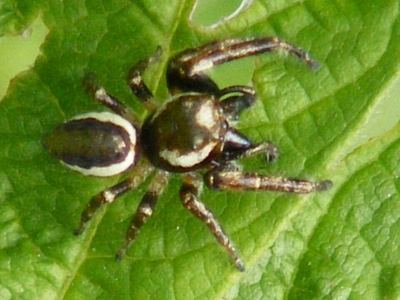
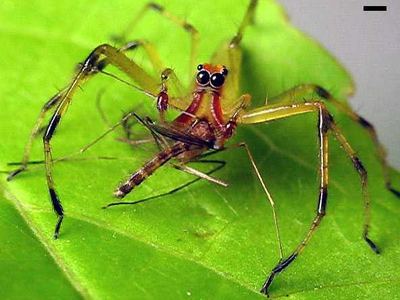
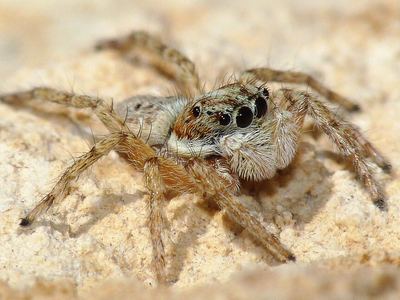
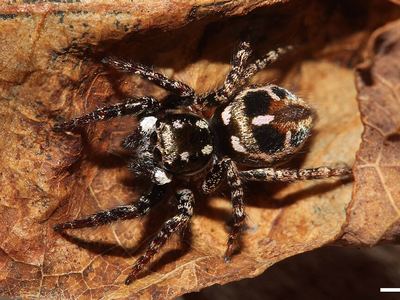
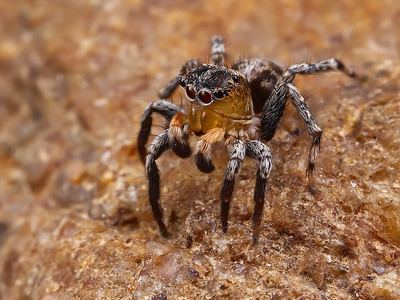
California flattened jumping spider (Platycryptus californicus)
The California flattened jumping spider is a spider in the family Salticidae that is not dangerous to people. GBIF holds 396 licensed U.S. records of it; it reaches our listing threshold in 11 states, most of all California (118), Washington (58) and Oregon (49). Its observation records peak in June.
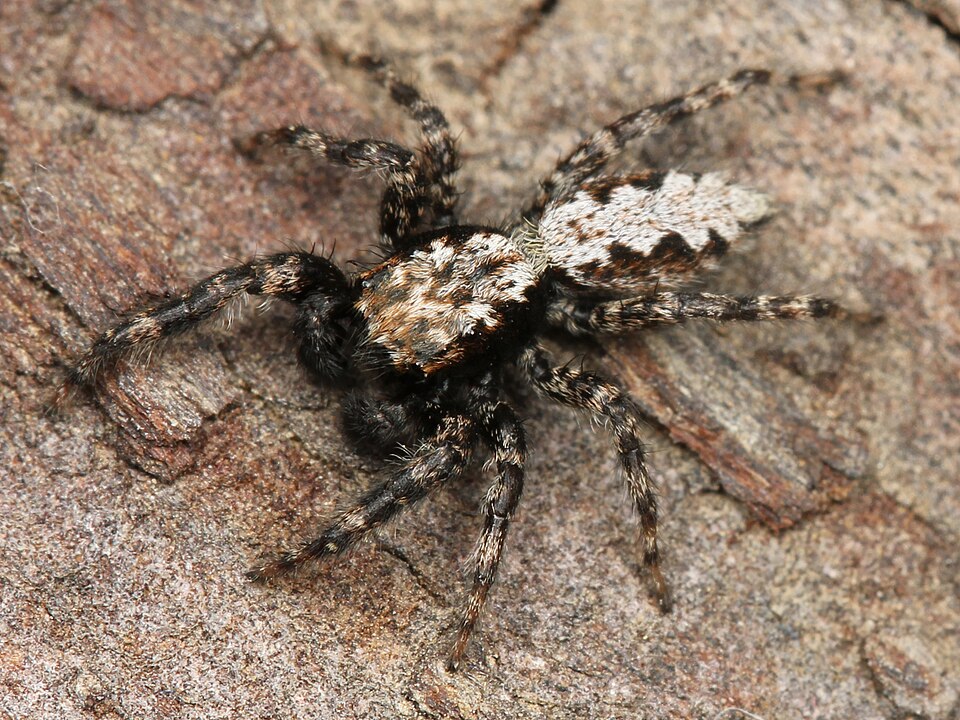

Platycryptus californicus is a species of jumping spider in the family Salticidae. It is found in North and Central America.
From Wikipedia: Platycryptus californicus, text under CC BY-SA 4.0.
Is the California flattened jumping spider poisonous or venomous?
Not in any medically significant way. Like almost all spiders the California flattened jumping spider (family Salticidae) has venom for its prey, but it is not a widow or recluse, the two U.S. groups whose bites need medical attention.
Which states have the California flattened jumping spider?
Records are spread over 11 states; the top three, California, Washington and Oregon, hold 57% of them.
| # | State | Records | Share of state spiders | Rank in state |
|---|---|---|---|---|
| 1 | California | 118 | 0.2% | 54th of 309 |
| 2 | Washington | 58 | 1.5% | 11th of 157 |
| 3 | Oregon | 49 | 1.7% | 10th of 88 |
| 4 | Utah | 46 | 1.9% | 6th of 97 |
| 5 | Idaho | 39 | 7.5% | 5th of 56 |
| 6 | Colorado | 29 | 0.7% | 19th of 378 |
| 7 | Arizona | 16 | 0.3% | 33rd of 162 |
| 8 | Montana | 15 | 0.7% | 14th of 75 |
| 9 | Nevada | 15 | 2.8% | 9th of 47 |
| 10 | New Mexico | 10 | 0.4% | 45th of 247 |
| 11 | Texas | 1 | 0.0% | 316th of 386 |
When is the California flattened jumping spider seen?
Across the U.S., observation records of the California flattened jumping spider run mostly April through September, peaking in June with 28% of them. Winter (December to February) holds 2% of them.
Season by state
Among states whose main season falls within one calendar year, it starts earliest in February (Washington) and latest in May (Oregon). The most common peak month is June, shared by Idaho, Oregon and Utah.
| State | Main season | Peak month | Observation records |
|---|---|---|---|
| California | April through October | May | 112 |
| Washington | February through August | July | 58 |
| Oregon | May through August | June | 49 |
| Utah | April through September | June | 46 |
| Idaho | March through August | June | 39 |
Where the California flattened jumping spider is recorded in each state
California
California holds 118 licensed records, the 54th most recorded of 309 spiders listed there. Its observation records in California run mostly April through October, peaking in May; most licensed records come from Sacramento County, Mariposa County and Fresno County. Next come Tuolumne County (6) and Riverside County (4).
Washington
Washington holds 58 licensed records, the 11th most recorded of 157 spiders listed there. Its observation records in Washington run mostly February through August, peaking in July; most licensed records come from Spokane County, Pierce County and King County. Next come Snohomish County (4) and Stevens County (4).
Oregon
Oregon holds 49 licensed records, the 10th most recorded of 88 spiders listed there. Its observation records in Oregon run mostly May through August, peaking in June; most licensed records come from Grant County, Deschutes County and Wallowa County. Next come Josephine County (4) and Wasco County (4).
Utah
Utah holds 46 licensed records, the joint 6th most recorded of 97 spiders listed there. Its observation records in Utah run mostly April through September, peaking in June; most licensed records come from Salt Lake County, Utah County and Box Elder County. Next come Davis County (3) and Sanpete County (2).
Idaho
Idaho holds 39 licensed records, the 5th most recorded of 56 spiders listed there. Its observation records in Idaho run mostly March through August, peaking in June; most licensed records come from Ada County, Latah County and Kootenai County. Next come Owyhee County (2) and Canyon County (1).
Top counties in the U.S.
| # | County | State | Records | Share of U.S. |
|---|---|---|---|---|
| 1 | Sacramento County | California | 52 | 13.1% |
| 2 | Salt Lake County | Utah | 23 | 5.8% |
| 3 | Ada County | Idaho | 20 | 5.1% |
| 4 | Grant County | Oregon | 14 | 3.5% |
| 5 | Latah County | Idaho | 12 | 3.0% |
| 6 | Mariposa County | California | 11 | 2.8% |
| 7 | Deschutes County | Oregon | 10 | 2.5% |
| 8 | Utah County | Utah | 10 | 2.5% |
| 9 | Spokane County | Washington | 9 | 2.3% |
| 10 | Fresno County | California | 6 | 1.5% |
| 11 | Tuolumne County | California | 6 | 1.5% |
| 12 | Wallowa County | Oregon | 6 | 1.5% |
| 13 | Pierce County | Washington | 6 | 1.5% |
| 14 | King County | Washington | 5 | 1.3% |
| 15 | Riverside County | California | 4 | 1.0% |
How recent are the California flattened jumping spider records?
Most of what is known about the California flattened jumping spider is recent: 96% of dated U.S. records were made in 2017–2026, and half date from 2024 or later. The oldest dated record is from 1940; the busiest year was 2024, with 81 records.
| Decade | Records | Share |
|---|---|---|
| 1940s | 4 | 1.0% |
| 1970s | 1 | 0.3% |
| 1980s | 1 | 0.3% |
| 2000s | 3 | 0.8% |
| 2010s | 47 | 11.8% |
| 2020s | 343 | 86.0% |
Species recorded in the same counties
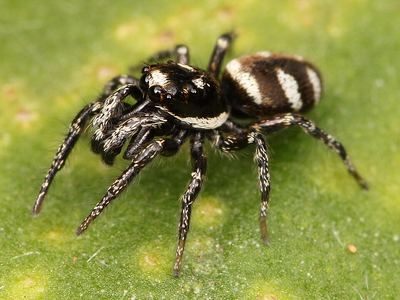
Of the 55 counties where the California flattened jumping spider is most recorded, 34 are also top counties for the zebra spider, more than for any other spider. None of its closest neighbors is venomous.
| Species | Shared counties |
|---|---|
| Zebra spider | 34 |
| Bold jumper | 30 |
| Pelegrina aeneola | 30 |
| Goldenrod crab spider | 22 |
| Johnson jumper | 22 |
| Longbodied cellar spider | 18 |
| Sixspotted orbweaver | 17 |
| Sierra dome spider | 15 |
Related species in the U.S.
Other species of the genus Platycryptus with profiles here: Familiar jumping spider.
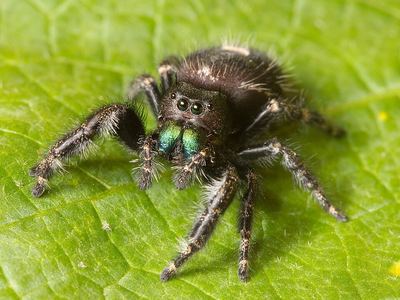
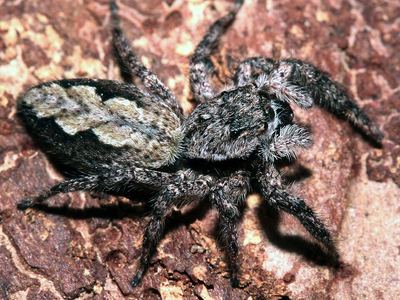
GBIF records read 2026-09-29. Listed: any license. Counted: CC0/CC BY only. How we count.