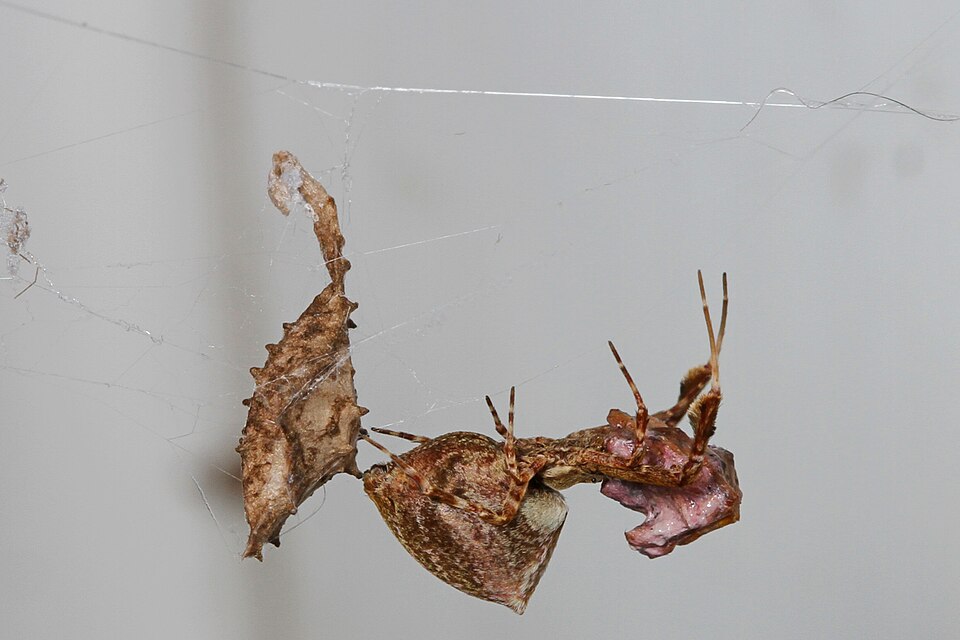
Featherlegged orbweaver (Uloborus glomosus)
The featherlegged orbweaver (genus Uloborus) is a spider in the family Uloboridae, which has no venom glands and is not dangerous to people. Most of its 27 listed states are in the South Atlantic (6), East North Central (5) and West South Central (4) census divisions. None is in the West. Its observation records peak in June.

27states on record
305licensed U.S. records
Junpeak month, observations
Novenomous to people
96%of wild records are field observations
Bitten? Call 911 for a venomous snakebite or any bite with trouble breathing. For advice on any bite or sting, call Poison Help at 1-800-222-1222 (free, 24/7, U.S.-wide). Do not cut the wound, suck out venom or use a tourniquet. General information, not medical advice. Do not handle or try to identify a snake or spider by this page; if unsure, treat it as venomous.
Is the featherlegged orbweaver poisonous or venomous?
No. The featherlegged orbweaver belongs to the family Uloboridae, spiders that have no venom glands at all and wrap their prey in silk instead. It is not a widow or recluse, the two U.S. groups whose bites need medical attention.
Which states have the featherlegged orbweaver?
| # | State | Records | Share of state spiders | Rank in state |
|---|---|---|---|---|
| 1 | Texas | 60 | 0.2% | 94th of 387 |
| 2 | Massachusetts | 24 | 0.5% | 47th of 191 |
| 3 | Florida | 22 | 0.2% | 81st of 241 |
| 4 | Pennsylvania | 22 | 0.3% | 53rd of 169 |
| 5 | Virginia | 22 | 0.2% | 80th of 178 |
| 6 | Alabama | 20 | 0.5% | 51st of 146 |
| 7 | Georgia | 19 | 0.3% | 69th of 190 |
| 8 | Louisiana | 17 | 0.4% | 45th of 108 |
| 9 | New York | 14 | 0.2% | 69th of 152 |
| 10 | Ohio | 10 | 0.1% | 86th of 333 |
| 11 | Illinois | 9 | 0.0% | 201st of 243 |
| 12 | Maryland | 9 | 0.2% | 89th of 155 |
| 13 | North Carolina | 7 | 0.1% | 101st of 189 |
| 14 | South Carolina | 7 | 0.3% | 66th of 124 |
| 15 | Indiana | 6 | 0.1% | 110th of 134 |
| 16 | Arkansas | 4 | 0.2% | 75th of 114 |
| 17 | Kansas | 4 | 0.2% | 58th of 93 |
| 18 | Mississippi | 4 | 0.3% | 62nd of 117 |
| 19 | Tennessee | 4 | 0.1% | 95th of 143 |
| 20 | Minnesota | 3 | 0.1% | 105th of 145 |
| 21 | Missouri | 2 | 0.1% | 83rd of 117 |
| 22 | New Jersey | 2 | 0.1% | 104th of 127 |
| 23 | Oklahoma | 2 | 0.0% | 127th of 151 |
| 24 | Wisconsin | 2 | 0.1% | 121st of 148 |
| 25 | Connecticut | 1 | 0.1% | 69th of 85 |
| 26 | Michigan | 1 | 0.0% | 104th of 123 |
| 27 | Rhode Island | 1 | 0.6% | 30th of 52 |
When is the featherlegged orbweaver seen?
Its observation records run mostly March through October.
How recent are the featherlegged orbweaver records?
2022median record year
90%dated records from 2017–2026
1928oldest dated record
2024busiest year, 55 records
| Decade | Records | Share |
|---|---|---|
| 1920s | 1 | 0.3% |
| 1980s | 3 | 1.0% |
| 1990s | 1 | 0.3% |
| 2000s | 3 | 1.0% |
| 2010s | 71 | 22.5% |
| 2020s | 236 | 74.9% |
Species recorded in the same counties
| Species | Shared counties |
|---|---|
| Banded garden spider | 10 |
| Bold jumper | 10 |
| Spotted orbweaver | 10 |
| Triangulate bud spider | 10 |
| Celer crab spider | 9 |
| Colonus puerperus | 9 |
| Common Hentz jumping spider | 9 |
| Cribellate spider | 9 |
GBIF records read 2026-11-05 (open these records on GBIF). Listed: any license. Counted: CC0/CC BY only. How we count.