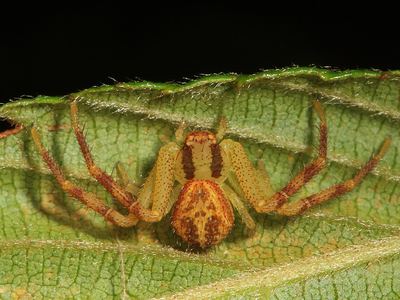
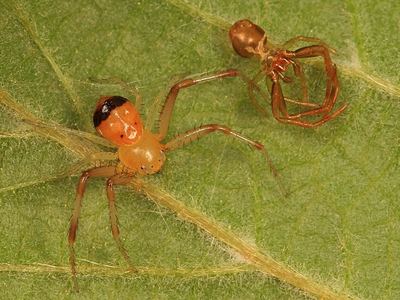
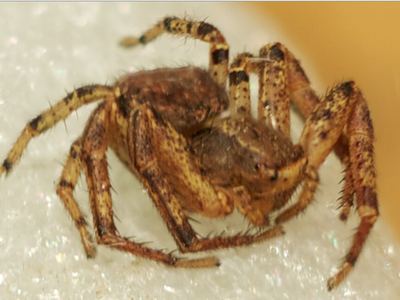
Celer crab spider (Mecaphesa celer)
The celer crab spider (genus Mecaphesa) is a spider in the family Thomisidae that is not dangerous to people. Among the eight crab spiders profiled here, it ranks 7th by number of states listed. Most of its 18 listed states are in the West North Central (6) and South Atlantic (5) census divisions. None is in the Northeast. Its observation records peak in April.
Also called: swift crab spider (English names in GBIF)
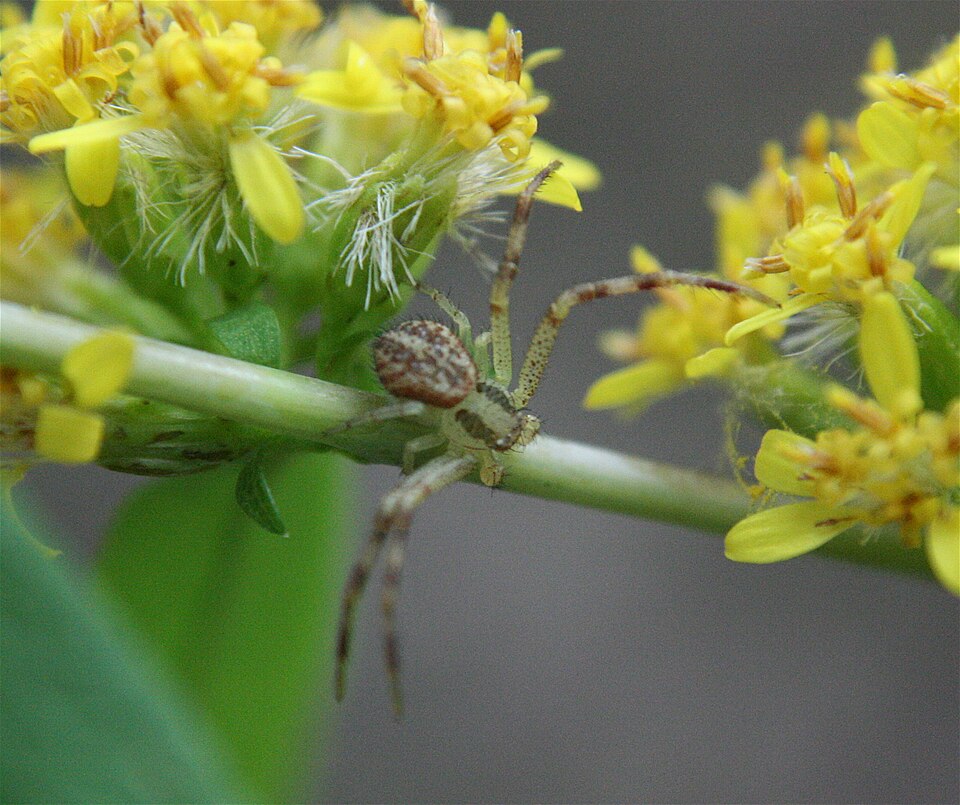

Mecaphesa celer, known generally as the swift crab spider, is a species of crab spider in the family Thomisidae. Its range is quite large, and it is found throughout much of North and Central America. M. celer are sit-and-wait predators who hide out on the flowers and upper stalks of plants, waiting for prey to pass by.
From Wikipedia: Mecaphesa celer, text under CC BY-SA 4.0.
Is the celer crab spider poisonous or venomous?
Not in any medically significant way. Like almost all spiders the celer crab spider (family Thomisidae) has venom for its prey, but it is not a widow or recluse, the two U.S. groups whose bites need medical attention.
Which states have the celer crab spider?
| # | State | Records | Share of state spiders | Rank in state |
|---|---|---|---|---|
| 1 | Texas | 124 | 0.4% | 49th of 387 |
| 2 | Oklahoma | 67 | 1.3% | 18th of 151 |
| 3 | Florida | 39 | 0.3% | 49th of 241 |
| 4 | Mississippi | 15 | 1.0% | 23rd of 117 |
| 5 | New Mexico | 15 | 0.6% | 23rd of 248 |
| 6 | North Carolina | 10 | 0.1% | 89th of 189 |
| 7 | Minnesota | 8 | 0.2% | 65th of 145 |
| 8 | Nebraska | 5 | 0.4% | 48th of 72 |
| 9 | Missouri | 4 | 0.2% | 70th of 117 |
| 10 | Alabama | 3 | 0.1% | 104th of 146 |
| 11 | Georgia | 3 | 0.0% | 142nd of 190 |
| 12 | Kansas | 3 | 0.2% | 66th of 93 |
| 13 | Colorado | 2 | 0.0% | 118th of 372 |
| 14 | Iowa | 2 | 0.3% | 37th of 58 |
| 15 | South Carolina | 2 | 0.1% | 103rd of 124 |
| 16 | South Dakota | 1 | 0.5% | 22nd of 30 |
| 17 | Virginia | 1 | 0.0% | 169th of 178 |
| 18 | Wyoming | 0 | — | — |
When is the celer crab spider seen?
Its observation records run mostly March through August.
Where the celer crab spider is recorded in each state
| State | Licensed records | Place among the state's spiders | Most recorded counties |
|---|---|---|---|
| Texas | 124 | 49th of 387 | Dallas County (27), Collin County (14), Travis County (12), Denton County (11) and Tarrant County (10) |
| Oklahoma | 67 | 18th of 151 | Comanche County (24), Marshall County (18), Mayes County (7), Tulsa County (7) and Oklahoma County (3) |
| Florida | 39 | 49th of 241 | Okeechobee County (11), Escambia County (10), Orange County (6), Sarasota County (3) and Highlands County (1) |
Top counties in the U.S.
| # | County | State | Records | Share of U.S. |
|---|---|---|---|---|
| 1 | Pima County | Arizona | 30 | 8.3% |
| 2 | Dallas County | Texas | 27 | 7.5% |
| 3 | Comanche County | Oklahoma | 24 | 6.6% |
| 4 | Marshall County | Oklahoma | 18 | 5.0% |
| 5 | Collin County | Texas | 14 | 3.9% |
| 6 | Travis County | Texas | 12 | 3.3% |
| 7 | Okeechobee County | Florida | 11 | 3.0% |
| 8 | Denton County | Texas | 11 | 3.0% |
| 9 | Escambia County | Florida | 10 | 2.8% |
| 10 | Tarrant County | Texas | 10 | 2.8% |
| 11 | Mayes County | Oklahoma | 7 | 1.9% |
| 12 | Tulsa County | Oklahoma | 7 | 1.9% |
| 13 | Galveston County | Texas | 7 | 1.9% |
| 14 | Yavapai County | Arizona | 6 | 1.7% |
| 15 | Coconino County | Arizona | 6 | 1.7% |
How recent are the celer crab spider records?
| Decade | Records | Share |
|---|---|---|
| 1920s | 24 | 6.6% |
| 1930s | 3 | 0.8% |
| 1940s | 2 | 0.5% |
| 1960s | 2 | 0.5% |
| 1980s | 11 | 3.0% |
| 1990s | 5 | 1.4% |
| 2000s | 47 | 12.9% |
| 2010s | 101 | 27.7% |
| 2020s | 170 | 46.6% |
Species recorded in the same counties
| Species | Shared counties |
|---|---|
| Green lynx spider | 23 |
| Familiar jumping spider | 22 |
| Rabid wolf spider | 22 |
| Striped lynx spider | 22 |
| Black-and-yellow argiope | 19 |
| Bold jumper | 19 |
| Shoreline wolf spider | 19 |
| Spotted orbweaver | 19 |
Related species in the U.S.
GBIF records read 2026-11-05 (open these records on GBIF). Listed: any license. Counted: CC0/CC BY only. How we count.