Broad-banded copperhead (Agkistrodon laticinctus)
The broad-banded copperhead (genus Agkistrodon) is a venomous pit viper in the family Viperidae. Among the four copperheads and cottonmouths profiled here, it ranks 3rd by number of states listed. Its 3 listed states fall in the West South Central (2) and West North Central (1) census divisions. None is in the Northeast or the West. Its observation records peak in May.
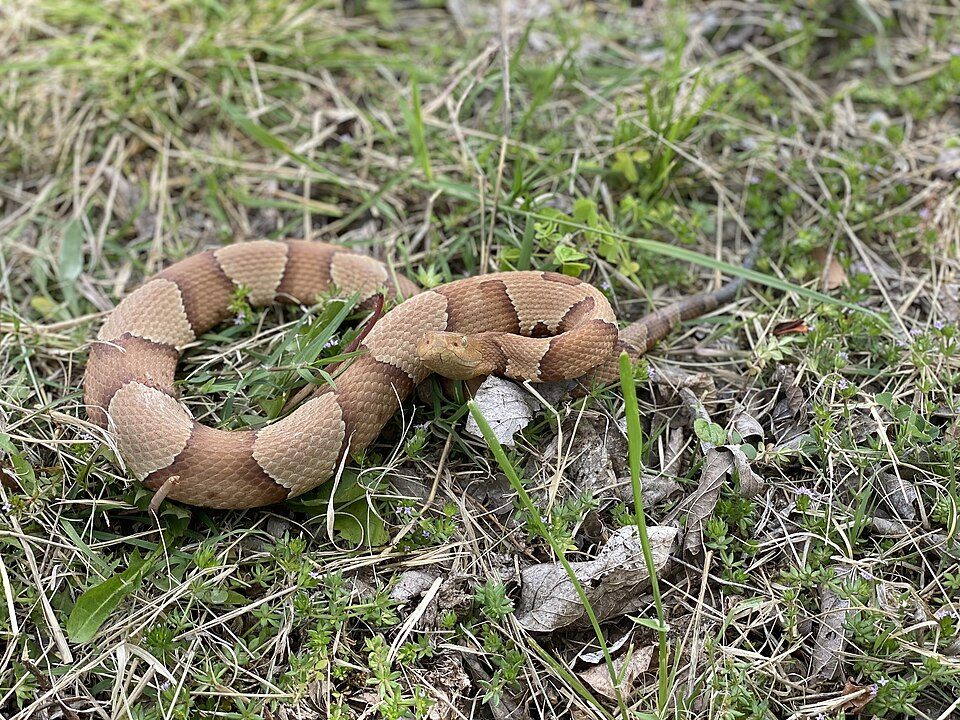

Agkistrodon laticinctus, commonly known as the broad-banded copperhead, is a venomous pit viper species, formerly considered a subspecies of Agkistrodon contortrix, which is found in the central United States, from Kansas, through Oklahoma and throughout central Texas.
From Wikipedia: Agkistrodon laticinctus, text under CC BY-SA 4.0.
Is the broad-banded copperhead poisonous or venomous?
Yes. The broad-banded copperhead is a pit viper (family Viperidae), like every rattlesnake, copperhead and cottonmouth in the U.S.
Is a broad-banded copperhead bite dangerous?
Yes. A broad-banded copperhead snake bite needs emergency care: call 911 and keep the bitten limb still. Antivenom is given in hospital.
Copperhead vs. corn snake, hog-nosed snake, milk snake and water snake
| Species commonly confused with copperheads | Its states where both are recorded |
|---|---|
| central plains milksnake | all 3 |
| corn snake | all 3 |
| eastern hog-nosed snake | all 3 |
| eastern milksnake | all 3 |
| northern water snake | all 3 |
Which states have the broad-banded copperhead?
Texas alone holds 68% of its licensed U.S. records.
| # | State | Records | Share of state snakes | Rank in state |
|---|---|---|---|---|
| 1 | Texas | 393 | 1.0% | 30th of 86 |
| 2 | Oklahoma | 181 | 1.4% | 25th of 50 |
| 3 | Kansas | 7 | 0.0% | 44th of 44 |
When is the broad-banded copperhead seen?
Its observation records run mostly March through October.
Where the broad-banded copperhead is recorded in each state
| State | Licensed records | Place among the state's snakes | Most recorded counties |
|---|---|---|---|
| Texas | 393 | 30th of 86 | Wilson County (46), Dallas County (34), Tarrant County (30), Bastrop County (24) and Travis County (22) |
| Oklahoma | 181 | 25th of 50 | Marshall County (69), Carter County (20), Comanche County (20), Payne County (14) and Osage County (11) |
Top counties in the U.S.
| # | County | State | Records | Share of U.S. |
|---|---|---|---|---|
| 1 | Marshall County | Oklahoma | 69 | 11.9% |
| 2 | Wilson County | Texas | 46 | 7.9% |
| 3 | Dallas County | Texas | 34 | 5.9% |
| 4 | Tarrant County | Texas | 30 | 5.2% |
| 5 | Bastrop County | Texas | 24 | 4.1% |
| 6 | Travis County | Texas | 22 | 3.8% |
| 7 | Carter County | Oklahoma | 20 | 3.4% |
| 8 | Comanche County | Oklahoma | 20 | 3.4% |
| 9 | Montague County | Texas | 19 | 3.3% |
| 10 | Parker County | Texas | 19 | 3.3% |
| 11 | Denton County | Texas | 19 | 3.3% |
| 12 | Milam County | Texas | 16 | 2.8% |
| 13 | Payne County | Oklahoma | 14 | 2.4% |
| 14 | Gonzales County | Texas | 13 | 2.2% |
| 15 | Osage County | Oklahoma | 11 | 1.9% |
How recent are the broad-banded copperhead records?
| Decade | Records | Share |
|---|---|---|
| 1900s | 2 | 0.3% |
| 1910s | 1 | 0.2% |
| 1920s | 10 | 1.7% |
| 1930s | 8 | 1.4% |
| 1940s | 24 | 4.2% |
| 1950s | 67 | 11.7% |
| 1960s | 53 | 9.2% |
| 1970s | 23 | 4.0% |
| 1980s | 9 | 1.6% |
| 1990s | 16 | 2.8% |
| 2000s | 22 | 3.8% |
| 2010s | 83 | 14.5% |
| 2020s | 255 | 44.5% |
Species recorded in the same counties
| Species | Shared counties |
|---|---|
| Lined snake | 17 |
| Western rat snake | 16 |
| Rough earthsnake | 15 |
| Speckled kingsnake | 15 |
| Plain-bellied watersnake | 14 |
| Rough greensnake | 14 |
| DeKay's brown snake | 13 |
| Flathead snake | 13 |
Related species in the U.S.
GBIF records read 2026-11-05 (open these records on GBIF). Listed: any license. Counted: CC0/CC BY only. How we count.