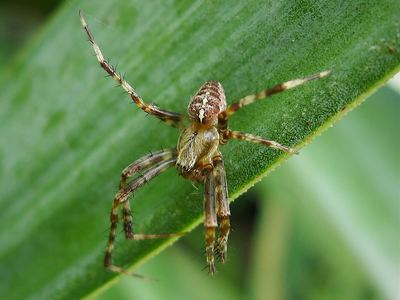
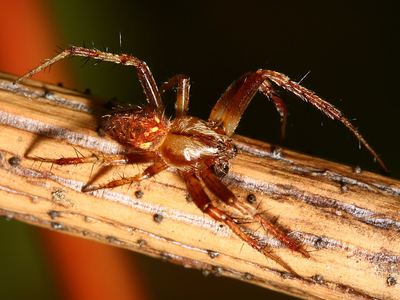
Bridge orbweaver (Larinioides sclopetarius)
The bridge orbweaver (genus Larinioides) is a spider in the family Araneidae that is not dangerous to people. Among the 31 orb weavers profiled here, it ranks 20th by number of states listed. Most of its 24 listed states are in the New England (5), East North Central (5) and South Atlantic (4) census divisions. Its observation records peak in September.
Also called: grey cross spider (English names in GBIF)
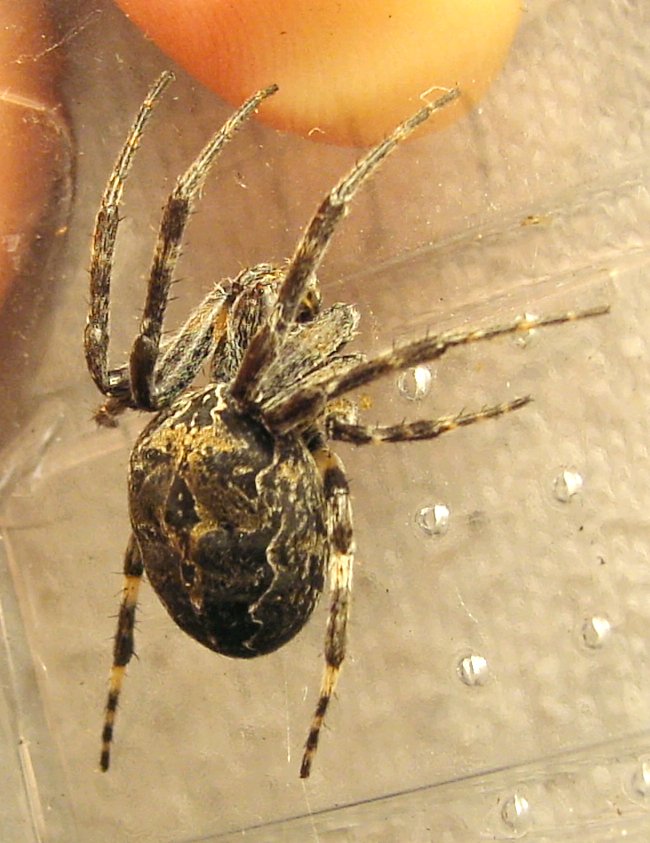

Larinioides sclopetarius, commonly called bridge-spider or gray cross-spider, is a relatively large orb-weaver spider with Holarctic distribution. These spiders originated in Europe, have been observed as south as the Mediterranean Coast and as north as Finland, and have been introduced to North America. They are often found on bridges, especially near light and over water.
From Wikipedia: Larinioides sclopetarius, text under CC BY-SA 4.0.
Is the bridge orbweaver poisonous or venomous?
Not in any medically significant way. Like almost all spiders the bridge orbweaver (family Araneidae) has venom for its prey, but it is not a widow or recluse, the two U.S. groups whose bites need medical attention.
Which states have the bridge orbweaver?
| # | State | Records | Share of state spiders | Rank in state |
|---|---|---|---|---|
| 1 | Wisconsin | 55 | 1.7% | 10th of 148 |
| 2 | Michigan | 50 | 2.0% | 14th of 123 |
| 3 | Washington | 48 | 1.1% | 17th of 159 |
| 4 | New York | 41 | 0.6% | 36th of 152 |
| 5 | Massachusetts | 38 | 0.8% | 29th of 191 |
| 6 | Illinois | 36 | 0.2% | 80th of 243 |
| 7 | Pennsylvania | 22 | 0.3% | 53rd of 169 |
| 8 | Maine | 15 | 1.5% | 17th of 298 |
| 9 | Minnesota | 15 | 0.5% | 45th of 145 |
| 10 | California | 12 | 0.0% | 207th of 312 |
| 11 | New Jersey | 11 | 0.5% | 50th of 127 |
| 12 | Vermont | 11 | 0.7% | 32nd of 73 |
| 13 | Ohio | 10 | 0.1% | 86th of 333 |
| 14 | Oregon | 9 | 0.3% | 46th of 89 |
| 15 | Connecticut | 8 | 0.8% | 28th of 85 |
| 16 | Maryland | 8 | 0.1% | 98th of 155 |
| 17 | Indiana | 7 | 0.2% | 104th of 134 |
| 18 | New Hampshire | 7 | 0.5% | 44th of 74 |
| 19 | Virginia | 7 | 0.1% | 125th of 178 |
| 20 | Alaska | 6 | 0.0% | 278th of 280 |
| 21 | Delaware | 3 | 0.1% | 63rd of 73 |
| 22 | Iowa | 2 | 0.3% | 37th of 58 |
| 23 | Tennessee | 1 | 0.0% | 125th of 143 |
| 24 | West Virginia | 1 | 0.1% | 58th of 90 |
When is the bridge orbweaver seen?
Its observation records run mostly April through October.
Season by state
Where the season stays within one calendar year, it starts earliest in March (Washington) and latest in May (Massachusetts and Wisconsin). Each of these states peaks in a different month: June in Michigan, July in Washington, August in Wisconsin, September in New York and October in Massachusetts.
| State | Main season | Peak month | Observation records |
|---|---|---|---|
| Wisconsin | May through October | August | 53 |
| Washington | March through October | July | 48 |
| Michigan | April through October | June | 46 |
| New York | April through November | September | 41 |
| Massachusetts | May through November | October | 38 |
Where the bridge orbweaver is recorded in each state
| State | Licensed records | Place among the state's spiders | Most recorded counties |
|---|---|---|---|
| Wisconsin | 55 | joint 10th of 148 | Dane County (16), Brown County (10), Milwaukee County (6), Waukesha County (6) and Kenosha County (3) |
| Michigan | 50 | 14th of 123 | Washtenaw County (7), Bay County (7), Monroe County (4), Emmet County (3) and Alcona County (2) |
| Washington | 48 | joint 17th of 159 | King County (21), Pierce County (13), Snohomish County (4), Spokane County (2) and Thurston County (2) |
| New York | 41 | joint 36th of 152 | Tompkins County (14), Erie County (5), Monroe County (3), Allegany County (2) and Oneida County (2) |
| Massachusetts | 38 | 29th of 191 | Suffolk County (30), Middlesex County (5), Norfolk County (1), Barnstable County (1) and Bristol County (1) |
| Illinois | 36 | 80th of 243 | Cook County (27), DuPage County (4), Will County (2), Winnebago County (1) and Kane County (1) |
Top counties in the U.S.
| # | County | State | Records | Share of U.S. |
|---|---|---|---|---|
| 1 | Suffolk County | Massachusetts | 30 | 6.7% |
| 2 | Cook County | Illinois | 27 | 6.0% |
| 3 | King County | Washington | 21 | 4.7% |
| 4 | Dane County | Wisconsin | 16 | 3.6% |
| 5 | Tompkins County | New York | 14 | 3.1% |
| 6 | Pierce County | Washington | 13 | 2.9% |
| 7 | Brown County | Wisconsin | 10 | 2.2% |
| 8 | Washtenaw County | Michigan | 7 | 1.6% |
| 9 | Bay County | Michigan | 7 | 1.6% |
| 10 | Milwaukee County | Wisconsin | 6 | 1.3% |
| 11 | Waukesha County | Wisconsin | 6 | 1.3% |
| 12 | Middlesex County | Massachusetts | 5 | 1.1% |
| 13 | Erie County | New York | 5 | 1.1% |
| 14 | DuPage County | Illinois | 4 | 0.9% |
| 15 | Monroe County | Michigan | 4 | 0.9% |
How recent are the bridge orbweaver records?
| Decade | Records | Share |
|---|---|---|
| 1920s | 1 | 0.2% |
| 1940s | 1 | 0.2% |
| 1950s | 4 | 0.9% |
| 1970s | 1 | 0.2% |
| 1990s | 5 | 1.1% |
| 2000s | 8 | 1.7% |
| 2010s | 78 | 16.8% |
| 2020s | 366 | 78.9% |
Species recorded in the same counties
| Species | Shared counties |
|---|---|
| Zebra spider | 38 |
| Garden spider | 36 |
| Bold jumper | 34 |
| Bronze jumper | 33 |
| Parson spider | 26 |
| Sixspotted orbweaver | 26 |
| Triangulate bud spider | 26 |
| Black-and-yellow argiope | 24 |
Related species in the U.S.
GBIF records read 2026-11-05 (open these records on GBIF). Listed: any license. Counted: CC0/CC BY only. How we count.