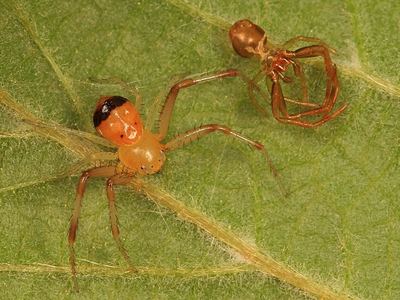
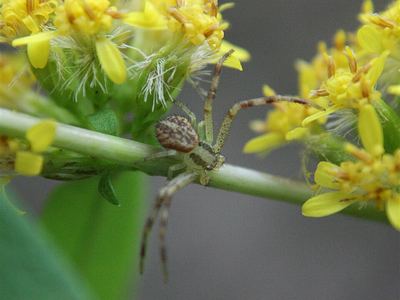
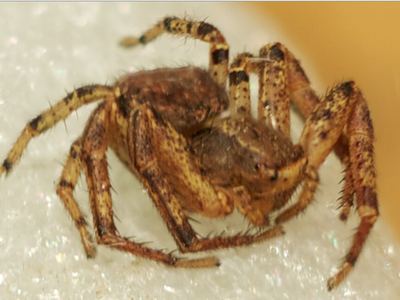
American green crab spider (Misumessus oblongus)
The American green crab spider (genus Misumessus) is a spider in the family Thomisidae that is not dangerous to people. Among the eight crab spiders profiled here, it ranks 3rd by number of states listed. Most of its 35 listed states are in the South Atlantic (8), New England (6) and East North Central (5) census divisions. None is in the West. Its observation records peak in July.
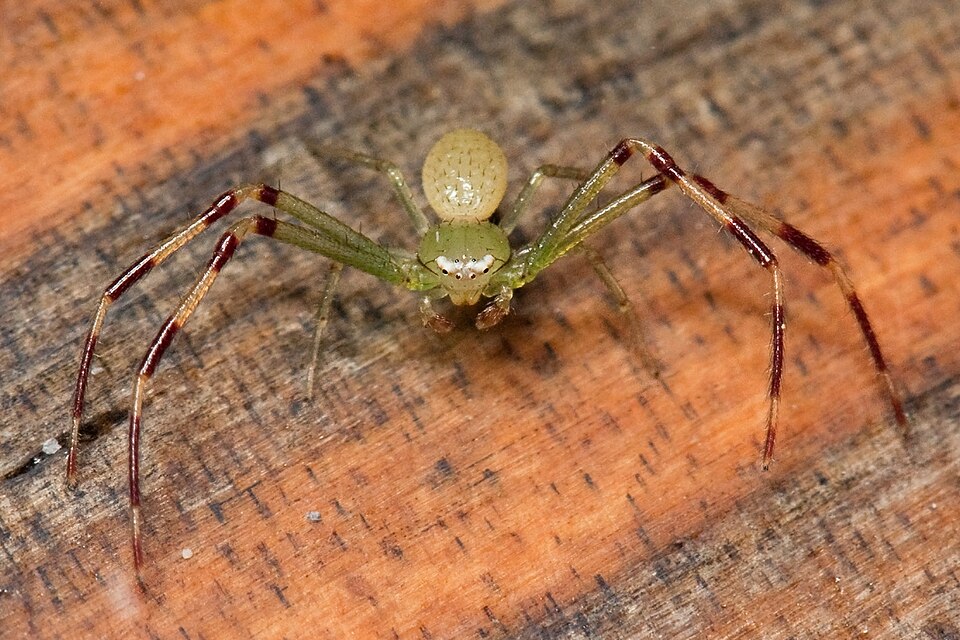

Misumessus oblongus, also known as the American green crab spider, is a species of crab spider in the family Thomisidae. It is found in Canada, the United States, and Mexico.
From Wikipedia: Misumessus oblongus, text under CC BY-SA 4.0.
Is the American green crab spider poisonous or venomous?
Not in any medically significant way. Like almost all spiders the American green crab spider (family Thomisidae) has venom for its prey, but it is not a widow or recluse, the two U.S. groups whose bites need medical attention.
Which states have the American green crab spider?
| # | State | Records | Share of state spiders | Rank in state |
|---|---|---|---|---|
| 1 | Virginia | 213 | 1.8% | 15th of 178 |
| 2 | Ohio | 110 | 1.5% | 15th of 333 |
| 3 | Maryland | 109 | 1.9% | 12th of 155 |
| 4 | Georgia | 103 | 1.5% | 17th of 190 |
| 5 | North Carolina | 103 | 1.2% | 21st of 189 |
| 6 | Pennsylvania | 88 | 1.1% | 17th of 169 |
| 7 | New York | 76 | 1.2% | 22nd of 152 |
| 8 | Illinois | 56 | 0.3% | 52nd of 243 |
| 9 | Indiana | 46 | 1.0% | 20th of 134 |
| 10 | Alabama | 44 | 1.1% | 17th of 146 |
| 11 | Tennessee | 37 | 1.0% | 28th of 143 |
| 12 | New Jersey | 33 | 1.4% | 18th of 127 |
| 13 | Delaware | 29 | 1.3% | 19th of 73 |
| 14 | Massachusetts | 28 | 0.6% | 41st of 191 |
| 15 | Texas | 20 | 0.1% | 151st of 387 |
| 16 | Kentucky | 18 | 0.9% | 32nd of 104 |
| 17 | Missouri | 15 | 0.6% | 34th of 117 |
| 18 | Connecticut | 14 | 1.3% | 20th of 85 |
| 19 | South Carolina | 14 | 0.5% | 45th of 124 |
| 20 | New Hampshire | 12 | 0.8% | 31st of 74 |
| 21 | Michigan | 11 | 0.4% | 40th of 123 |
| 22 | Arkansas | 9 | 0.5% | 47th of 114 |
| 23 | West Virginia | 9 | 1.1% | 24th of 90 |
| 24 | Oklahoma | 8 | 0.2% | 85th of 151 |
| 25 | Iowa | 7 | 1.0% | 19th of 58 |
| 26 | Louisiana | 7 | 0.2% | 73rd of 108 |
| 27 | Mississippi | 7 | 0.5% | 41st of 117 |
| 28 | Florida | 6 | 0.0% | 178th of 241 |
| 29 | Maine | 6 | 0.6% | 34th of 298 |
| 30 | Vermont | 6 | 0.4% | 36th of 73 |
| 31 | Nebraska | 5 | 0.4% | 48th of 72 |
| 32 | Wisconsin | 5 | 0.2% | 103rd of 148 |
| 33 | Kansas | 4 | 0.2% | 58th of 93 |
| 34 | Minnesota | 4 | 0.1% | 93rd of 145 |
| 35 | Rhode Island | 0 | — | — |
When is the American green crab spider seen?
Its observation records run mostly May through September.
Season by state
Where the season stays within one calendar year, it starts earliest in April (Alabama) and latest in June (Maryland, New Jersey, Pennsylvania and Tennessee). June is the most common peak month (Illinois, Indiana, Maryland, Ohio and Tennessee).
| State | Main season | Peak month | Observation records |
|---|---|---|---|
| Virginia | May through September | August | 213 |
| Maryland | June through September | June | 109 |
| Ohio | May through September | June | 109 |
| Georgia | May through September | May | 103 |
| North Carolina | May through September | August | 103 |
| Pennsylvania | June through September | July | 87 |
| New York | May through August | July | 75 |
| Alabama | April through September | May | 44 |
| Indiana | May through August | June | 43 |
| Illinois | May through August | June | 41 |
| Tennessee | June through September | June | 37 |
| New Jersey | June through September | July | 33 |
Where the American green crab spider is recorded in each state
| State | Licensed records | Place among the state's spiders | Most recorded counties |
|---|---|---|---|
| Virginia | 213 | 15th of 178 | Fairfax County (91), Arlington County (31), Loudoun County (27), Fairfax City County (8) and Highland County (5) |
| Ohio | 110 | 15th of 333 | Franklin County (22), Hamilton County (11), Montgomery County (7), Cuyahoga County (5) and Summit County (5) |
| Maryland | 109 | 12th of 155 | Montgomery County (27), Frederick County (15), Baltimore County (12), Prince George's County (11) and Carroll County (10) |
| Georgia | 103 | 17th of 190 | Cobb County (20), DeKalb County (17), Bartow County (13), Clarke County (10) and Gwinnett County (10) |
| North Carolina | 103 | 21st of 189 | Orange County (36), Wake County (14), Mecklenburg County (11), Durham County (9) and Cumberland County (5) |
| Pennsylvania | 88 | 17th of 169 | Allegheny County (14), Bucks County (13), Montgomery County (10), Philadelphia County (7) and Berks County (6) |
| New York | 76 | 22nd of 152 | Tompkins County (10), Rockland County (7), Westchester County (7), Suffolk County (6) and Richmond County (5) |
| Illinois | 56 | joint 52nd of 243 | Champaign County (10), McLean County (7), Cook County (6), Jo Daviess County (5) and Coles County (2) |
| Indiana | 46 | 20th of 134 | Lake County (6), Marion County (6), Morgan County (6), Tippecanoe County (5) and Allen County (4) |
| Alabama | 44 | 17th of 146 | Blount County (10), Pickens County (9), Jefferson County (7), Tuscaloosa County (4) and DeKalb County (3) |
| Tennessee | 37 | 28th of 143 | Knox County (10), Williamson County (7), Davidson County (4), Robertson County (3) and Blount County (2) |
| New Jersey | 33 | joint 18th of 127 | Hunterdon County (5), Burlington County (4), Monmouth County (3), Salem County (3) and Bergen County (3) |
Top counties in the U.S.
| # | County | State | Records | Share of U.S. |
|---|---|---|---|---|
| 1 | Fairfax County | Virginia | 91 | 7.2% |
| 2 | Orange County | North Carolina | 36 | 2.8% |
| 3 | Arlington County | Virginia | 31 | 2.4% |
| 4 | Montgomery County | Maryland | 27 | 2.1% |
| 5 | Loudoun County | Virginia | 27 | 2.1% |
| 6 | Franklin County | Ohio | 22 | 1.7% |
| 7 | Cobb County | Georgia | 20 | 1.6% |
| 8 | DeKalb County | Georgia | 17 | 1.3% |
| 9 | Frederick County | Maryland | 15 | 1.2% |
| 10 | Wake County | North Carolina | 14 | 1.1% |
| 11 | Allegheny County | Pennsylvania | 14 | 1.1% |
| 12 | Bartow County | Georgia | 13 | 1.0% |
| 13 | Bucks County | Pennsylvania | 13 | 1.0% |
| 14 | Baltimore County | Maryland | 12 | 0.9% |
| 15 | Prince George's County | Maryland | 11 | 0.9% |
How recent are the American green crab spider records?
| Decade | Records | Share |
|---|---|---|
| 1910s | 1 | 0.1% |
| 1920s | 1 | 0.1% |
| 1930s | 4 | 0.3% |
| 1940s | 1 | 0.1% |
| 1960s | 1 | 0.1% |
| 1970s | 2 | 0.1% |
| 1980s | 9 | 0.7% |
| 1990s | 6 | 0.4% |
| 2000s | 12 | 0.9% |
| 2010s | 141 | 10.5% |
| 2020s | 1,163 | 86.7% |
Species recorded in the same counties
| Species | Shared counties |
|---|---|
| Orchard orbweaver | 117 |
| Familiar jumping spider | 113 |
| Nursery web spider | 113 |
| Spotted orbweaver | 112 |
| Spined micrathena | 111 |
| Paraphidippus aurantius | 105 |
| Black-and-yellow argiope | 104 |
| Bold jumper | 97 |
Related species in the U.S.
GBIF records read 2026-11-05 (open these records on GBIF). Listed: any license. Counted: CC0/CC BY only. How we count.