Cone-shaped orbweaver (Cyclosa conica)
The cone-shaped orbweaver (genus Cyclosa) is a spider in the family Araneidae that is not dangerous to people. Among the 31 orb weavers profiled here, it ranks 8th by number of states listed, level with two others. Most of its 33 listed states are in the New England (6), South Atlantic (6) and East North Central (5) census divisions. Its observation records peak in May.
Also called: conical orbweaver, conical trashline orbweaver (English names in GBIF)
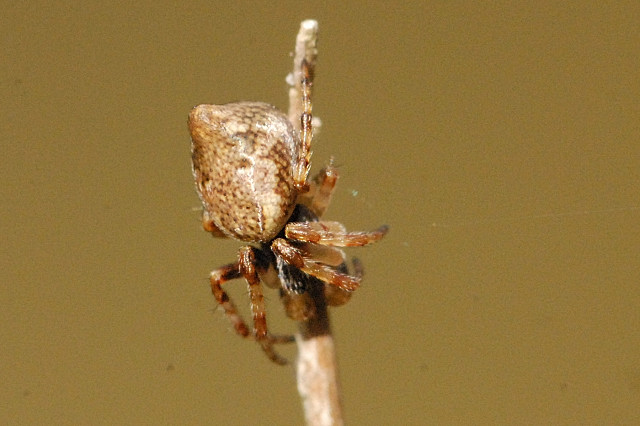

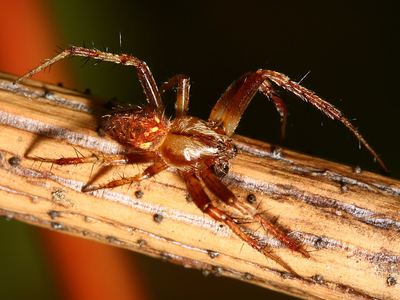
Cyclosa conica is a small spider with no common name. It is an orb weaver, and it is easily recognized by the way it strings together the dead bodies of insects and other debris and hangs it near the center of its web. It hides on this string of debris, and its natural coloration makes it extremely difficult to see until it moves.
From Wikipedia: Cyclosa conica, text under CC BY-SA 4.0.
Is the cone-shaped orbweaver poisonous or venomous?
Not in any medically significant way. Like almost all spiders the cone-shaped orbweaver (family Araneidae) has venom for its prey, but it is not a widow or recluse, the two U.S. groups whose bites need medical attention.
Which states have the cone-shaped orbweaver?
| # | State | Records | Share of state spiders | Rank in state |
|---|---|---|---|---|
| 1 | California | 105 | 0.2% | 59th of 312 |
| 2 | Alaska | 68 | 0.3% | 70th of 280 |
| 3 | Ohio | 58 | 0.8% | 31st of 333 |
| 4 | Maryland | 33 | 0.6% | 44th of 155 |
| 5 | Oregon | 27 | 0.9% | 22nd of 89 |
| 6 | Washington | 25 | 0.6% | 34th of 159 |
| 7 | Massachusetts | 23 | 0.5% | 48th of 191 |
| 8 | New York | 23 | 0.4% | 53rd of 152 |
| 9 | Minnesota | 17 | 0.5% | 41st of 145 |
| 10 | North Carolina | 17 | 0.2% | 75th of 189 |
| 11 | Montana | 16 | 0.7% | 16th of 73 |
| 12 | New Hampshire | 14 | 1.0% | 26th of 74 |
| 13 | Virginia | 14 | 0.1% | 101st of 178 |
| 14 | Wisconsin | 12 | 0.4% | 62nd of 148 |
| 15 | Maine | 11 | 1.1% | 23rd of 298 |
| 16 | Michigan | 11 | 0.4% | 40th of 123 |
| 17 | Utah | 10 | 0.4% | 28th of 99 |
| 18 | Kentucky | 9 | 0.4% | 49th of 104 |
| 19 | Pennsylvania | 9 | 0.1% | 93rd of 169 |
| 20 | Colorado | 5 | 0.1% | 75th of 372 |
| 21 | Illinois | 5 | 0.0% | 225th of 243 |
| 22 | Indiana | 5 | 0.1% | 115th of 134 |
| 23 | New Jersey | 5 | 0.2% | 82nd of 127 |
| 24 | Iowa | 4 | 0.6% | 28th of 58 |
| 25 | Connecticut | 3 | 0.3% | 50th of 85 |
| 26 | Idaho | 3 | 0.6% | 28th of 58 |
| 27 | Missouri | 3 | 0.1% | 78th of 117 |
| 28 | Vermont | 3 | 0.2% | 45th of 73 |
| 29 | Delaware | 2 | 0.1% | 67th of 73 |
| 30 | Georgia | 2 | 0.0% | 156th of 190 |
| 31 | West Virginia | 2 | 0.3% | 48th of 90 |
| 32 | Rhode Island | 1 | 0.6% | 30th of 52 |
| 33 | Wyoming | 1 | 0.5% | 21st of 68 |
When is the cone-shaped orbweaver seen?
Its observation records run mostly March through October.
Season by state
Where the season stays within one calendar year, it starts earliest in March (Maryland) and latest in April (Ohio). April is the most common peak month (California, Maryland and Ohio).
| State | Main season | Peak month | Observation records |
|---|---|---|---|
| California | October through June | April | 96 |
| Ohio | April through October | April | 58 |
| Maryland | March through September | April | 33 |
Where the cone-shaped orbweaver is recorded in each state
| State | Licensed records | Place among the state's spiders | Most recorded counties |
|---|---|---|---|
| California | 105 | 59th of 312 | Contra Costa County (19), Marin County (10), Sonoma County (9), Alameda County (7) and Santa Clara County (7) |
| Alaska | 68 | joint 70th of 280 | Kenai Peninsula Borough (35), Fairbanks North Star Borough (10), Prince of Wales-Outer Ketchikan Census Area (6), Wrangell-Petersburg Census Area (4) and Anchorage Municipality (4) |
| Ohio | 58 | 31st of 333 | Franklin County (26), Mahoning County (8), Richland County (8), Summit County (7) and Delaware County (3) |
| Maryland | 33 | joint 44th of 155 | Frederick County (11), Harford County (6), Montgomery County (5), Howard County (3) and Prince George's County (2) |
Top counties in the U.S.
| # | County | State | Records | Share of U.S. |
|---|---|---|---|---|
| 1 | Kenai Peninsula Borough | Alaska | 35 | 6.3% |
| 2 | Franklin County | Ohio | 26 | 4.7% |
| 3 | Contra Costa County | California | 19 | 3.4% |
| 4 | Frederick County | Maryland | 11 | 2.0% |
| 5 | Fairbanks North Star Borough | Alaska | 10 | 1.8% |
| 6 | Marin County | California | 10 | 1.8% |
| 7 | Sonoma County | California | 9 | 1.6% |
| 8 | Mahoning County | Ohio | 8 | 1.4% |
| 9 | Richland County | Ohio | 8 | 1.4% |
| 10 | Alameda County | California | 7 | 1.3% |
| 11 | Santa Clara County | California | 7 | 1.3% |
| 12 | Summit County | Ohio | 7 | 1.3% |
| 13 | Prince of Wales-Outer Ketchikan Census Area | Alaska | 6 | 1.1% |
| 14 | Los Angeles County | California | 6 | 1.1% |
| 15 | San Mateo County | California | 6 | 1.1% |
How recent are the cone-shaped orbweaver records?
| Decade | Records | Share |
|---|---|---|
| 1940s | 1 | 0.2% |
| 1960s | 1 | 0.2% |
| 1970s | 4 | 0.7% |
| 1980s | 3 | 0.5% |
| 1990s | 2 | 0.4% |
| 2000s | 33 | 5.8% |
| 2010s | 112 | 19.8% |
| 2020s | 410 | 72.4% |
Species recorded in the same counties
| Species | Shared counties |
|---|---|
| Sixspotted orbweaver | 22 |
| Spotted orbweaver | 22 |
| Banded garden spider | 20 |
| Black-and-yellow argiope | 20 |
| Bowl and doily spider | 20 |
| Arabesque orbweaver | 19 |
| Bold jumper | 19 |
| Triangulate bud spider | 19 |
Related species in the U.S.
GBIF records read 2026-11-05 (open these records on GBIF). Listed: any license. Counted: CC0/CC BY only. How we count.