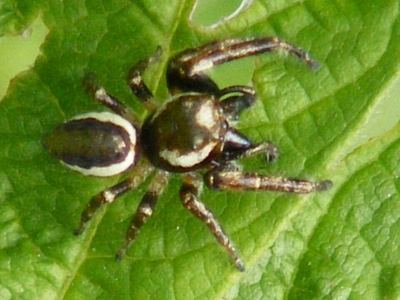
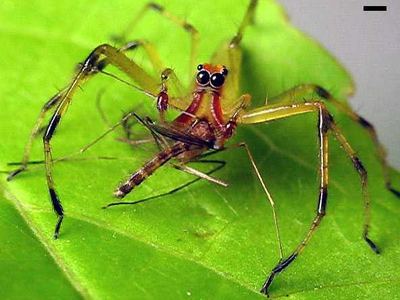
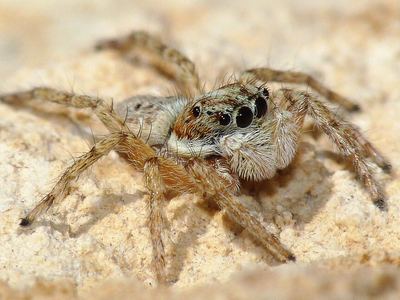
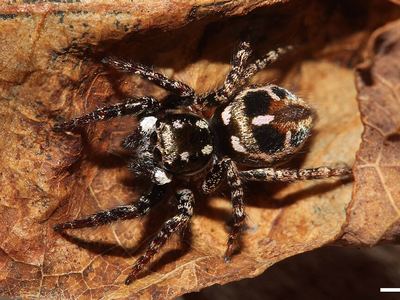
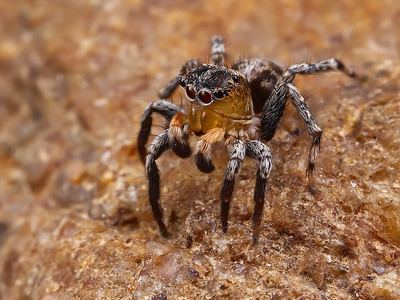
Ribbon jumping spider (Metacyrba taeniola)
The ribbon jumping spider is a spider in the family Salticidae that is not dangerous to people. GBIF holds 591 licensed U.S. records of it; it reaches our listing threshold in 18 states, most of all California (237), Texas (75) and Virginia (52). Its observation records peak in June.
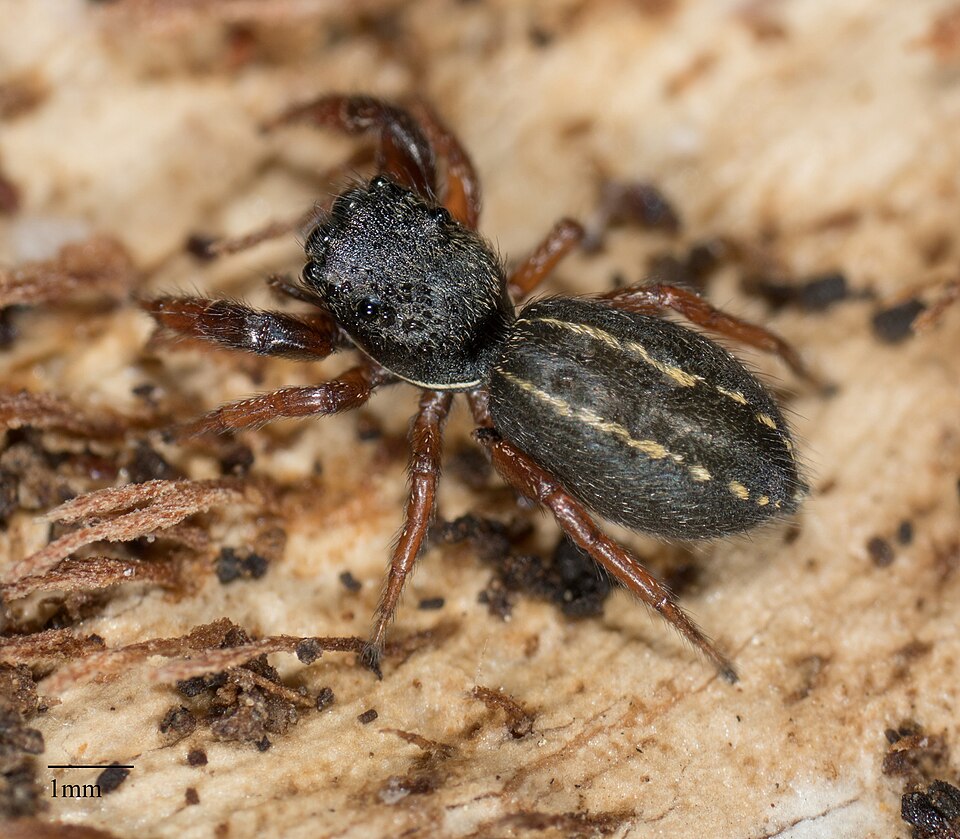

Metacyrba taeniola, or the ribbon jumping spider, is a species of spider in the family Salticidae, the jumping spiders. Males grow to a length of 4.4–6.0 millimeters (0.17–0.24 in), while females reach 5.0–7.2 mm (0.20–0.28 in). M. taeniola differs from related species such as Metacyrba floridana and M. punctata by its greater overall size, and by the relative broadness of its carapace, which is around 70% of its length.
From Wikipedia: Metacyrba taeniola, text under CC BY-SA 4.0.
Is the ribbon jumping spider poisonous or venomous?
Not in any medically significant way. Like almost all spiders the ribbon jumping spider (family Salticidae) has venom for its prey, but it is not a widow or recluse, the two U.S. groups whose bites need medical attention.
Which states have the ribbon jumping spider?
Records are spread over 18 states; the top three, California, Texas and Virginia, hold 62% of them.
| # | State | Records | Share of state spiders | Rank in state |
|---|---|---|---|---|
| 1 | California | 237 | 0.5% | 33rd of 309 |
| 2 | Texas | 75 | 0.3% | 76th of 386 |
| 3 | Virginia | 52 | 0.5% | 50th of 176 |
| 4 | Maryland | 49 | 0.9% | 33rd of 153 |
| 5 | Arizona | 24 | 0.5% | 21st of 162 |
| 6 | Delaware | 22 | 1.0% | 24th of 71 |
| 7 | North Carolina | 20 | 0.2% | 68th of 184 |
| 8 | Oklahoma | 20 | 0.4% | 51st of 149 |
| 9 | Arkansas | 14 | 0.9% | 31st of 114 |
| 10 | Tennessee | 14 | 0.4% | 54th of 138 |
| 11 | Georgia | 13 | 0.2% | 81st of 186 |
| 12 | New Jersey | 13 | 0.6% | 45th of 127 |
| 13 | Pennsylvania | 13 | 0.2% | 72nd of 164 |
| 14 | New Mexico | 8 | 0.3% | 60th of 247 |
| 15 | Alabama | 5 | 0.1% | 85th of 143 |
| 16 | South Carolina | 5 | 0.2% | 68th of 121 |
| 17 | Florida | 3 | 0.0% | 208th of 237 |
| 18 | Nevada | 1 | 0.2% | 36th of 47 |
When is the ribbon jumping spider seen?
Across the U.S., observation records of the ribbon jumping spider run through most of the year, peaking in June with 16% of them. Winter (December to February) holds 19% of them.
Season by state
Observation records run through most of the year in California. Among states whose main season falls within one calendar year, it starts earliest in February (Maryland and Texas) and latest in March (Virginia). The most common peak month is April, shared by Texas and Virginia.
| State | Main season | Peak month | Observation records |
|---|---|---|---|
| California | most of the year | January | 215 |
| Texas | February through October | April | 70 |
| Virginia | March through October | April | 52 |
| Maryland | February through September | June | 49 |
Where the ribbon jumping spider is recorded in each state
California
California holds 237 licensed records, the 33rd most recorded of 309 spiders listed there. Its observation records in California run through most of the year, peaking in January; most licensed records come from Sacramento County, Los Angeles County and Riverside County. Next come San Diego County (17) and San Bernardino County (10).
Texas
Texas holds 75 licensed records, the joint 76th most recorded of 386 spiders listed there. Its observation records in Texas run mostly February through October, peaking in April; most licensed records come from Dallas County, Lubbock County and Travis County. Next come Hidalgo County (5) and Bexar County (4).
Virginia
Virginia holds 52 licensed records, the 50th most recorded of 176 spiders listed there. Its observation records in Virginia run mostly March through October, peaking in April; most licensed records come from Fairfax County, Arlington County and Prince William County. Next come Fairfax City County (2) and Norfolk (2).
Maryland
Maryland holds 49 licensed records, the 33rd most recorded of 153 spiders listed there. Its observation records in Maryland run mostly February through September, peaking in June; most licensed records come from Montgomery County, Anne Arundel County and Baltimore County. Next come Prince George's County (4) and Howard County (3).
Top counties in the U.S.
| # | County | State | Records | Share of U.S. |
|---|---|---|---|---|
| 1 | Sacramento County | California | 103 | 17.4% |
| 2 | Fairfax County | Virginia | 25 | 4.2% |
| 3 | Los Angeles County | California | 22 | 3.7% |
| 4 | Riverside County | California | 20 | 3.4% |
| 5 | Montgomery County | Maryland | 19 | 3.2% |
| 6 | San Diego County | California | 17 | 2.9% |
| 7 | Dallas County | Texas | 15 | 2.5% |
| 8 | Lubbock County | Texas | 14 | 2.4% |
| 9 | Arlington County | Virginia | 13 | 2.2% |
| 10 | San Bernardino County | California | 10 | 1.7% |
| 11 | Anne Arundel County | Maryland | 9 | 1.5% |
| 12 | Baltimore County | Maryland | 9 | 1.5% |
| 13 | Monterey County | California | 8 | 1.4% |
| 14 | San Luis Obispo County | California | 8 | 1.4% |
| 15 | Travis County | Texas | 7 | 1.2% |
How recent are the ribbon jumping spider records?
Most of what is known about the ribbon jumping spider is recent: 90% of dated U.S. records were made in 2017–2026, and half date from 2022 or later. The oldest dated record is from 1928; the busiest year was 2025, with 139 records.
| Decade | Records | Share |
|---|---|---|
| 1920s | 1 | 0.2% |
| 1940s | 8 | 1.3% |
| 1970s | 1 | 0.2% |
| 1980s | 6 | 1.0% |
| 1990s | 4 | 0.7% |
| 2000s | 9 | 1.5% |
| 2010s | 86 | 14.3% |
| 2020s | 485 | 80.8% |
Species recorded in the same counties
Of the 51 counties where the ribbon jumping spider is most recorded, 33 are also top counties for the bold jumper, more than for any other spider. None of its closest neighbors is venomous.
| Species | Shared counties |
|---|---|
| Bold jumper | 33 |
| Spotted orbweaver | 32 |
| Arabesque orbweaver | 27 |
| Dysdera crocata | 27 |
| Triangulate bud spider | 27 |
| Black-and-yellow argiope | 25 |
| Bowl and doily spider | 25 |
| Common house spider | 22 |
Related species in the U.S.
Other members of the family Salticidae with profiles here: Bold jumper, Familiar jumping spider, Zebra spider, Bronze jumper, Magnolia green jumper and Half-edged wall jumping spider.
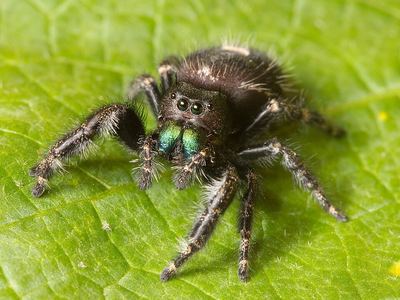
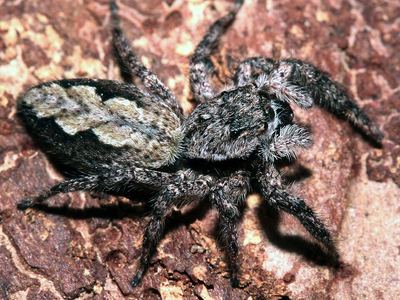
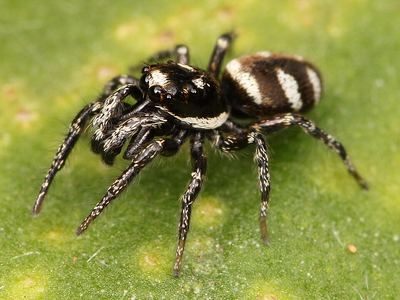
GBIF records read 2026-09-29. Listed: any license. Counted: CC0/CC BY only. How we count.