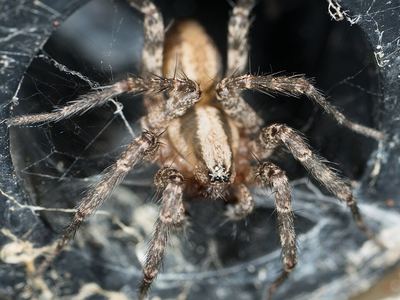
Barn funnel weaver (Tegenaria domestica)
The barn funnel weaver is a spider in the family Agelenidae that is not dangerous to people. GBIF holds 392 licensed U.S. records of it; it reaches our listing threshold in 34 states, most of all Colorado (64), Illinois (35) and Alaska (33). Its observation records peak in July.
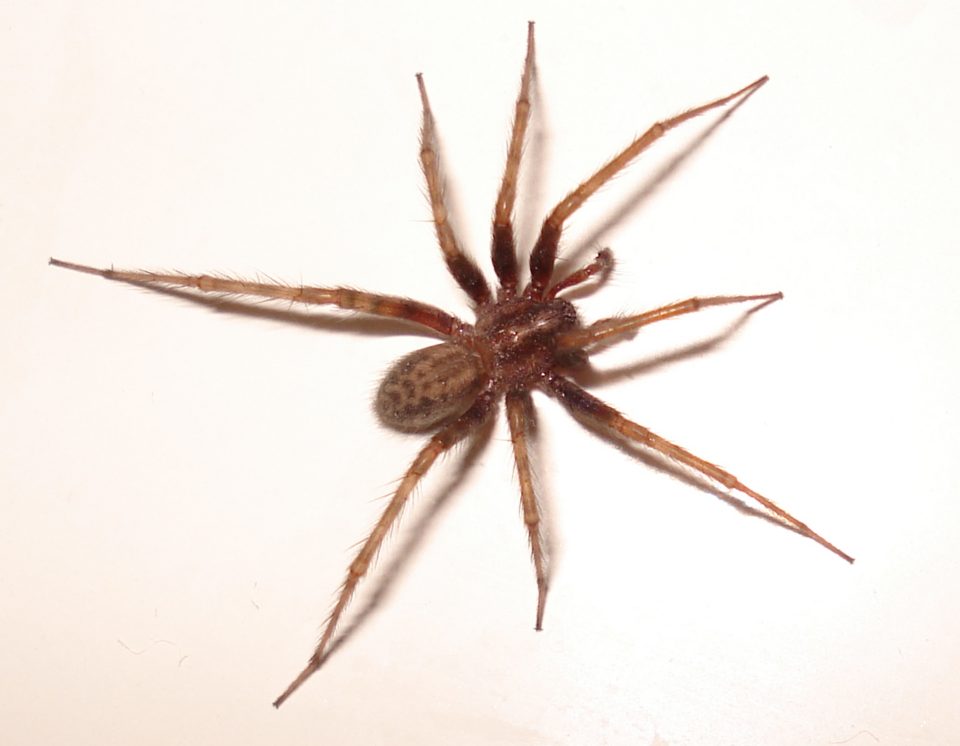
The spider species Tegenaria domestica, commonly known as the barn funnel weaver in North America and the domestic house spider in Europe, is a member of the funnel-web family Agelenidae.
From Wikipedia: Tegenaria domestica, text under CC BY-SA 4.0.
Is the barn funnel weaver poisonous or venomous?
Not in any medically significant way. Like almost all spiders the barn funnel weaver (family Agelenidae) has venom for its prey, but it is not a widow or recluse, the two U.S. groups whose bites need medical attention.
Which states have the barn funnel weaver?
Records are spread over 34 states; the top three, Colorado, Illinois and Alaska, hold 34% of them.
| # | State | Records | Share of state spiders | Rank in state |
|---|---|---|---|---|
| 1 | Colorado | 64 | 1.5% | 10th of 378 |
| 2 | Illinois | 35 | 0.2% | 79th of 243 |
| 3 | Alaska | 33 | 0.1% | 139th of 280 |
| 4 | Pennsylvania | 29 | 0.4% | 47th of 164 |
| 5 | Minnesota | 28 | 0.9% | 24th of 145 |
| 6 | Oregon | 24 | 0.9% | 23rd of 88 |
| 7 | Utah | 24 | 1.0% | 14th of 97 |
| 8 | Ohio | 18 | 0.3% | 71st of 332 |
| 9 | Washington | 17 | 0.4% | 43rd of 157 |
| 10 | Kentucky | 13 | 0.7% | 39th of 103 |
| 11 | California | 12 | 0.0% | 207th of 309 |
| 12 | Indiana | 11 | 0.2% | 79th of 133 |
| 13 | Iowa | 11 | 1.6% | 13th of 57 |
| 14 | Montana | 9 | 0.4% | 23rd of 75 |
| 15 | Wisconsin | 7 | 0.2% | 87th of 149 |
| 16 | Maryland | 6 | 0.1% | 107th of 153 |
| 17 | Massachusetts | 6 | 0.1% | 93rd of 189 |
| 18 | Nebraska | 6 | 0.5% | 42nd of 71 |
| 19 | New York | 6 | 0.1% | 96th of 149 |
| 20 | Michigan | 4 | 0.2% | 65th of 122 |
| 21 | New Jersey | 4 | 0.2% | 90th of 127 |
| 22 | West Virginia | 4 | 0.5% | 38th of 90 |
| 23 | South Dakota | 3 | 1.6% | 10th of 29 |
| 24 | Virginia | 3 | 0.0% | 155th of 176 |
| 25 | Wyoming | 3 | 1.4% | 6th of 68 |
| 26 | Kansas | 2 | 0.1% | 74th of 94 |
| 27 | Missouri | 2 | 0.1% | 82nd of 117 |
| 28 | North Dakota | 2 | 2.4% | 8th of 115 |
| 29 | Vermont | 2 | 0.1% | 57th of 74 |
| 30 | Idaho | 1 | 0.2% | 35th of 56 |
| 31 | Connecticut | 0 | — | — |
| 32 | Maine | 0 | — | — |
| 33 | New Mexico | 0 | — | — |
| 34 | Tennessee | 0 | — | — |
When is the barn funnel weaver seen?
Across the U.S., observation records of the barn funnel weaver run mostly January through September, peaking in July with 18% of them. Winter (December to February) holds 11% of them.
Where the barn funnel weaver is recorded in each state
Colorado
Colorado holds 64 licensed records, the 10th most recorded of 378 spiders listed there. Its observation records in Colorado run mostly January through August, peaking in July; most licensed records come from Boulder County, El Paso County and Denver County. Next come Larimer County (9) and Jefferson County (4).
Illinois
Illinois holds 35 licensed records, the joint 79th most recorded of 243 spiders listed there. Most of its licensed records in Illinois come from Cook County, Champaign County and McHenry County. Next come DuPage County (2) and Jo Daviess County (2).
Alaska
Alaska holds 33 licensed records, the joint 139th most recorded of 280 spiders listed there. Most of its licensed records in Alaska come from Anchorage Municipality, Wrangell-Petersburg Census Area and Ketchikan Gateway Borough. Next come Matanuska-Susitna Borough (2) and Kodiak Island Borough (1).
Top counties in the U.S.
| # | County | State | Records | Share of U.S. |
|---|---|---|---|---|
| 1 | Boulder County | Colorado | 29 | 7.4% |
| 2 | Anchorage Municipality | Alaska | 19 | 4.8% |
| 3 | Cook County | Illinois | 18 | 4.6% |
| 4 | El Paso County | Colorado | 10 | 2.6% |
| 5 | Denver County | Colorado | 9 | 2.3% |
| 6 | Larimer County | Colorado | 9 | 2.3% |
| 7 | Champaign County | Illinois | 6 | 1.5% |
| 8 | Wrangell-Petersburg Census Area | Alaska | 5 | 1.3% |
| 9 | Ketchikan Gateway Borough | Alaska | 4 | 1.0% |
| 10 | Jefferson County | Colorado | 4 | 1.0% |
| 11 | McHenry County | Illinois | 3 | 0.8% |
| 12 | Matanuska-Susitna Borough | Alaska | 2 | 0.5% |
| 13 | DuPage County | Illinois | 2 | 0.5% |
| 14 | Jo Daviess County | Illinois | 2 | 0.5% |
| 15 | Kodiak Island Borough | Alaska | 1 | 0.3% |
How recent are the barn funnel weaver records?
Most of what is known about the barn funnel weaver is recent: 87% of dated U.S. records were made in 2017–2026, and half date from 2022 or later. The oldest dated record is from 1967; the busiest year was 2025, with 60 records.
| Decade | Records | Share |
|---|---|---|
| 1960s | 2 | 0.5% |
| 1980s | 4 | 1.0% |
| 1990s | 9 | 2.2% |
| 2000s | 17 | 4.2% |
| 2010s | 72 | 18.0% |
| 2020s | 297 | 74.1% |
Species recorded in the same counties
Of the 24 counties where the barn funnel weaver is most recorded, 14 are also top counties for both Dysdera crocata and the triangulate bud spider; no other spider shares more. None of its closest neighbors is venomous.
| Species | Shared counties |
|---|---|
| Dysdera crocata | 14 |
| Triangulate bud spider | 14 |
| Banded garden spider | 13 |
| Bold jumper | 13 |
| Zebra spider | 13 |
| Asian wall jumper | 12 |
| Peppered jumper | 10 |
| Parson spider | 9 |
Related species in the U.S.
Other members of the family Agelenidae with profiles here: Corner funnel weaver.

GBIF records read 2026-09-29. Listed: any license. Counted: CC0/CC BY only. How we count.