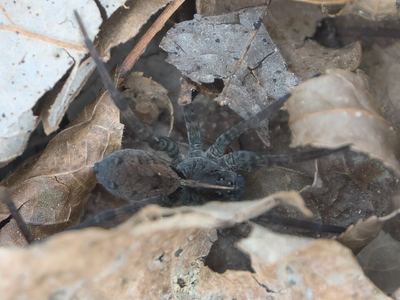
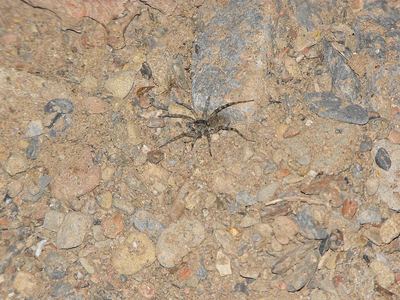
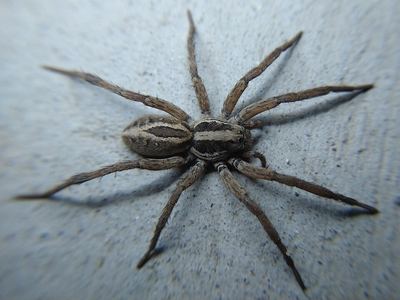
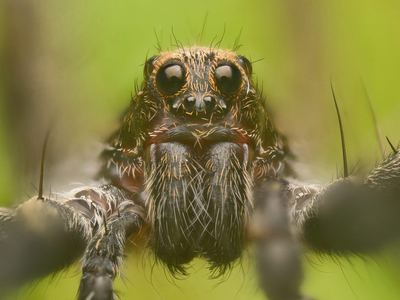
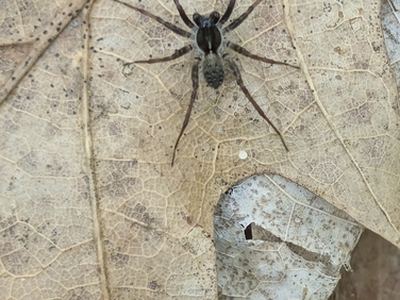
Drumming sword wolf spider (Gladicosa gulosa)
The drumming sword wolf spider (genus Gladicosa) is a spider in the family Lycosidae that is not dangerous to people. Among the 13 wolf spiders profiled here, it ranks 5th by number of states listed. Most of its 28 listed states are in the New England (6), South Atlantic (6) and East North Central (5) census divisions. Its observation records peak in April.
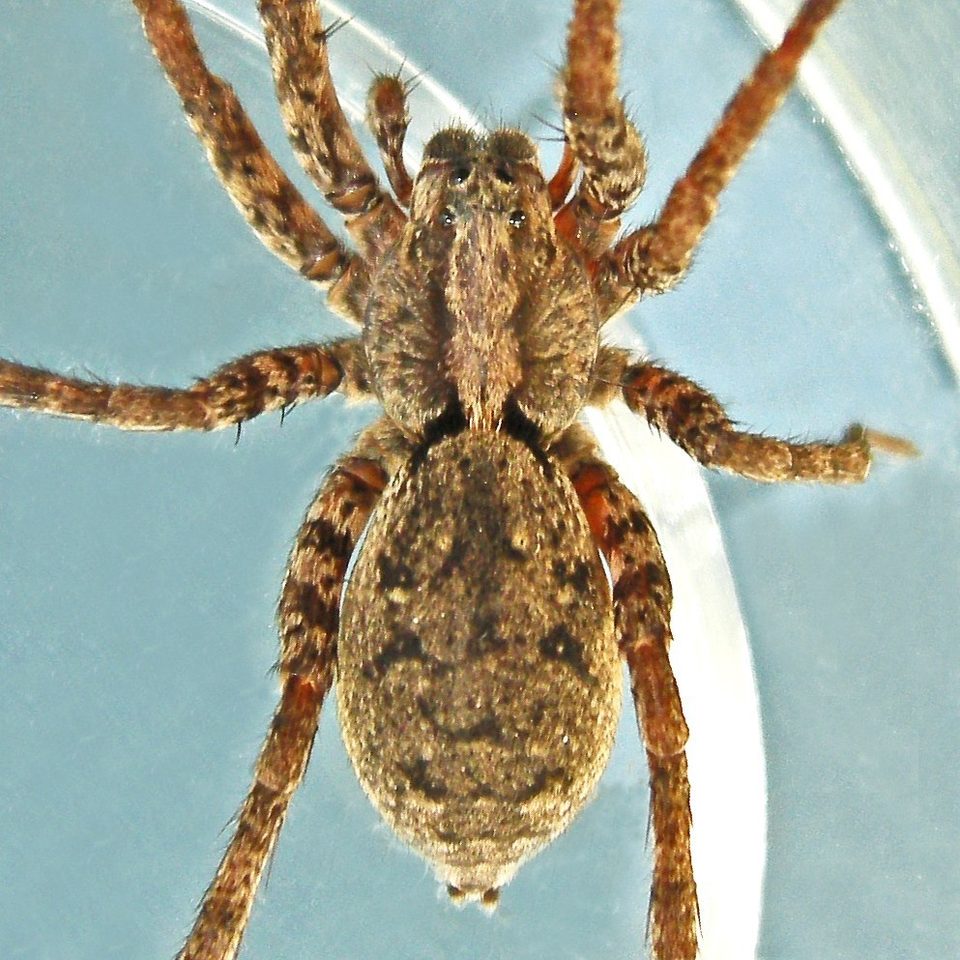
Gladicosa gulosa (the drumming sword wolf spider ) is a type of wolf spider found, among other habits, in Beech-Maple forests of the US and Canada, where the spider can be found in the plant strata of ground, herb or shrub.
From Wikipedia: Gladicosa gulosa, text under CC BY-SA 4.0.
Is the drumming sword wolf spider poisonous or venomous?
Not in any medically significant way. Like almost all spiders the drumming sword wolf spider (family Lycosidae) has venom for its prey, but it is not a widow or recluse, the two U.S. groups whose bites need medical attention.
Which states have the drumming sword wolf spider?
| # | State | Records | Share of state spiders | Rank in state |
|---|---|---|---|---|
| 1 | Massachusetts | 89 | 1.8% | 10th of 191 |
| 2 | Virginia | 46 | 0.4% | 56th of 178 |
| 3 | New York | 41 | 0.6% | 36th of 152 |
| 4 | Michigan | 29 | 1.1% | 26th of 123 |
| 5 | New Hampshire | 25 | 1.8% | 17th of 74 |
| 6 | Pennsylvania | 24 | 0.3% | 50th of 169 |
| 7 | Vermont | 19 | 1.2% | 20th of 73 |
| 8 | North Carolina | 18 | 0.2% | 74th of 189 |
| 9 | Illinois | 15 | 0.1% | 156th of 243 |
| 10 | Maryland | 15 | 0.3% | 74th of 155 |
| 11 | New Jersey | 15 | 0.6% | 41st of 127 |
| 12 | Wisconsin | 12 | 0.4% | 62nd of 148 |
| 13 | Texas | 10 | 0.0% | 217th of 387 |
| 14 | Connecticut | 8 | 0.8% | 28th of 85 |
| 15 | Arkansas | 7 | 0.4% | 54th of 114 |
| 16 | Louisiana | 7 | 0.2% | 73rd of 108 |
| 17 | Colorado | 6 | 0.1% | 61st of 372 |
| 18 | Delaware | 6 | 0.3% | 57th of 73 |
| 19 | Maine | 6 | 0.6% | 34th of 298 |
| 20 | Indiana | 5 | 0.1% | 115th of 134 |
| 21 | Iowa | 5 | 0.7% | 22nd of 58 |
| 22 | Missouri | 5 | 0.2% | 65th of 117 |
| 23 | Ohio | 5 | 0.1% | 116th of 333 |
| 24 | Georgia | 3 | 0.0% | 142nd of 190 |
| 25 | Nebraska | 1 | 0.1% | 69th of 72 |
| 26 | Rhode Island | 1 | 0.6% | 30th of 52 |
| 27 | Tennessee | 1 | 0.0% | 125th of 143 |
| 28 | West Virginia | 1 | 0.1% | 58th of 90 |
When is the drumming sword wolf spider seen?
Its observation records run mostly March through November.
Season by state
Where the season stays within one calendar year, it starts earliest in February (Virginia) and latest in March (Massachusetts and New York). Each of these states peaks in a different month: March in Virginia, April in Massachusetts and May in New York.
| State | Main season | Peak month | Observation records |
|---|---|---|---|
| Massachusetts | March through October | April | 71 |
| Virginia | February through September | March | 46 |
| New York | March through September | May | 38 |
Where the drumming sword wolf spider is recorded in each state
| State | Licensed records | Place among the state's spiders | Most recorded counties |
|---|---|---|---|
| Massachusetts | 89 | 10th of 191 | Barnstable County (19), Middlesex County (14), Essex County (13), Norfolk County (12) and Dukes County (11) |
| Virginia | 46 | joint 56th of 178 | Fairfax County (12), Accomack County (4), Madison County (4), Powhatan County (4) and Spotsylvania County (2) |
| New York | 41 | joint 36th of 152 | Suffolk County (6), Westchester County (5), Dutchess County (4), Tompkins County (4) and Onondaga County (3) |
Top counties in the U.S.
| # | County | State | Records | Share of U.S. |
|---|---|---|---|---|
| 1 | Barnstable County | Massachusetts | 19 | 4.4% |
| 2 | Middlesex County | Massachusetts | 14 | 3.3% |
| 3 | Essex County | Massachusetts | 13 | 3.0% |
| 4 | Norfolk County | Massachusetts | 12 | 2.8% |
| 5 | Fairfax County | Virginia | 12 | 2.8% |
| 6 | Dukes County | Massachusetts | 11 | 2.6% |
| 7 | Franklin County | Massachusetts | 7 | 1.6% |
| 8 | Worcester County | Massachusetts | 6 | 1.4% |
| 9 | Suffolk County | New York | 6 | 1.4% |
| 10 | Westchester County | New York | 5 | 1.2% |
| 11 | Suffolk County | Massachusetts | 4 | 0.9% |
| 12 | Dutchess County | New York | 4 | 0.9% |
| 13 | Tompkins County | New York | 4 | 0.9% |
| 14 | Accomack County | Virginia | 4 | 0.9% |
| 15 | Madison County | Virginia | 4 | 0.9% |
How recent are the drumming sword wolf spider records?
| Decade | Records | Share |
|---|---|---|
| 1930s | 2 | 0.5% |
| 1960s | 7 | 1.6% |
| 2000s | 23 | 5.3% |
| 2010s | 77 | 17.6% |
| 2020s | 329 | 75.1% |
Species recorded in the same counties
| Species | Shared counties |
|---|---|
| Black-and-yellow argiope | 24 |
| Sixspotted orbweaver | 23 |
| Bronze jumper | 22 |
| Dimorphic jumper | 22 |
| Filmy dome spider | 22 |
| Nursery web spider | 22 |
| Sixspotted fishing spider | 22 |
| Bold jumper | 21 |
Related species in the U.S.
GBIF records read 2026-11-05 (open these records on GBIF). Listed: any license. Counted: CC0/CC BY only. How we count.