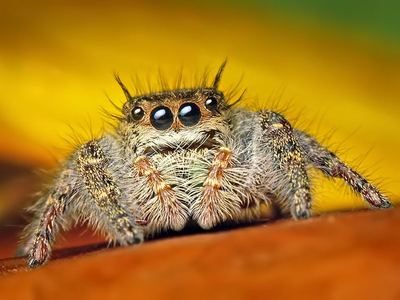
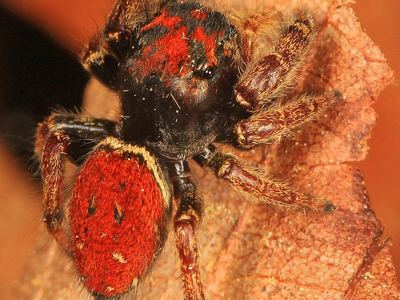
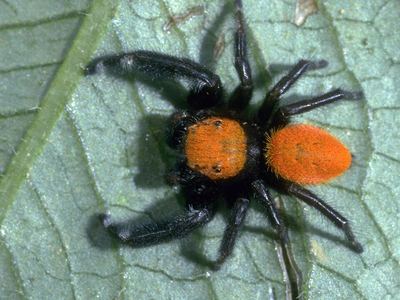
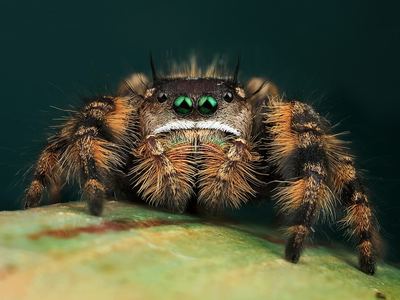
Brilliant jumping spider (Phidippus clarus)
The brilliant jumping spider (genus Phidippus) is a spider in the family Salticidae that is not dangerous to people. Among the 30 jumping spiders profiled here, it ranks 2nd by number of states listed, level with one other. It is listed in 45 states, spread over all nine census divisions. Its observation records peak in July.
Also called: brilliant jumper, Florida red-backed jumper, eastern red-back jumping spider (English names in GBIF)
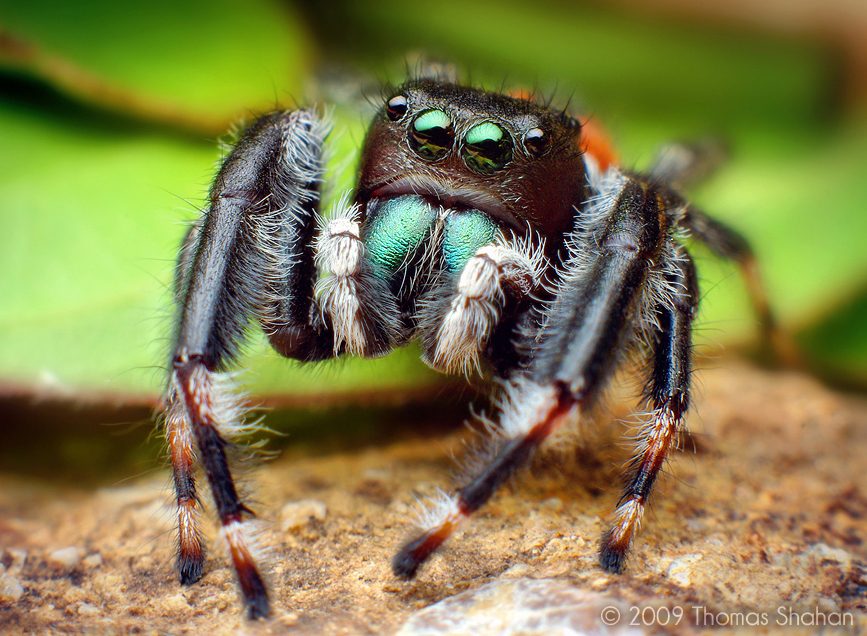

Phidippus clarus, also known as the brilliant jumping spider, is a species of jumping spider (family Salticidae) found in old fields throughout eastern North America. It often waits upside down near the top of a plant, which may be useful for detecting prey, and then quickly jumps down before the prey can escape. The spider is one of 60 species in the genus Phidippus, and one of about 5,000 in the Salticidae, a family that accounts for about 10% of all spider species.
From Wikipedia: Phidippus clarus, text under CC BY-SA 4.0.
Is the brilliant jumping spider poisonous or venomous?
Not in any medically significant way. Like almost all spiders the brilliant jumping spider (family Salticidae) has venom for its prey, but it is not a widow or recluse, the two U.S. groups whose bites need medical attention.
Which states have the brilliant jumping spider?
| # | State | Records | Share of state spiders | Rank in state |
|---|---|---|---|---|
| 1 | Illinois | 140 | 0.7% | 15th of 243 |
| 2 | Georgia | 94 | 1.3% | 20th of 190 |
| 3 | Virginia | 90 | 0.7% | 33rd of 178 |
| 4 | North Carolina | 77 | 0.9% | 29th of 189 |
| 5 | Texas | 64 | 0.2% | 86th of 387 |
| 6 | Maryland | 53 | 0.9% | 31st of 155 |
| 7 | Oklahoma | 46 | 0.9% | 25th of 151 |
| 8 | Florida | 42 | 0.3% | 44th of 241 |
| 9 | Minnesota | 42 | 1.3% | 18th of 145 |
| 10 | Ohio | 40 | 0.5% | 43rd of 333 |
| 11 | Missouri | 39 | 1.6% | 14th of 117 |
| 12 | New Hampshire | 37 | 2.6% | 10th of 74 |
| 13 | Massachusetts | 35 | 0.7% | 32nd of 191 |
| 14 | Delaware | 29 | 1.3% | 19th of 73 |
| 15 | Wisconsin | 29 | 0.9% | 23rd of 148 |
| 16 | New York | 28 | 0.4% | 47th of 152 |
| 17 | Arkansas | 27 | 1.6% | 19th of 114 |
| 18 | Kansas | 27 | 1.6% | 13th of 93 |
| 19 | South Carolina | 27 | 1.0% | 25th of 124 |
| 20 | Vermont | 27 | 1.7% | 13th of 73 |
| 21 | Tennessee | 26 | 0.7% | 40th of 143 |
| 22 | Pennsylvania | 24 | 0.3% | 50th of 169 |
| 23 | Michigan | 22 | 0.9% | 28th of 123 |
| 24 | Colorado | 20 | 0.5% | 26th of 372 |
| 25 | Kentucky | 20 | 1.0% | 28th of 104 |
| 26 | Oregon | 19 | 0.6% | 27th of 89 |
| 27 | Mississippi | 18 | 1.2% | 17th of 117 |
| 28 | Alabama | 15 | 0.4% | 63rd of 146 |
| 29 | Indiana | 15 | 0.3% | 60th of 134 |
| 30 | Iowa | 11 | 1.5% | 14th of 58 |
| 31 | Louisiana | 10 | 0.2% | 63rd of 108 |
| 32 | New Jersey | 9 | 0.4% | 54th of 127 |
| 33 | California | 8 | 0.0% | 239th of 312 |
| 34 | Maine | 8 | 0.8% | 28th of 298 |
| 35 | West Virginia | 6 | 0.8% | 27th of 90 |
| 36 | South Dakota | 5 | 2.5% | 7th of 30 |
| 37 | Connecticut | 4 | 0.4% | 42nd of 85 |
| 38 | Montana | 4 | 0.2% | 43rd of 73 |
| 39 | Washington | 4 | 0.1% | 83rd of 159 |
| 40 | Idaho | 3 | 0.6% | 28th of 58 |
| 41 | Utah | 3 | 0.1% | 58th of 99 |
| 42 | Nebraska | 2 | 0.2% | 67th of 72 |
| 43 | New Mexico | 2 | 0.1% | 127th of 248 |
| 44 | North Dakota | 1 | 1.1% | 12th of 129 |
| 45 | Rhode Island | 1 | 0.6% | 30th of 52 |
When is the brilliant jumping spider seen?
Its observation records run mostly May through August.
Season by state
Where the season stays within one calendar year, it starts earliest in February (Florida) and latest in June (Illinois, Maryland and Ohio). June is the most common peak month (New Hampshire, Ohio, Oklahoma and Virginia).
| State | Main season | Peak month | Observation records |
|---|---|---|---|
| Georgia | May through September | August | 94 |
| Virginia | May through September | June | 90 |
| North Carolina | April through September | August | 77 |
| Texas | April through August | July | 63 |
| Maryland | June through August | August | 53 |
| Oklahoma | May through August | June | 43 |
| Minnesota | concentrated in June and July | — | 42 |
| Illinois | June through August | July | 40 |
| Ohio | June through August | June | 40 |
| Missouri | May through August | July | 38 |
| New Hampshire | May through July | June | 37 |
| Massachusetts | concentrated in June and July | — | 35 |
| Florida | February through September | September | 31 |
Where the brilliant jumping spider is recorded in each state
| State | Licensed records | Place among the state's spiders | Most recorded counties |
|---|---|---|---|
| Illinois | 140 | 15th of 243 | Champaign County (43), Iroquois County (30), Cook County (17), Lake County (7) and Jo Daviess County (5) |
| Georgia | 94 | 20th of 190 | Clarke County (49), Jones County (5), Oconee County (4), Rockdale County (4) and Cherokee County (4) |
| Virginia | 90 | 33rd of 178 | Fairfax County (16), Hanover County (15), Prince William County (14), Chesterfield County (4) and Albemarle County (4) |
| North Carolina | 77 | 29th of 189 | Cumberland County (15), Durham County (6), Wake County (6), Cabarrus County (5) and Orange County (5) |
| Texas | 64 | joint 86th of 387 | Erath County (16), Dallas County (13), Tarrant County (5), Brazos County (3) and Denton County (3) |
| Maryland | 53 | 31st of 155 | Prince George's County (14), Baltimore County (7), Frederick County (6), Carroll County (6) and Montgomery County (4) |
| Oklahoma | 46 | joint 25th of 151 | Mayes County (11), Osage County (11), Carter County (4), Cleveland County (2) and Comanche County (2) |
| Florida | 42 | joint 44th of 241 | Okeechobee County (6), Orange County (5), Hillsborough County (4), Collier County (3) and Osceola County (3) |
| Minnesota | 42 | 18th of 145 | Hennepin County (9), Ramsey County (7), Dakota County (4), Anoka County (2) and Mower County (2) |
| Ohio | 40 | 43rd of 333 | Montgomery County (4), Clark County (3), Clermont County (3), Franklin County (3) and Hamilton County (3) |
| Missouri | 39 | 14th of 117 | Adair County (7), DeKalb County (4), Texas County (3), Jackson County (3) and Platte County (3) |
| New Hampshire | 37 | joint 10th of 74 | Hillsborough County (20), Rockingham County (8), Sullivan County (3), Cheshire County (3) and Grafton County (3) |
| Massachusetts | 35 | 32nd of 191 | Barnstable County (9), Plymouth County (6), Worcester County (4), Dukes County (4) and Middlesex County (4) |
Top counties in the U.S.
| # | County | State | Records | Share of U.S. |
|---|---|---|---|---|
| 1 | Clarke County | Georgia | 49 | 3.9% |
| 2 | Champaign County | Illinois | 43 | 3.4% |
| 3 | Iroquois County | Illinois | 30 | 2.4% |
| 4 | Hillsborough County | New Hampshire | 20 | 1.6% |
| 5 | Cook County | Illinois | 17 | 1.4% |
| 6 | Erath County | Texas | 16 | 1.3% |
| 7 | Fairfax County | Virginia | 16 | 1.3% |
| 8 | Cumberland County | North Carolina | 15 | 1.2% |
| 9 | Hanover County | Virginia | 15 | 1.2% |
| 10 | Prince George's County | Maryland | 14 | 1.1% |
| 11 | Prince William County | Virginia | 14 | 1.1% |
| 12 | Dallas County | Texas | 13 | 1.0% |
| 13 | Mayes County | Oklahoma | 11 | 0.9% |
| 14 | Osage County | Oklahoma | 11 | 0.9% |
| 15 | Barnstable County | Massachusetts | 9 | 0.7% |
How recent are the brilliant jumping spider records?
| Decade | Records | Share |
|---|---|---|
| 1910s | 1 | 0.1% |
| 1920s | 2 | 0.2% |
| 1930s | 6 | 0.5% |
| 1940s | 9 | 0.7% |
| 1950s | 7 | 0.5% |
| 1960s | 12 | 0.9% |
| 1970s | 2 | 0.2% |
| 1980s | 3 | 0.2% |
| 1990s | 72 | 5.6% |
| 2000s | 4 | 0.3% |
| 2010s | 172 | 13.4% |
| 2020s | 997 | 77.5% |
Species recorded in the same counties
| Species | Shared counties |
|---|---|
| Black-and-yellow argiope | 103 |
| Bold jumper | 96 |
| Spotted orbweaver | 88 |
| Familiar jumping spider | 87 |
| Nursery web spider | 87 |
| Rabid wolf spider | 84 |
| Whitebanded crab spider | 84 |
| Banded garden spider | 80 |
Related species in the U.S.
GBIF records read 2026-11-05 (open these records on GBIF). Listed: any license. Counted: CC0/CC BY only. How we count.