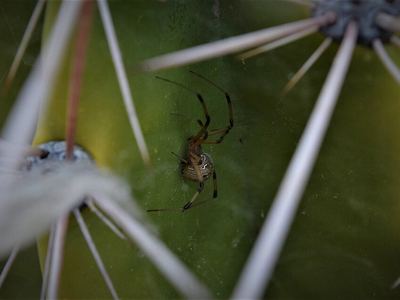
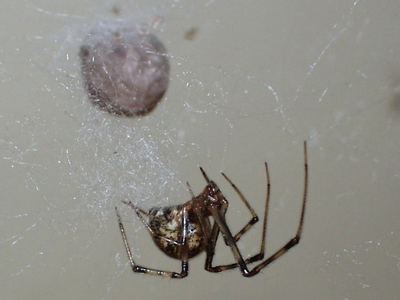
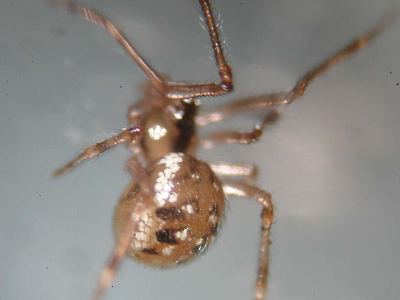
Common candy-striped spider (Enoplognatha ovata)
The common candy-striped spider (genus Enoplognatha) is a spider in the family Theridiidae that is not dangerous to people. Among the six cobweb spiders profiled here, it ranks 4th by number of states listed. Most of its 20 listed states are in the New England (5), Mountain (5) and East North Central (4) census divisions. None is in the South. Its observation records peak in July.
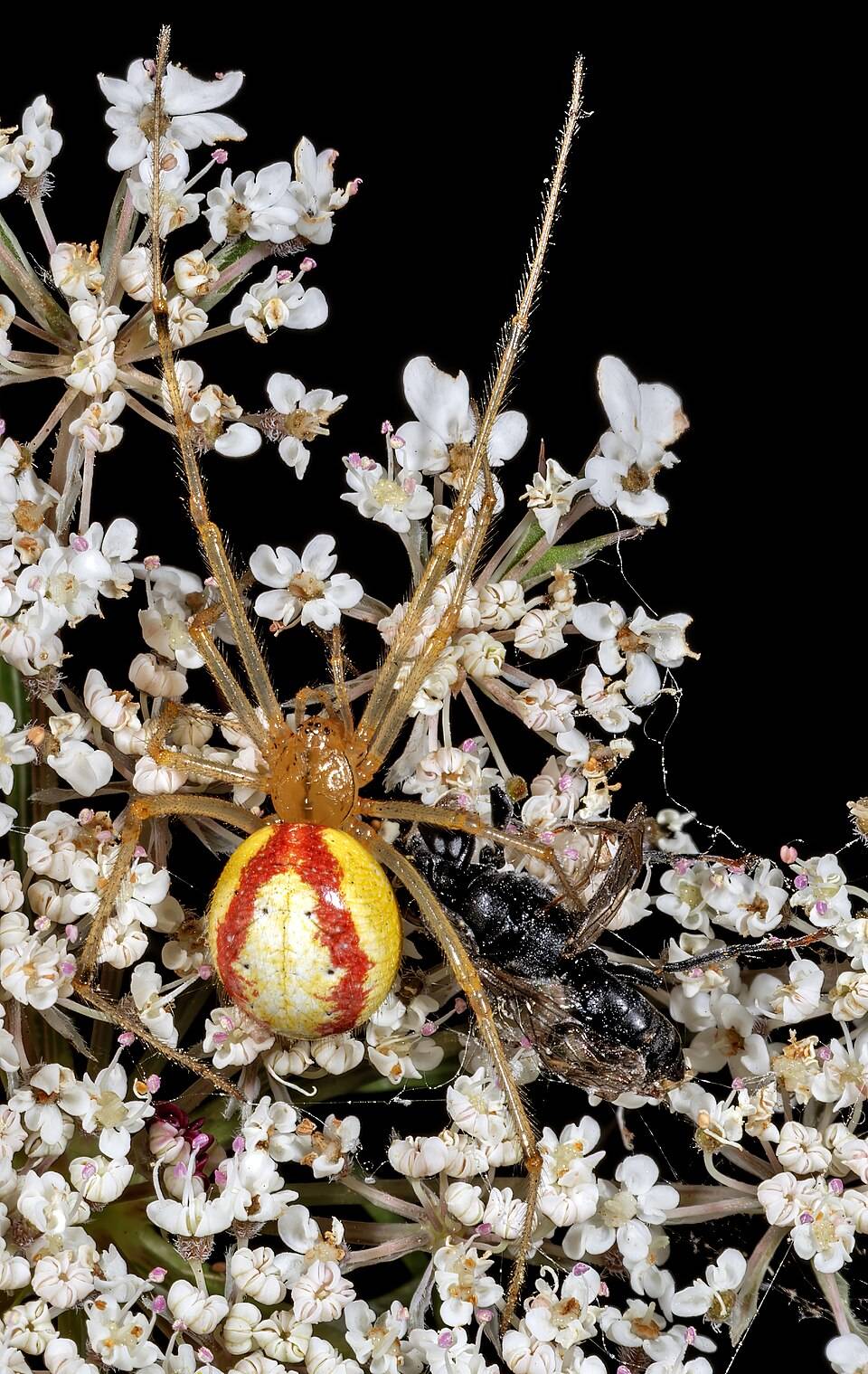

Enoplognatha ovata, the common candy-striped spider, is a species of spider belonging to the family Theridiidae. Their scientific name derives from the latin word 'ovatus' which means egg-shaped. Despite its small size, this is a formidable predator which can prey on insects many times its size.
From Wikipedia: Enoplognatha ovata, text under CC BY-SA 4.0.
Is the common candy-striped spider poisonous or venomous?
Not in any medically significant way. Like almost all spiders the common candy-striped spider (family Theridiidae) has venom for its prey, but it is not a widow or recluse, the two U.S. groups whose bites need medical attention.
Which states have the common candy-striped spider?
| # | State | Records | Share of state spiders | Rank in state |
|---|---|---|---|---|
| 1 | Ohio | 72 | 1.0% | 24th of 333 |
| 2 | Washington | 62 | 1.4% | 14th of 159 |
| 3 | Michigan | 44 | 1.7% | 16th of 123 |
| 4 | Oregon | 43 | 1.5% | 13th of 89 |
| 5 | Maine | 33 | 3.4% | 8th of 298 |
| 6 | Wisconsin | 31 | 1.0% | 21st of 148 |
| 7 | Minnesota | 29 | 0.9% | 25th of 145 |
| 8 | Colorado | 26 | 0.6% | 23rd of 372 |
| 9 | New York | 23 | 0.4% | 53rd of 152 |
| 10 | Vermont | 19 | 1.2% | 20th of 73 |
| 11 | Illinois | 17 | 0.1% | 143rd of 243 |
| 12 | New Hampshire | 14 | 1.0% | 26th of 74 |
| 13 | California | 12 | 0.0% | 207th of 312 |
| 14 | Utah | 6 | 0.2% | 38th of 99 |
| 15 | Idaho | 5 | 0.9% | 20th of 58 |
| 16 | Montana | 3 | 0.1% | 46th of 73 |
| 17 | Pennsylvania | 3 | 0.0% | 134th of 169 |
| 18 | Massachusetts | 2 | 0.0% | 125th of 191 |
| 19 | Connecticut | 1 | 0.1% | 69th of 85 |
| 20 | Wyoming | 0 | — | — |
When is the common candy-striped spider seen?
Its observation records run mostly June through August.
Season by state
Where the season stays within one calendar year, it starts earliest in May (Oregon) and latest in June (Maine and Washington). July is the most common peak month (Maine, Oregon and Washington).
| State | Main season | Peak month | Observation records |
|---|---|---|---|
| Washington | June through August | July | 57 |
| Michigan | concentrated in June and July | — | 42 |
| Oregon | May through July | July | 42 |
| Maine | June through August | July | 33 |
| Wisconsin | concentrated in June and July | — | 30 |
Where the common candy-striped spider is recorded in each state
| State | Licensed records | Place among the state's spiders | Most recorded counties |
|---|---|---|---|
| Ohio | 72 | 24th of 333 | Ottawa County (56), Lake County (1), Portage County (1) and Summit County (1) |
| Washington | 62 | 14th of 159 | King County (34), Jefferson County (6), Pierce County (5), Whatcom County (4) and Clark County (3) |
| Michigan | 44 | 16th of 123 | Emmet County (24), Benzie County (5), Charlevoix County (3), Allegan County (3) and Ingham County (2) |
| Oregon | 43 | 13th of 89 | Multnomah County (22), Clatsop County (9), Benton County (2), Washington County (2) and Clackamas County (2) |
| Maine | 33 | 8th of 298 | Hancock County (16), Somerset County (7), Piscataquis County (4), Androscoggin County (4) and Lincoln County (1) |
| Wisconsin | 31 | joint 21st of 148 | Dane County (10), Milwaukee County (4), Ozaukee County (3), Door County (2) and Walworth County (2) |
Top counties in the U.S.
| # | County | State | Records | Share of U.S. |
|---|---|---|---|---|
| 1 | Ottawa County | Ohio | 56 | 12.4% |
| 2 | King County | Washington | 34 | 7.5% |
| 3 | Emmet County | Michigan | 24 | 5.3% |
| 4 | Multnomah County | Oregon | 22 | 4.9% |
| 5 | Hancock County | Maine | 16 | 3.5% |
| 6 | Dane County | Wisconsin | 10 | 2.2% |
| 7 | Clatsop County | Oregon | 9 | 2.0% |
| 8 | Somerset County | Maine | 7 | 1.5% |
| 9 | Jefferson County | Washington | 6 | 1.3% |
| 10 | Benzie County | Michigan | 5 | 1.1% |
| 11 | Pierce County | Washington | 5 | 1.1% |
| 12 | Piscataquis County | Maine | 4 | 0.9% |
| 13 | Androscoggin County | Maine | 4 | 0.9% |
| 14 | Whatcom County | Washington | 4 | 0.9% |
| 15 | Milwaukee County | Wisconsin | 4 | 0.9% |
How recent are the common candy-striped spider records?
| Decade | Records | Share |
|---|---|---|
| 1960s | 1 | 0.2% |
| 1970s | 58 | 12.7% |
| 1980s | 12 | 2.6% |
| 1990s | 13 | 2.8% |
| 2000s | 11 | 2.4% |
| 2010s | 68 | 14.8% |
| 2020s | 295 | 64.4% |
Species recorded in the same counties
| Species | Shared counties |
|---|---|
| Bronze jumper | 42 |
| Garden spider | 41 |
| Zebra spider | 35 |
| Goldenrod crab spider | 34 |
| Sixspotted orbweaver | 33 |
| Bold jumper | 30 |
| Black-and-yellow argiope | 20 |
| Bridge orbweaver | 20 |
Related species in the U.S.
GBIF records read 2026-11-05 (open these records on GBIF). Listed: any license. Counted: CC0/CC BY only. How we count.