Northern black widow (Latrodectus variolus)
The northern black widow (genus Latrodectus) is a venomous spider in the family Theridiidae. Of the four widow spiders profiled here, it is listed in more states than any other. Most of its 30 listed states are in the South Atlantic (8), East North Central (5) and New England (4) census divisions. None is in the West. Its observation records peak in September.
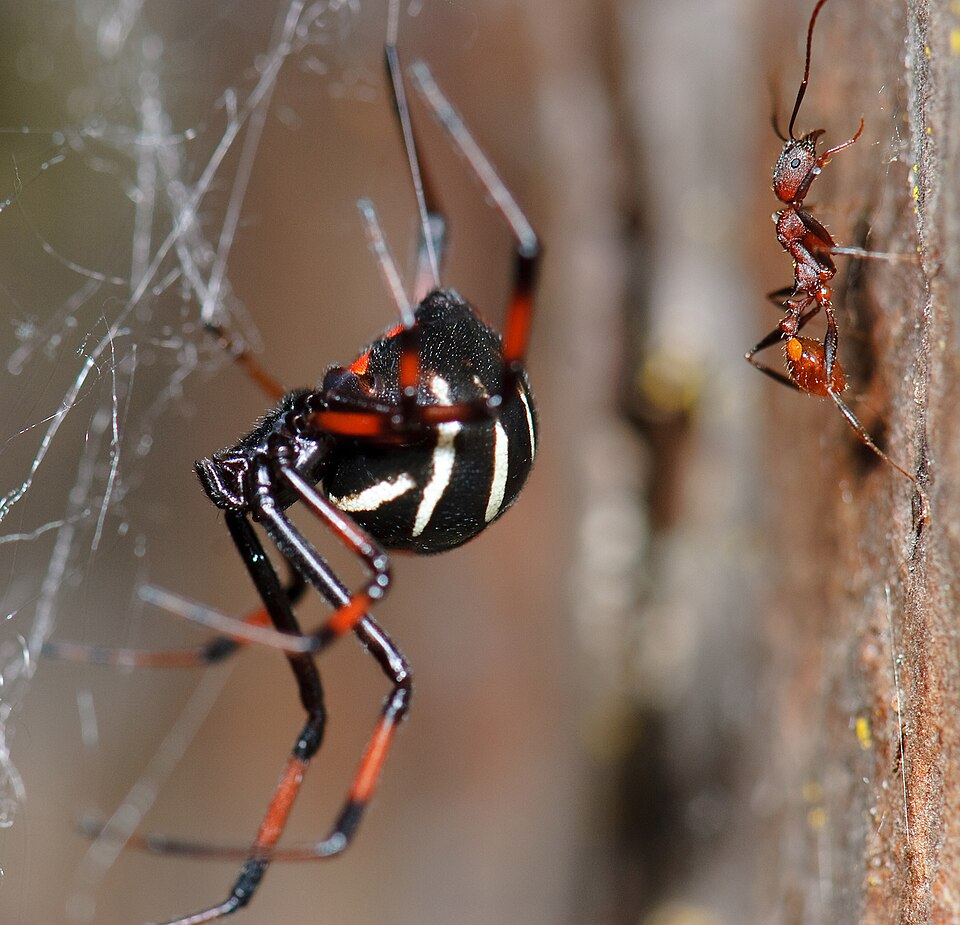

Latrodectus variolus, the northern black widow spider or northern widow, is a venomous species of spider in the genus Latrodectus of the family Theridiidae. The population is closely related to the red widow, Latrodectus bishopi. In North America, the species is commonly found in Middle Atlantic states (New Jersey, Delaware, Connecticut, Maryland).
From Wikipedia: Latrodectus variolus, text under CC BY-SA 4.0.
Is the northern black widow poisonous or venomous?
Yes. The northern black widow is a widow spider (genus Latrodectus).
Is a northern black widow bite dangerous?
It can be. A northern black widow spider bite can cause pain, cramps and sweating spreading from the bite. Bites are rarely fatal but worth a call to Poison Help at 1-800-222-1222.
Spiders often mistaken for it
| Species commonly confused with widow spiders | Its states where both are recorded |
|---|---|
| triangulate bud spider | all 30 |
| common house spider | 29 of 30 |
| boreal combfoot | 20 of 30 |
| twospotted cobweb spider | 13 of 30 |
| false black widow | 9 of 30 |
Which states have the northern black widow?
It is the most recorded spider of all in Massachusetts.
| # | State | Records | Share of state spiders | Rank in state |
|---|---|---|---|---|
| 1 | Massachusetts | 350 | 6.9% | 1st of 191 |
| 2 | Virginia | 66 | 0.5% | 43rd of 178 |
| 3 | North Carolina | 40 | 0.5% | 54th of 189 |
| 4 | Kentucky | 39 | 1.9% | 11th of 104 |
| 5 | Maryland | 37 | 0.6% | 41st of 155 |
| 6 | Missouri | 33 | 1.3% | 16th of 117 |
| 7 | New Jersey | 30 | 1.2% | 21st of 127 |
| 8 | Delaware | 20 | 0.9% | 28th of 73 |
| 9 | Tennessee | 20 | 0.5% | 47th of 143 |
| 10 | Illinois | 18 | 0.1% | 138th of 243 |
| 11 | Indiana | 16 | 0.3% | 56th of 134 |
| 12 | Ohio | 14 | 0.2% | 75th of 333 |
| 13 | Texas | 14 | 0.0% | 183rd of 387 |
| 14 | Pennsylvania | 10 | 0.1% | 87th of 169 |
| 15 | Arkansas | 7 | 0.4% | 54th of 114 |
| 16 | Georgia | 7 | 0.1% | 110th of 190 |
| 17 | New York | 7 | 0.1% | 93rd of 152 |
| 18 | Oklahoma | 7 | 0.1% | 86th of 151 |
| 19 | Rhode Island | 5 | 2.9% | 9th of 52 |
| 20 | Alabama | 4 | 0.1% | 96th of 146 |
| 21 | Kansas | 4 | 0.2% | 58th of 93 |
| 22 | Michigan | 4 | 0.2% | 65th of 123 |
| 23 | Mississippi | 4 | 0.3% | 62nd of 117 |
| 24 | Florida | 3 | 0.0% | 213th of 241 |
| 25 | Louisiana | 3 | 0.1% | 95th of 108 |
| 26 | South Carolina | 3 | 0.1% | 92nd of 124 |
| 27 | West Virginia | 3 | 0.4% | 40th of 90 |
| 28 | Connecticut | 1 | 0.1% | 69th of 85 |
| 29 | Wisconsin | 1 | 0.0% | 131st of 148 |
| 30 | Vermont | 0 | — | — |
When is the northern black widow seen?
Its observation records run mostly April through October.
Season by state
Where the season stays within one calendar year, it starts earliest in March (Kentucky, Missouri, New Jersey and North Carolina) and latest in June (Massachusetts). May is the most common peak month (Kentucky, New Jersey, North Carolina and Virginia).
| State | Main season | Peak month | Observation records |
|---|---|---|---|
| Massachusetts | June through October | September | 350 |
| Virginia | April through November | May | 66 |
| North Carolina | March through September | May | 40 |
| Kentucky | March through October | May | 39 |
| Maryland | April through September | June | 37 |
| Missouri | March through October | June | 32 |
| New Jersey | March through July | May | 30 |
Where the northern black widow is recorded in each state
| State | Licensed records | Place among the state's spiders | Most recorded counties |
|---|---|---|---|
| Massachusetts | 350 | 1st of 191 | Norfolk County (232), Essex County (61), Middlesex County (53), Barnstable County (2) and Plymouth County (1) |
| Virginia | 66 | joint 43rd of 178 | Fairfax County (13), Prince William County (7), Loudoun County (4), Montgomery County (4) and Rockbridge County (3) |
| North Carolina | 40 | joint 54th of 189 | Orange County (9), Wake County (7), Dare County (5), Chatham County (3) and Currituck County (3) |
| Kentucky | 39 | 11th of 104 | Madison County (29), Fayette County (2), Garrard County (2), Rowan County (1) and Crittenden County (1) |
| Maryland | 37 | joint 41st of 155 | Harford County (6), Frederick County (5), Prince George's County (4), Worcester County (4) and Montgomery County (3) |
| Missouri | 33 | 16th of 117 | Boone County (4), Jefferson County (3), Texas County (2), Greene County (2) and Lewis County (2) |
| New Jersey | 30 | 21st of 127 | Cape May County (13), Monmouth County (3), Burlington County (3), Cumberland County (3) and Middlesex County (2) |
Top counties in the U.S.
| # | County | State | Records | Share of U.S. |
|---|---|---|---|---|
| 1 | Norfolk County | Massachusetts | 232 | 30.1% |
| 2 | Essex County | Massachusetts | 61 | 7.9% |
| 3 | Middlesex County | Massachusetts | 53 | 6.9% |
| 4 | Madison County | Kentucky | 29 | 3.8% |
| 5 | Cape May County | New Jersey | 13 | 1.7% |
| 6 | Fairfax County | Virginia | 13 | 1.7% |
| 7 | Orange County | North Carolina | 9 | 1.2% |
| 8 | Wake County | North Carolina | 7 | 0.9% |
| 9 | Prince William County | Virginia | 7 | 0.9% |
| 10 | Harford County | Maryland | 6 | 0.8% |
| 11 | Frederick County | Maryland | 5 | 0.6% |
| 12 | Dare County | North Carolina | 5 | 0.6% |
| 13 | Prince George's County | Maryland | 4 | 0.5% |
| 14 | Worcester County | Maryland | 4 | 0.5% |
| 15 | Boone County | Missouri | 4 | 0.5% |
How recent are the northern black widow records?
| Decade | Records | Share |
|---|---|---|
| 1930s | 1 | 0.1% |
| 1940s | 2 | 0.3% |
| 1950s | 1 | 0.1% |
| 1970s | 2 | 0.3% |
| 1990s | 1 | 0.1% |
| 2000s | 6 | 0.8% |
| 2010s | 45 | 5.7% |
| 2020s | 727 | 92.6% |
Species recorded in the same counties
| Species | Shared counties |
|---|---|
| Familiar jumping spider | 53 |
| Nursery web spider | 52 |
| Paraphidippus aurantius | 51 |
| Bold jumper | 48 |
| Dark fishing spider | 48 |
| Spotted orbweaver | 48 |
| Black-and-yellow argiope | 47 |
| Orchard orbweaver | 47 |
Related species in the U.S.
GBIF records read 2026-11-05 (open these records on GBIF). Listed: any license. Counted: CC0/CC BY only. How we count.